
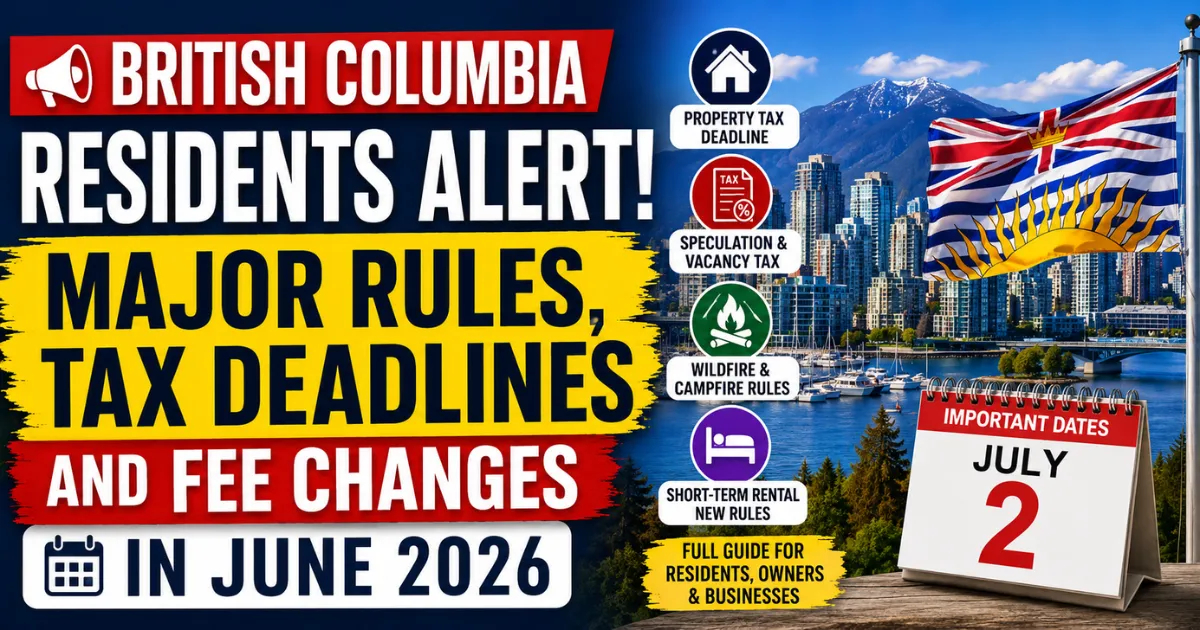
Many people in British Columbia usually treat June as the start of summer plans. Some people are booking campsites, some are waiting for property tax notices, and some business owners are checking new tax rules before they affect their billing.
But June 2026 is not only about summer travel. This month has brought several important updates for property owners, renters, campers, boaters, short term rental hosts, and businesses in B.C.
Some changes are already active. Some deadlines are coming in early July. A missed payment or late action can create extra cost, so it is better to check the rules early instead of waiting until the last week.
Property Tax Notices Are Arriving Across B.C.
Most property owners in British Columbia receive their main property tax notice in early June. For many municipalities, the payment deadline is July 2, 2026.
Vancouver has a separate deadline. In Vancouver, the main property tax payment is due on July 3, 2026.
This is one of the most important deadlines for homeowners because missing it can lead to a 10 percent penalty on the unpaid amount. In most cases, there is no grace period after the deadline has passed.
What Homeowners Should Do
Open your tax notice as soon as it arrives.
Check your assessed value with your BC Assessment record.
Apply for the Home Owner Grant if the home is your main residence.
Pay before the deadline.
Keep proof of payment for your records.
Home Owner Grant Must Be Claimed On Time
Many homeowners forget that paying property tax and claiming the Home Owner Grant are two different steps. If your property is your principal residence, you may need to claim the grant before the tax deadline.
The basic grant can reduce property taxes by up to 570 dollars in Metro Vancouver, the Capital Regional District, and the Fraser Valley. In northern and rural areas, it can be up to 770 dollars.
Seniors, veterans, and people with disabilities may qualify for a higher grant amount.
For 2026, the full grant is available for properties assessed at 2,075,000 dollars or less. If the assessed value is higher, the grant slowly reduces.
The grant is handled by the Province of British Columbia, not by your city office. So homeowners should apply through the provincial portal.
Speculation And Vacancy Tax Payment Deadline
The Speculation and Vacancy Tax applies to residential property owners in designated taxable areas of British Columbia.
These areas include places such as Metro Vancouver, the Capital Regional District, Kelowna, West Kelowna, Nanaimo, Lantzville, and the Fraser Valley.
For 2026 and later years, the tax rates are higher.
Canadian citizens and permanent residents who leave a taxable property vacant may pay 1 percent of the assessed value.
Foreign owners and untaxed worldwide earners may pay 3 percent.
The declaration deadline was March 31, 2026. But owners who missed that date should not ignore it. A late declaration before the payment deadline may still help them claim an exemption if they qualify.
The payment deadline is July 2, 2026.
What Property Owners Should Do
Check if your property is in a taxable area.
Use your Letter ID and Declaration Code to log in.
File your declaration if you have not done it yet.
Check if you qualify for an exemption.
Pay any balance before July 2, 2026.
Wildfire Rules Are Already Affecting Summer Plans
B.C. entered wildfire season early in 2026. Fire rules can change quickly because they depend on weather, dryness, wind, and local risk.
The Coastal Fire Centre had already brought in fire restrictions in May, and other areas may also face more rules during June.
Campers should not assume that a campfire is allowed just because a campsite is open. Fire bans can apply even when parks, trails, and campgrounds are still operating.
Outdoor cooking devices may still be allowed in some areas if they meet safety rules and have a small flame height. But every traveller should check the latest local fire ban before leaving home.
Common Mistake To Avoid
A common mistake is checking the fire rule once and then travelling two or three days later. In summer, rules can change fast. It is better to check again on the morning of your trip.
Vancouver Official Development Plan Is Now In Effect
Vancouver has moved forward with its city wide Official Development Plan. This plan guides how land can be used across the city in the coming years.
For property owners, the most practical part is the Generalized Land Use designation. It gives a broad idea of what type of development may be expected in an area.
For developers, the plan may also affect rezoning applications. If a project matches the plan, some approval steps may become more direct.
What Vancouver Property Owners Should Check
Search your property on the City of Vancouver planning website.
Look at the Generalized Land Use designation.
Check what type of development is planned around your area.
Do not rely only on social media posts or neighbourhood rumours.
If the issue affects your property value or development plan, speak with a qualified planning professional.
Kelowna Short Term Rental Rule Changed On June 1
Kelowna received an early exemption from B.C.’s principal residence rule for short term rentals. This change took effect on June 1, 2026.
Under the previous provincial rule, many short term rental operators could only list their principal residence or a secondary suite on the same property.
Kelowna qualified for the opt out because its rental vacancy rate rose above the required level. This does not mean every property in Kelowna can now operate as a full time vacation rental.
The change applies only to eligible properties that fit the city’s new short term rental sub zone rules.
A business licence is still needed. If the property is in a strata building, strata approval may also be required.
What Hosts Should Do
Check if your property is in an eligible STR sub zone.
Review city licence rules.
Confirm strata rules before listing the unit.
Keep records of approvals.
Do not assume old listings are automatically legal under the new system.
B.C. Parks Camping Fees And Booking Rules
June is also important for campers because peak season pricing starts at many popular B.C. Parks campgrounds.
The 2026 camping season has also brought a shorter booking window. Reservations can now be made up to three months in advance instead of four months.
There is also a 20 dollar surcharge per stay for campers who are not B.C. residents. This applies to reservations in the system, including frontcountry and backcountry sites.
Popular campgrounds can fill very quickly when the booking window opens. Many families lose good dates because they wait too long or search only one campground.
Simple Camping Tips For June
Check the reservation system early.
Keep two or three backup parks ready.
Be flexible with arrival dates.
Budget for peak season fees.
Check fire bans before travelling.
Carry a safe cooking device in case campfires are not allowed.
PST Expansion Needs Business Preparation
B.C. is preparing to expand Provincial Sales Tax to some professional services from October 1, 2026.
The 7 percent PST will apply to some services such as accounting, bookkeeping, security, private investigation, rental property management, strata management, and non residential real estate transaction commissions.
Some professional services, including architectural, engineering, and geoscience services, will have a lower effective tax impact based on how the rule is applied.
Even though this change starts in October, June is a good time for businesses to prepare. Registration, billing systems, invoices, contracts, and client notices may need updates.
What Businesses Should Do Now
Check if your service category is affected.
Watch for final provincial rules and exemptions.
Prepare your accounting software.
Train staff who handle invoices.
Update quotes for work that may be billed after October 1, 2026.
Register for PST if required.
Property Assessment Changes May Affect Some Homeowners
New zoning and housing rules across British Columbia may affect how some properties are assessed for the 2027 tax year.
BC Assessment looks at property value based on the condition and permitted use of the land as of July 1 each year.
If a municipality changes zoning and allows more housing units on a lot, the land value may rise because the property has more development potential.
This can worry homeowners who live in a single family home and have no plan to redevelop.
Some long term owner occupied properties may qualify for assessment relief under Section 19(8) of the Assessment Act. This can help certain owners by valuing the home based on its current use instead of full redevelopment potential.
Homeowners may need to apply in early 2027 for relief related to the 2027 assessment roll.
June 2026 B.C. Rule Calendar
| Date | Update | Who Should Check |
|---|---|---|
| June 1, 2026 | Kelowna short term rental opt out begins | STR hosts and property owners |
| June 1, 2026 | Vessel restricted zones near Pender and Saturna Islands begin | Boaters and fishers |
| Early June 2026 | Main property tax notices arrive | Property owners |
| Mid June 2026 | Peak season pricing begins at many B.C. Parks campgrounds | Campers and travellers |
| June or July 2026 | Final PST expansion rules expected | Service providers and businesses |
| July 2, 2026 | Property tax deadline in many municipalities | Property owners |
| July 2, 2026 | Speculation and Vacancy Tax payment deadline | Owners in taxable areas |
| July 3, 2026 | Vancouver property tax deadline | Vancouver property owners |
Common Mistakes To Avoid
Do not wait until the last day to pay property tax.
Do not forget to claim the Home Owner Grant separately.
Do not ignore the Speculation and Vacancy Tax declaration if you missed March 31.
Do not assume campfires are allowed in every open campground.
Do not list a Kelowna short term rental without checking city and strata rules.
Do not wait until October to prepare for PST changes if your business is affected.
Do not rely only on social media posts for legal or tax rules.
Who Should Pay Attention To These Updates
These June 2026 changes are important for many groups in British Columbia.
Homeowners should watch tax and grant deadlines.
Rental property owners should check vacancy tax rules.
Campers should check park fees and fire bans.
Short term rental hosts in Kelowna should review local licence rules.
Business owners should prepare for PST changes.
Vancouver property owners should check the new development plan.
Boaters should review vessel restricted zones before travelling.
FAQ
For many property owners, the most urgent deadline is the early July property tax payment date. Most municipalities have a July 2 deadline, while Vancouver has a July 3 deadline.
Yes, owners who missed the declaration deadline should still file as soon as possible. A late declaration before the payment deadline may help if you qualify for an exemption.
No. The change applies only to eligible properties under Kelowna’s local rules. A business licence is still required, and strata approval may be needed.
Not always. Fire restrictions depend on the fire centre and local risk. Travellers should check the BC Wildfire Service updates before every trip.
No. The October 2026 PST expansion applies to selected service categories. Businesses should check official provincial guidance to confirm if their services are affected.
Final Thoughts
June 2026 is a busy month for British Columbia residents. Some updates may look small at first, but they can affect money, travel plans, property rules, and business costs.
The safest step is simple. Check your own situation early. Pay what needs to be paid. Apply for grants on time. Review local rules before renting, camping, boating, or changing business billing.
Disclaimer: This article is for general information only. It is not legal, tax, financial, real estate, immigration, or municipal planning advice. Rules may vary by city, property type, business type, and personal situation. Readers should verify all details with official government sources and speak with a qualified professional before making important decisions.