
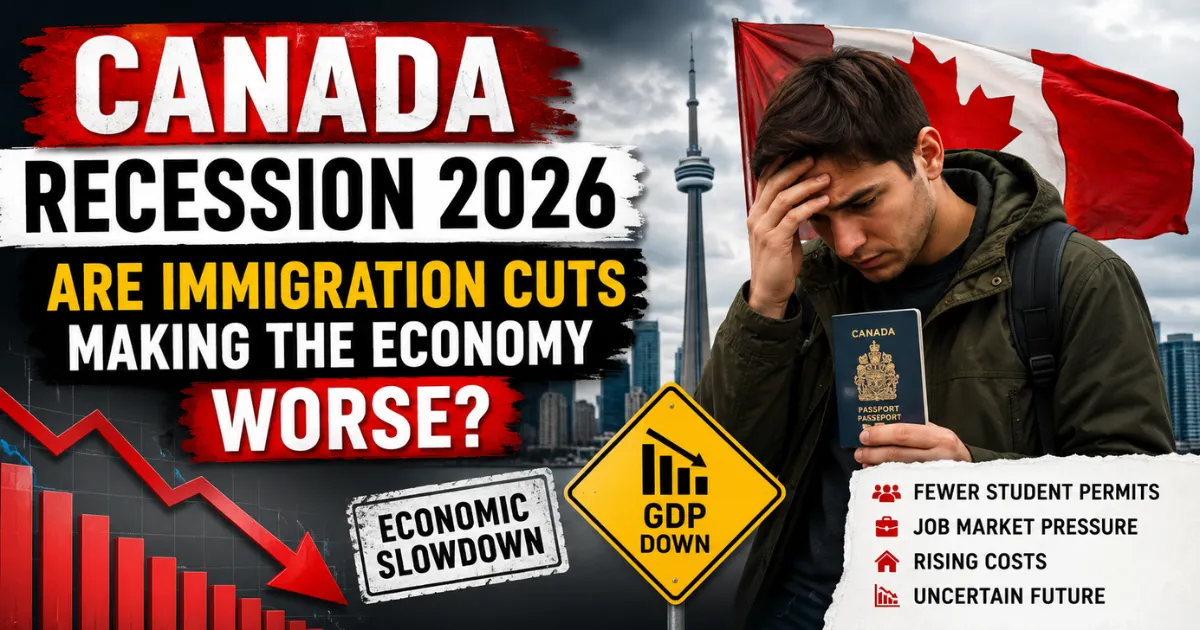
Canada Recession 2026 Explained: How Immigration Changes Are Affecting The Economy
Many people planning to move to Canada are confused right now. Some are hearing that Canada is facing a recession. Others are reading news about fewer student permits and lower immigration targets. At the same time, many Canadians are worried about rising costs, fewer job opportunities, and an uncertain economy.
So what is really happening?
The truth is that Canada’s economy is going through a difficult phase. Recent GDP figures have raised concerns about a technical recession. At the same time, major changes in immigration policies have started affecting colleges, businesses, and local communities across the country.
This article explains what the latest economic data means, how immigration changes fit into the bigger picture, and what students, workers, and future immigrants should understand moving forward.
Is Canada Really In A Recession?
The word recession often creates panic, but it is important to understand what it actually means.
A technical recession usually refers to two consecutive quarters of economic contraction. According to recent economic reports, Canada’s economy showed negative growth in late 2025 and early 2026.
However, economists do not always agree on whether this automatically means a severe recession. Some experts believe the slowdown could improve with time, while others think deeper structural problems need urgent attention.
For ordinary people, the bigger concern is not the label itself. It is how the economy affects jobs, business confidence, education, housing, and future opportunities.
Canada’s Growth Model Has Been Changing
Over the past decade, Canada experienced strong population growth through immigration.
New permanent residents, temporary workers, and international students helped support economic activity. More people meant higher demand for housing, transportation, food services, mobile plans, education, and everyday spending.
This supported many sectors of the economy.
However, rapid population growth also increased pressure on housing affordability, healthcare systems, and public infrastructure.
As public concerns grew, the federal government decided to reduce immigration targets and place tighter controls on some temporary resident programs.
While the goal was to create a more sustainable system, critics argue that the pace of these changes may have created new economic challenges.
Why International Students Matter To Canada’s Economy
International students are often discussed only from an immigration perspective. However, they also play a major economic role.
When students arrive in Canada, they pay tuition fees, rent accommodation, purchase groceries, use transportation services, and spend money in local communities.
Their spending supports universities, colleges, restaurants, retail businesses, telecommunications companies, and many other industries.
According to publicly available government reports, international education contributes billions of dollars to Canada’s economy every year.
This means changes in student numbers can have effects that go far beyond college campuses.
What Changed In Canada’s Student Policies?
Canada introduced measures to reduce the number of new international students entering the country.
The government stated that these changes were necessary to improve system integrity, address housing pressures, and ensure educational quality.
Supporters of the policy believe the previous system expanded too quickly without proper oversight.
Critics argue that sudden reductions may create financial pressure for educational institutions and local economies that had become dependent on student spending.
The reality is likely somewhere in the middle.
Canada needed reforms, but the timing and scale of those reforms continue to generate debate.
How Colleges And Communities Are Being Affected
Some colleges relied heavily on international tuition revenue.
When student numbers began declining, these institutions faced difficult financial decisions.
Reports from different provinces have highlighted concerns such as:
- Budget reductions
- Program reviews
- Hiring freezes
- Lower enrolment projections
- Financial uncertainty
The impact does not stop at educational institutions.
Businesses located near campuses may also experience reduced customer activity. Rental markets in certain areas may adjust as demand changes.
This demonstrates how interconnected immigration and economic activity can become.
Immigration Is Not The Only Reason Behind Economic Challenges
It would be inaccurate to say that immigration policy alone caused Canada’s economic slowdown.
Several factors have influenced the economy during recent years.
These include:
- Global economic uncertainty
- Trade tensions
- Higher borrowing costs
- Slower business investment
- Inflation pressures
- Changing consumer behaviour
Immigration policy is one part of a much larger economic picture.
Understanding this broader context helps avoid overly simplistic conclusions.
The Housing Factor Cannot Be Ignored
Housing affordability remains one of Canada’s biggest challenges.
Many Canadians have struggled with rising rents and home prices.
Some policymakers argued that reducing temporary resident growth could ease pressure on housing markets.
Others believe that housing shortages are more closely linked to supply constraints and years of underbuilding.
Most experts agree on one thing.
Immigration planning and housing development need to work together.
Population growth without adequate infrastructure can create stress. At the same time, abrupt policy shifts can create different types of economic disruption.
Finding balance remains essential.
What About Canada’s Labour Market?
Canada continues to face labour shortages in several sectors.
Healthcare, skilled trades, agriculture, and certain service industries still report difficulties finding workers.
International students and temporary residents have often helped fill these gaps through part time employment and work programs.
As policies evolve, employers may need alternative strategies to address workforce needs.
The challenge for policymakers is ensuring that immigration systems support both economic growth and long term sustainability.
What Does This Mean For Future Students?
Students considering Canada should not assume that opportunities have disappeared.
Canada remains one of the world’s leading education destinations.
However, applicants should approach the process more carefully than before.
Important steps include:
Research Institutions Carefully
Choose recognised institutions with strong academic reputations.
Avoid making decisions based solely on promises made by agents or advertisements.
Understand Costs Realistically
Living expenses can vary significantly depending on the province and city.
Students should create detailed budgets before making commitments.
Follow Official Updates
Immigration policies continue to evolve.
Information should always be verified through official government channels.
Focus On Long Term Goals
Educational choices should align with genuine academic and career objectives rather than relying entirely on future immigration pathways.
What Should Canada Do Next?
Many experts believe that Canada needs a balanced approach moving forward.
Possible areas of focus include:
Better Regional Planning
Different regions have different needs.
Policies should consider local labour markets, housing capacity, and economic conditions.
Stronger Oversight Of Educational Institutions
Ensuring quality standards can protect both students and Canada’s international reputation.
Improved Infrastructure Investment
Housing, healthcare, and transportation systems need to grow alongside population changes.
Predictable Policy Frameworks
Frequent and dramatic policy changes can create uncertainty for students, employers, and communities.
Long term planning may provide greater stability.
Common Mistakes People Make When Reading Immigration News
Immigration news often generates emotional reactions.
Some common mistakes include:
Assuming One Factor Explains Everything
Economic conditions are usually influenced by multiple factors.
Relying On Social Media Rumours
Official announcements remain the most reliable source of information.
Making Decisions Based On Fear
Students and immigrants should evaluate opportunities carefully rather than reacting to headlines alone.
Ignoring Regional Differences
Conditions in one province may differ significantly from another.
What This Means For Canadians
For Canadian families, these discussions go beyond immigration numbers.
They affect housing affordability, employment opportunities, education systems, public services, and future economic growth.
Canadians want policies that support prosperity while maintaining quality of life.
Achieving both goals requires thoughtful planning rather than extreme approaches.
My View
Canada’s recent economic challenges highlight the importance of balance.
Rapid growth without sufficient infrastructure can create pressure. At the same time, sudden restrictions may have unintended consequences for institutions, businesses, and communities.
Immigration should not be viewed only through political debates.
When managed carefully, it can support innovation, labour markets, and economic development. The focus should be on creating policies that benefit both newcomers and existing residents.
The conversation should move beyond simple arguments and towards practical solutions.
FAQ
Recent GDP data has raised concerns about a technical recession. However, economists continue to monitor broader indicators before drawing long term conclusions.
No. Several factors such as trade conditions, business investment trends, inflation pressures, and policy changes have influenced Canada’s economy.
Yes. Canada continues to accept international students, although the rules and targets have changed.
Not necessarily. Students should conduct thorough research, understand costs, and choose recognised institutions that align with their educational goals.
Immigration policies are reviewed regularly. Future adjustments may occur based on economic conditions, housing capacity, and labour market needs.
Fact Check
This article is based on publicly available information from Statistics Canada, Immigration, Refugees and Citizenship Canada, economic reports, and official government announcements available at the time of writing.
Economic forecasts and policy outcomes may change as new information becomes available.
Disclaimer: This article is intended for informational purposes only. It should not be considered financial, legal, or immigration advice. Readers should consult official Canadian government sources or qualified professionals before making important decisions related to immigration or investments.