
Many people waiting for a Canada visa, permanent residence decision, or citizenship update keep checking processing times every few weeks. I have noticed that one of the biggest concerns among applicants is uncertainty. People want to know whether their file is moving or if delays are getting worse.
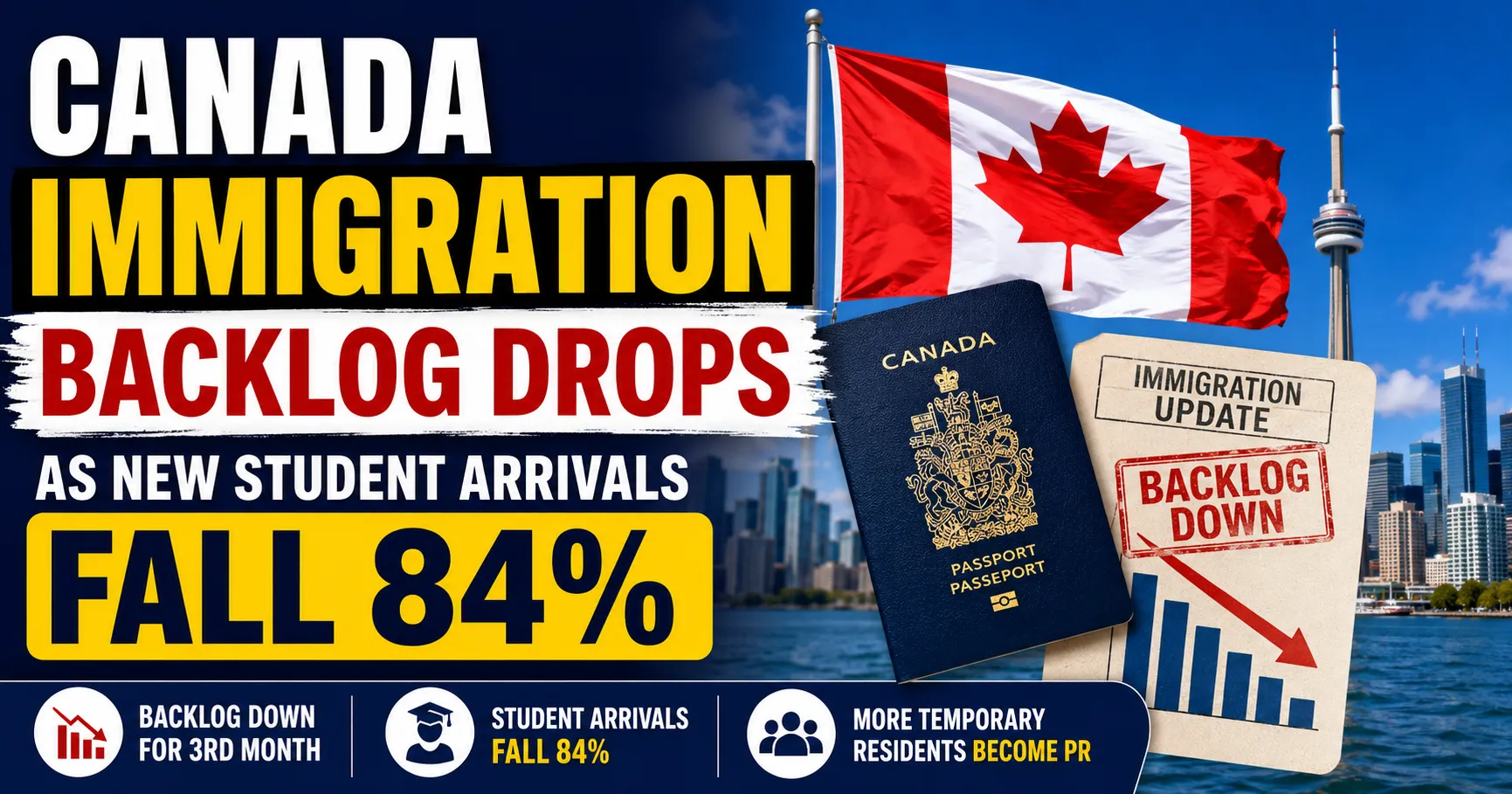
The latest update from Immigration, Refugees and Citizenship Canada (IRCC) brings some positive news. Canada’s immigration backlog continued to shrink in April 2026. At the same time, the number of new international students and temporary workers arriving in Canada has dropped sharply compared to previous years.
While the falling backlog is encouraging, the bigger story may be how Canada’s immigration system is changing its focus toward people who are already living inside the country.
Canada Immigration Backlog Continues To Decline
According to the latest IRCC inventory update released on June 16, 2026, the total immigration backlog stood at 922,700 applications as of April 30, 2026.
This is the third straight month that the backlog has decreased.
In March 2026, the backlog was 935,000 applications. By April, that number had dropped by another 12,300 files.
Since January 2026, Canada has reduced its immigration backlog by a total of 67,600 applications.
Even though the overall application inventory remained almost unchanged, IRCC managed to move thousands of applications back within normal processing timelines.
Key Numbers From April 2026
| Category | April 2026 |
|---|---|
| Total application inventory | 2,153,900 |
| Applications within service standards | 1,231,200 |
| Applications in backlog | 922,700 |
| Monthly backlog reduction | 12,300 |
This shows that IRCC is processing more overdue files without significantly reducing the total number of applications it manages.
Three Months Of Continuous Improvement
The immigration backlog reached its highest point in January 2026 when it crossed 990,000 applications.
Since then, the situation has improved month after month.
Backlog Trend In 2026
| Month | Backlog |
|---|---|
| January 2026 | 990,300 |
| February 2026 | 941,400 |
| March 2026 | 935,000 |
| April 2026 | 922,700 |
The backlog now represents around 42.8 percent of all applications, compared to 47.3 percent in January.
IRCC aims to process around 80 percent of applications within its published service standards. The latest numbers suggest the department is slowly moving closer to that goal.
Permanent Residence Applications Face The Biggest Delays
While the overall backlog is improving, permanent residence applications continue to face challenges.
The total permanent residence inventory has now grown to more than 1 million applications.
Out of 1,038,100 permanent residence files, around 557,700 are currently outside standard processing times.
That means more than half of all permanent residence applications remain in backlog.
This category includes popular immigration programs such as:
- Express Entry
- Provincial Nominee Program
- Family Sponsorship
- Humanitarian Programs
Because application demand remains high, processing teams are still struggling to keep pace.
Applicants who submitted permanent residence applications during late 2025 or early 2026 may continue to experience longer waiting periods.
Temporary Residence Processing Shows Strong Recovery
Temporary residence applications have become the main reason behind the overall backlog improvement.
This category includes:
- Study permits
- Work permits
- Visitor permits
IRCC currently holds 842,000 temporary residence applications.
Around 548,900 of these files are still being processed within normal timelines.
Only 303,100 remain in backlog.
Compared to the beginning of 2026, this is a significant improvement.
One major reason is the sharp decline in new study permit and work permit applications, which has reduced pressure on processing officers.
Citizenship Applications Remain The Fastest Category
Citizenship applications continue to perform better than other immigration streams.
IRCC reported 273,800 citizenship applications in April 2026.
Out of these files:
- 211,900 were within service standards
- 61,900 were in backlog
The citizenship backlog rate currently stands at only 23 percent.
IRCC also welcomed approximately 24,200 new Canadian citizens during April alone.
Although citizenship processing remains relatively efficient, some applicants may still experience delays in citizenship certificate issuance.
How Much Work Did IRCC Complete In Early 2026?
The department processed a large number of applications during the first four months of the year.
January To April 2026 Processing Results
| Activity | Volume |
|---|---|
| Permanent residence decisions | 155,500 |
| New permanent residents welcomed | 112,900 |
| Study permit applications finalized | 145,000 |
| Work permit applications finalized | 618,500 |
| New citizens welcomed in April | 24,200 |
These numbers show that IRCC continues to process a high volume of applications across different immigration categories.
International Student Arrivals Fall By 84 Percent
Perhaps the most surprising update came from Canada’s latest temporary resident statistics.
The number of new international students entering Canada between January and April 2026 dropped dramatically compared with the same period in 2024.
Student And Worker Arrivals
| Category | Jan To Apr 2026 | Jan To Apr 2024 |
|---|---|---|
| Student arrivals | 16,115 | 99,435 |
| Worker arrivals | 58,360 | 174,380 |
| Total arrivals | 74,475 | 273,810 |
International student arrivals fell by 84 percent.
Temporary worker arrivals declined by 67 percent.
Overall arrivals dropped by 73 percent.
This sharp decline reflects several recent government policy changes.
These include limits on international student permits, stricter post graduation work permit rules, restrictions on spouse work permits, and tighter temporary worker program requirements.
Why Are Fewer Students And Workers Coming To Canada?
Over the last two years, Canada introduced multiple measures to slow temporary resident growth.
Some of the major changes include:
- Annual study permit caps
- Stricter eligibility rules for work permits
- Reduced low wage temporary foreign worker hiring limits
- New restrictions affecting spouses of temporary residents
As a result, far fewer new applicants are entering the system compared to previous years.
This reduction is also helping IRCC process existing applications faster.
More Temporary Residents Are Becoming Permanent Residents
Another important trend is the increasing number of temporary residents moving into permanent residence programs.
Share Of New Permanent Residents
| Year | Former Temporary Residents |
|---|---|
| 2024 | 44% |
| 2025 | 48% |
| 2026 Jan To Apr | 58% |
More than half of all new permanent residents in 2026 were already living in Canada before receiving permanent status.
Many of these applicants are transitioning through:
- Express Entry
- Provincial Nominee Program
- Atlantic Immigration Program
- Rural Community Immigration Pilot
- Francophone Community Immigration Pilot
This suggests that Canada is placing greater focus on candidates who already have Canadian work or study experience.
What Applicants Should Do Next
If you currently have a temporary residence application in process, the latest data is encouraging. Processing conditions have improved significantly compared to last year.
Permanent residence applicants should continue monitoring their file status closely and prepare for possible delays beyond standard timelines.
For people already living in Canada on temporary permits, programs that lead to permanent residence may become even more important in the coming years.
Common Mistakes Applicants Should Avoid
- Assuming all immigration categories are improving equally
- Relying only on average processing times
- Ignoring updates from IRCC
- Missing document requests from immigration officers
- Expecting permanent residence files to move at the same speed as citizenship applications
Keeping application documents updated and responding quickly to IRCC requests can help avoid additional delays.
FAQ
As of April 30, 2026, IRCC reported 922,700 applications that exceeded normal service standards.
Permanent residence programs continue receiving large numbers of applications, while processing capacity has not fully matched demand.
International student arrivals dropped by 84 percent between January and April 2026 compared with the same period in 2024.
Yes. Temporary residence applications have shown the strongest improvement in 2026, with a growing share of files being processed within service standards.
Yes. During the first four months of 2026, 58 percent of new permanent residents were people who were already living in Canada as temporary residents.
Fact Check
The information in this article is based on official data released by Immigration, Refugees and Citizenship Canada on June 16, 2026. The figures reflect application inventory and temporary resident statistics available as of April 30, 2026.
Final Thoughts
The latest IRCC data shows two major trends happening at the same time. Canada is gradually reducing its immigration backlog, which is positive for many applicants. However, the sharp drop in new student and worker arrivals signals a larger shift in immigration policy. Going forward, people already living in Canada may continue to have stronger opportunities for permanent residence compared to new applicants entering from abroad.
Disclaimer: This article is provided for informational and educational purposes only. It should not be considered immigration, legal, or professional advice. Immigration policies and processing times may change. Applicants should always verify information through official government sources or seek guidance from a licensed immigration professional when necessary.