
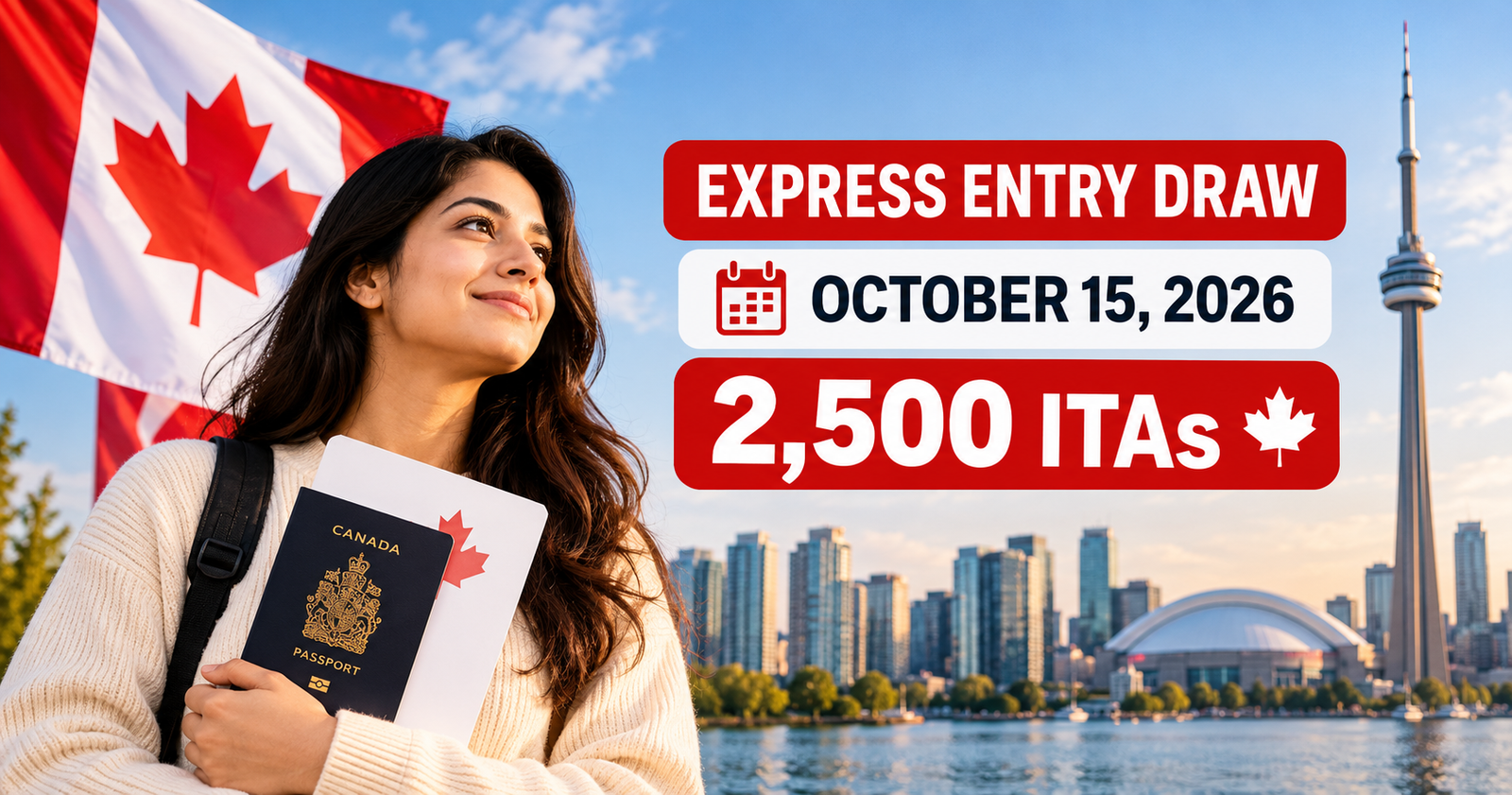
Canada’s latest Express Entry draw has increased opportunities for skilled workers already building their careers in the country. On October 15, 2026, Immigration, Refugees and Citizenship Canada (IRCC) issued 2,500 invitations to apply (ITAs) for permanent residence through the Canadian Experience Class (CEC), with the minimum Comprehensive Ranking System (CRS) score set at 519.
The round is notable because IRCC issued 500 more invitations than in the previous CEC draw on September 29, when 2,000 candidates received invitations at a CRS cut-off of 518. However, the minimum score moved up by one point, showing why candidates should look beyond invitation numbers when assessing their chances of receiving an invitation.
October 15 Express Entry Draw: Key Details
The latest round focused specifically on candidates eligible under the Canadian Experience Class. Unlike a general Express Entry draw, a CEC-specific round does not invite every candidate in the Express Entry pool. Candidates must qualify for the targeted program and meet the selection requirements for that particular round.
Here are the main details of the October 15 selection:
| Draw Detail | Officially Reported Information |
|---|---|
| Draw date | October 15, 2026 |
| Express Entry round number | 449 |
| Draw category | Canadian Experience Class (CEC) |
| Invitations to Apply issued | 2,500 |
| Minimum CRS score | 519 |
| Draw time | 10:02:33 UTC |
| Tie-breaking timestamp | September 21, 2026, at 19:00:47 UTC |
The CRS cut-off of 519 represents the score of the lowest-ranked candidate invited in this round. Candidates with scores above the cut-off were not automatically guaranteed an invitation, because they also needed to meet the requirements of the draw. The number of invitations available and the candidate’s eligibility both influence whether a profile can be selected.
Why the October 15 Draw Matters for Canadian Experience Class Candidates
The increase to 2,500 invitations is an important development for eligible candidates in the CEC pool. Compared with the previous CEC round, IRCC expanded the number of invitations by 500, although the CRS cut-off also rose slightly. This combination shows that a larger draw does not necessarily result in a lower minimum score.
For applicants who have Canadian work experience and qualify for the Canadian Experience Class, the result offers a useful point of comparison when reviewing their own profiles. However, one draw cannot establish a reliable prediction for the next round. IRCC determines each round according to its selection instructions and the candidates eligible and ranked in the pool at that time.
Candidates should also remember that an Express Entry profile is not the same as a permanent residence application. A profile allows an eligible person to enter the selection pool, while an invitation gives the selected candidate an opportunity to submit a complete application for permanent residence.
What Is the Canadian Experience Class?
The Canadian Experience Class is one of the three immigration programs managed through Express Entry. It is designed for eligible skilled workers who have qualifying work experience in Canada and want to become permanent residents.
CEC eligibility depends on specific requirements, including qualifying Canadian work experience, the appropriate occupational classification, language proficiency and other program conditions. Meeting the minimum CRS score alone does not establish eligibility for this program.
Applicants should review their circumstances against the current official requirements rather than relying only on the result of the latest draw. Work experience must meet the applicable rules, and language test results and other information must remain valid when required.
Understanding the CRS Cut-Off of 519
The Comprehensive Ranking System is used to rank candidates in the Express Entry pool. It considers factors such as age, education, language ability, qualifying work experience and certain additional factors. A candidate’s score can change when their circumstances or eligible information changes.
In the October 15 draw, the minimum CRS score was 519. This means that IRCC selected candidates according to the round’s eligibility and ranking rules, with the lowest-ranked invited candidate having a score of 519.
The previous CEC draw, held on September 29, had a cut-off of 518 and issued 2,000 invitations. The latest round therefore had a higher invitation total but a one-point higher CRS threshold. Candidates should not assume that an increase in invitation numbers will always lower the score required for selection.
October 15 vs. September 29: CEC Draw Comparison
| Detail | September 29, 2026 | October 15, 2026 |
|---|---|---|
| Draw type | Canadian Experience Class | Canadian Experience Class |
| Invitations issued | 2,000 | 2,500 |
| CRS cut-off | 518 | 519 |
| Change in invitations | — | 500 more |
| Change in CRS cut-off | — | 1 point higher |
The comparison highlights two separate measures: the number of candidates invited and the score needed to receive an invitation. Both matter, but neither should be treated as a guarantee about future selections.
How the Tie-Breaking Rule Works in This Draw
IRCC also published a tie-breaking timestamp of September 21, 2026, at 19:00:47 UTC. This rule is relevant when candidates have the same CRS score at the cut-off point and IRCC needs to determine which profiles rank ahead of others.
For this draw, candidates with a CRS score of 519 whose profiles were submitted before the published tie-breaking timestamp ranked ahead of otherwise similarly scored profiles submitted after that time, where the tie-break was needed.
The timestamp does not add points to a candidate’s CRS score, nor does it replace the eligibility requirements of the Canadian Experience Class. It is a ranking rule used in specific circumstances when candidates share the same score.
If your score is 519, check both your profile submission date and the applicable round details before deciding what the result means for you. A matching CRS score alone does not prove that you received an invitation.
What Should Express Entry Candidates Do Now?
The right next step depends on whether you received an invitation, remain in the pool, or are still preparing to qualify for Express Entry. Reviewing your profile carefully is more useful than making decisions based on a single draw result.
If You Received an Invitation
- Check your IRCC account. Confirm that the invitation appears in your account and review the program under which you were invited.
- Review the deadline. An invitation to apply for permanent residence is generally valid for 60 days, so make sure you understand the deadline displayed in your account.
- Prepare supporting documents. Depending on your circumstances, these may include employment records, language test results, education documents, police certificates and other required evidence.
- Check every detail for accuracy. Ensure that the information in your application matches your actual circumstances and the documents you provide.
- Submit a complete application on time. Do not wait until the final days to resolve missing documents or inconsistencies.
If Your CRS Score Is Below 519
A score below this round’s cut-off does not automatically mean that you cannot receive an invitation in the future. Cut-offs can vary between rounds, and selection depends on the type of draw and the candidates eligible for consideration.
Review whether you can improve your language test results, gain additional qualifying work experience, or update other eligible factors in your profile. Before making changes, confirm how each factor affects your CRS score and whether you still meet your program’s eligibility requirements.
If Your CRS Score Is 519 or Higher but You Were Not Invited
Check whether your profile meets the requirements for the Canadian Experience Class and whether the tie-breaking rule applies to your situation. Also confirm that your profile was active and valid for the round. A score at or above the published cut-off should not be interpreted as an unconditional guarantee of selection.
Practical Take: Do Not Plan Your Immigration Timeline Around One Draw
The October 15 result provides a useful snapshot of IRCC’s selection of Canadian Experience Class candidates, but it should not be treated as a promise that the next draw will have the same cut-off or invitation total. The latest round issued 2,500 invitations at a CRS score of 519, compared with 2,000 invitations at 518 on September 29. That is a meaningful change in the numbers, but it does not establish a fixed pattern for future rounds.
Candidates can use the result to review their profiles and prepare their documents, while keeping their plans flexible. In practice, it is worth checking the validity of language test results, confirming that work experience is correctly recorded and keeping important employment documents organized before an invitation arrives. If your circumstances change, update your profile where required and verify how the change affects your eligibility and score.
Frequently Asked Questions
IRCC issued 2,500 invitations to apply for permanent residence in Express Entry round 449. The draw targeted candidates eligible under the Canadian Experience Class.
The minimum CRS score was 519. Candidates also had to meet the applicable requirements of the Canadian Experience Class draw to be considered for an invitation.
Yes. The October 15 round issued 2,500 invitations, which was 500 more than the 2,000 invitations issued in the September 29 CEC draw. The CRS cut-off also increased from 518 to 519.
The tie-breaking timestamp was September 21, 2026, at 19:00:47 UTC. When the tie-break was necessary, candidates with a score of 519 whose profiles were submitted before that timestamp ranked ahead of otherwise similarly scored profiles submitted later.
Review your eligibility, check that your profile information is accurate, and explore legitimate ways to improve your CRS score if possible. Future cut-offs may differ, so the October 15 result should not be treated as a permanent minimum for all future CEC draws.
Fact Check: The draw details in this article are based on the October 15, 2026, Express Entry round 449 report and should be cross-checked against IRCC’s official Express Entry rounds of invitations page.
Disclaimer: This article is for general informational purposes only and does not constitute legal or immigration advice. Immigration rules and selection details may change; always verify eligibility, deadlines and official draw information with Immigration, Refugees and Citizenship Canada (IRCC).