
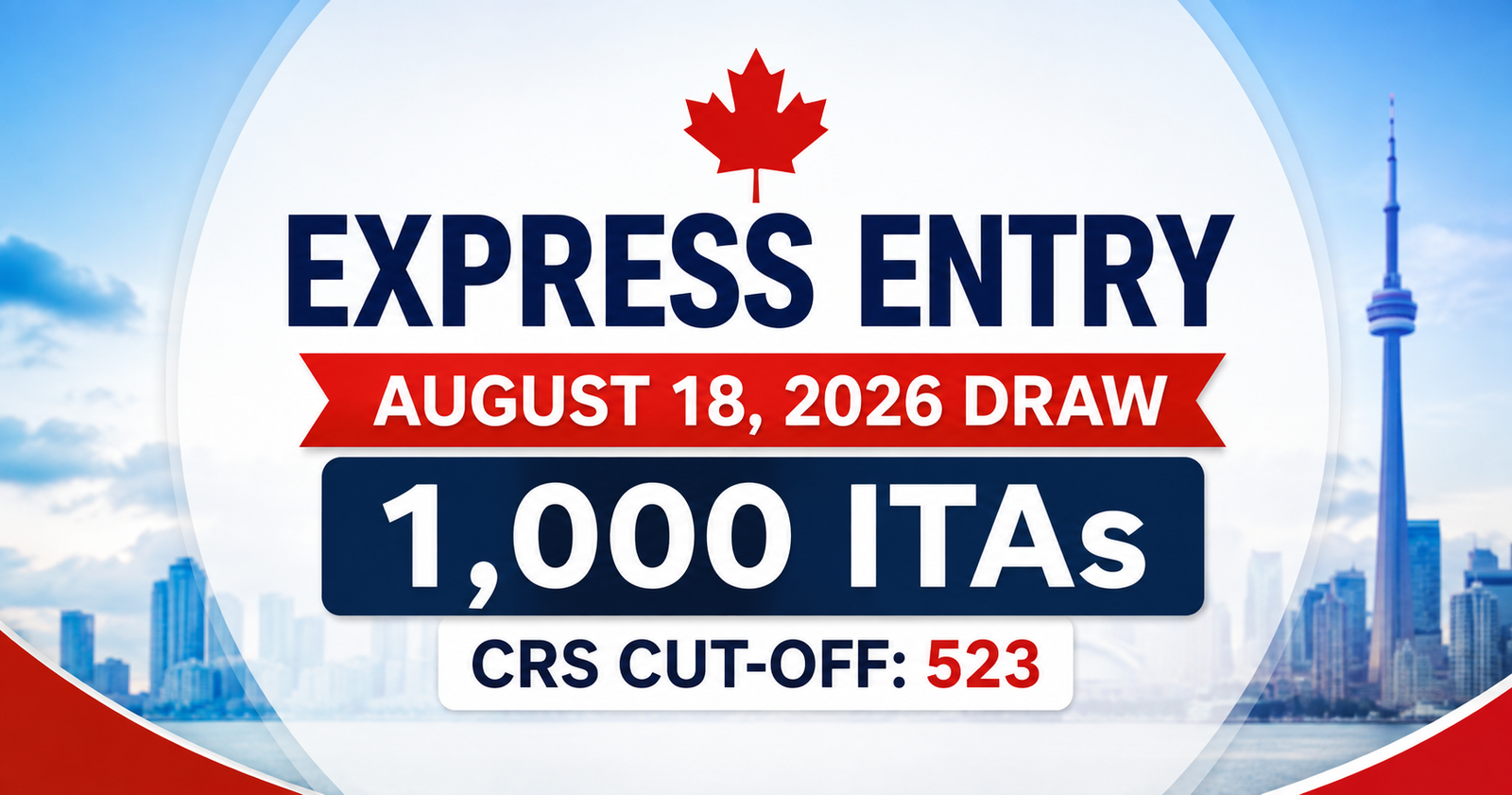
A smaller Canadian Experience Class draw has pushed the Express Entry CRS cutoff sharply higher. On August 18, 2026, Immigration, Refugees and Citizenship Canada (IRCC) issued 1,000 invitations to apply (ITAs) for permanent residence, with the lowest-ranked invited candidate recording a CRS score of 523.
The result stands out because the previous CEC draw on August 5 invited 3,000 candidates at 516 CRS points. The seven-point increase does not necessarily mean candidates suddenly became stronger; the much smaller invitation target meant that IRCC selected a narrower group of high-ranking profiles from the Express Entry pool.
August 18 Express Entry Draw Results
The latest Express Entry round was specifically for candidates eligible under the Canadian Experience Class (CEC). IRCC conducted the round on August 18 and invited 1,000 candidates to submit applications for Canadian permanent residence.
Here are the key details:
| Draw detail | August 18, 2026 result |
|---|---|
| Express Entry program | Canadian Experience Class |
| Draw date | August 18, 2026 |
| Draw time | 10:13:44 UTC |
| Invitations issued | 1,000 |
| Lowest CRS score | 523 |
| Rank required | 1,000 or above |
| Tie-breaking date | August 17, 2026 at 22:09:00 UTC |
IRCC’s Express Entry system ranks candidates according to the Comprehensive Ranking System and invites the highest-ranking eligible candidates in each round. The type of draw, number of invitations and eligibility requirements are established in the instructions for that particular round.
The August 18 result therefore matters for more than just the 523 score. It also shows how strongly the size of an invitation round can influence the CRS threshold.
Why Did the CRS Cutoff Jump From 516 to 523?
The simplest explanation is the sharp reduction in invitation numbers.
On August 5, IRCC issued 3,000 CEC invitations and the CRS cutoff was 516. Just two weeks later, the department issued only 1,000 invitations, meaning two-thirds fewer candidates were selected in the latest round. With fewer places available, the selection line moved upward to 523.
This is an important distinction for candidates watching Express Entry scores. A higher cutoff in one draw does not automatically mean that the overall candidate pool has become seven points stronger. In this case, the smaller draw size appears to have played a major role in determining where the cutoff landed.
The previous CEC draws also show why candidates should be careful about treating one CRS result as a permanent new benchmark. Since April, CEC cutoffs had generally remained within the 514 to 518 range even when IRCC issued between 2,000 and 4,000 invitations. The August 18 draw broke that pattern because the invitation volume fell to its lowest level of the year.
August 18 Was the Smallest CEC Draw of 2026
The latest round is notable when placed alongside the other Canadian Experience Class draws held this year.
| Date | Invitations | CRS cutoff |
| August 18, 2026 | 1,000 | 523 |
| August 5, 2026 | 3,000 | 516 |
| July 21, 2026 | 2,000 | 516 |
| July 7, 2026 | 2,000 | 517 |
| June 23, 2026 | 4,000 | 516 |
| May 27, 2026 | 3,000 | 518 |
| April 28, 2026 | 2,000 | 514 |
| April 14, 2026 | 2,000 | 515 |
| March 31, 2026 | 2,250 | 509 |
| March 17, 2026 | 4,000 | 507 |
| March 3, 2026 | 4,000 | 508 |
| February 17, 2026 | 6,000 | 508 |
| January 21, 2026 | 6,000 | 509 |
| January 7, 2026 | 8,000 | 511 |
CEC-specific invitations have reached approximately 49,250 across 14 draws in 2026, according to the draw data compiled from the year’s rounds. The pattern is also striking: the CEC invitation size has gradually fallen from 8,000 in January to just 1,000 in the latest round.
That decline helps explain why the latest cutoff deserves attention. The 523 score is not just the highest CEC cutoff recorded so far in 2026; it came alongside the smallest CEC invitation round of the year.
What Happened to Candidates With CRS Scores Between 516 and 522?
This is probably the most practical question for people who were close to the previous cutoff.
Candidates with scores from 516 through 522 would have been above the August 5 cutoff of 516, but they were not high enough to receive an invitation in the August 18 round. They have not necessarily become ineligible for CEC, however. Their immediate issue is that they remain in the pool and must wait for another round in which the invitation volume and cutoff may be different.
A common mistake at this point is to assume that 523 will automatically become the new permanent CEC threshold. Express Entry does not work that way. IRCC decides the size and type of each round, and the cutoff is determined by the ranking of candidates selected in that particular round. A larger future CEC draw could produce a considerably lower cutoff.
For candidates sitting just below 523, the practical move is to work on factors that can improve the CRS rather than simply waiting for the next draw. A language retest, additional eligible work experience or another change that legitimately increases CRS points can make a meaningful difference when the cutoff is moving within a narrow range.
Express Entry Pool Remains Highly Competitive
The size and distribution of the Express Entry pool also provide useful context.
An IRCC pool snapshot from August 16, 2026 showed 226,859 candidates in the system before the August 17 PNP draw. Within that pool, 18,657 candidates were in the 501–600 CRS range, compared with 17,085 in the same range in the July 19 snapshot.
That increase is significant for high-scoring CEC candidates because it means there was a substantial group competing in the upper CRS bands. When IRCC chooses to invite only 1,000 people, the selection naturally reaches a much narrower portion of that competitive group.
The largest CRS band was actually 451–500, which contained 73,554 candidates in the August 16 snapshot. For people in that range, a CEC-only draw at 523 does not provide an immediate route to an ITA. They may instead need to improve their CRS score or qualify through another Express Entry category or a provincial nomination pathway, depending on their individual circumstances.
The August Express Entry Draws Are Happening in Clusters
The August 18 CEC round also came immediately after a Provincial Nominee Program Express Entry draw on August 17, which issued 442 invitations at a CRS cutoff of 760. That means IRCC conducted two Express Entry rounds on consecutive days, although they targeted different groups of candidates.
IRCC does not publish a guaranteed schedule for upcoming rounds. Its official guidance explains that the department decides the round type, the number of candidates to invite and the eligibility requirements for each invitation round.
Based on the draw pattern observed in 2026, another category-based round could follow during this period, including a French-language proficiency draw. However, candidates should treat that as a possibility rather than a confirmed schedule because IRCC can change the timing, category and number of invitations.
Could a French-Language Draw Follow?
French-language proficiency has been one of the lower-CRS pathways seen in Express Entry this year.
The source data shows French-language draws in 2026 have recorded CRS cutoffs between 391 and 420 across nine rounds. Candidates who meet the applicable French-language requirements may therefore have a very different competitive position from someone relying solely on a CEC draw with a cutoff above 500.
This is where looking only at the latest CEC score can become misleading. Someone with a CRS of 410 may have no realistic chance in a CEC-only round at 523, while potentially being much more competitive in a category-based round for which they qualify.
Candidates should therefore assess the categories they actually qualify for instead of comparing their score with every Express Entry draw indiscriminately.
What Should Candidates Do After the CRS Increase?
If your CRS is below 523, the August 18 result is a reason to review your profile, not necessarily a reason to give up on Express Entry.
First, check whether your CRS calculation is still accurate. Make sure your age, education, language results, Canadian work experience, foreign work experience and other relevant factors are correctly reflected. Even a small error can affect your ranking.
Second, look for realistic ways to increase your score. Language testing is one area candidates can actively work on. If improving an IELTS, CELPIP, TEF or TCF result can move your profile into a stronger position, preparing for another test may be worth considering.
Third, examine provincial nomination opportunities. A provincial nomination can substantially change an Express Entry candidate’s ranking, although eligibility depends on the specific provincial or territorial program and the applicant’s circumstances. The source article notes active pathways involving Ontario, Alberta, British Columbia and Manitoba, including Ontario’s Workforce Priority stream, which began accepting new registrations on August 4.
Finally, don’t make decisions based on one draw. Express Entry cutoffs can move significantly when IRCC changes the number or type of invitations. The jump from 516 to 523 is a good example of why a single draw should be viewed as one data point rather than a guaranteed forecast for the next round.
What Does the August 18 Draw Mean for You?
For a CEC candidate with a CRS of 523 or higher, the immediate result is straightforward: if the profile met the other requirements and the tie-breaking rule applied where necessary, the candidate could receive an ITA in this round.
For someone sitting between 516 and 522, the situation is more frustrating but not necessarily permanent. The latest cutoff reflects a 1,000-invitation round. If IRCC increases the number of CEC invitations in a future round, the cutoff could move downward again.
For candidates below that range, particularly those in the 400s, it may be more useful to focus on alternative routes available to them rather than waiting for the CEC cutoff alone. That could include category-based Express Entry opportunities, improving language scores or exploring provincial nomination options if eligible.
The key lesson from this draw is simple: CRS cutoffs have to be read together with invitation numbers. Looking at 523 without looking at the 1,000 ITAs misses the most important part of the result.
What Happens After Receiving an Express Entry ITA?
Receiving an invitation is not the same as receiving permanent residence. It gives the invited candidate the opportunity to submit a complete permanent residence application to IRCC.
Candidates invited in the August 18 draw have 60 calendar days to submit their complete application.
This is where preparation becomes especially important. If you receive an ITA, you should already have a clear understanding of which documents you will need and whether the information in your Express Entry profile can be supported with documentation.
A practical point that often gets overlooked is consistency. Your application should accurately support the information declared in your Express Entry profile, including employment history, education, language results and other claimed factors. An incomplete or unsupported application can create avoidable problems during processing.
How Long Could CEC Permanent Residence Processing Take?
IRCC’s processing-time information is updated regularly and is intended to provide an estimate rather than a guaranteed completion date. Processing begins when IRCC receives a complete application and can vary depending on factors such as inventory, application volume and case complexity.
The source data available for the August 18 draw reported approximately six months for CEC permanent residence processing at that time. Based on that figure, applicants should understand that an ITA in August 2026 does not mean an immediate PR approval; the permanent residence application still has to go through the full processing process.
It is also worth checking IRCC’s current processing-time tool when preparing an application because processing estimates can change.
Key Takeaway From the August 18 Express Entry Draw
The August 18, 2026 CEC draw was unusual because IRCC issued only 1,000 invitations, the lowest CEC invitation count of the year, while the CRS cutoff climbed to a new 2026 high of 523.
The seven-point increase from the August 5 cutoff should not automatically be interpreted as a permanent shift in the CRS requirement. The number of invitations matters enormously, and a future round with a larger invitation target could produce a lower cutoff.
For candidates who missed this round, the best response is to keep the Express Entry profile current, review opportunities to improve the CRS, and assess whether other categories or provincial pathways may provide a stronger option. IRCC’s official Express Entry page remains the most reliable place to confirm future draw results and invitation instructions.
Frequently Asked Questions (FAQ’s)
The CRS cutoff was 523 points. IRCC issued 1,000 invitations through the Canadian Experience Class in this round.
The biggest factor was the reduction in invitation numbers. IRCC issued 3,000 CEC invitations on August 5 but only 1,000 on August 18. With fewer invitations available, the selection moved higher in the ranking and reached 523.
There is no guarantee that it will. Express Entry cutoffs can change from one round to another depending on the number of invitations, the draw type and the candidates in the pool. The previous CEC cutoffs had generally remained between 514 and 518 from April through early August.
A valid job offer is not required for CEC eligibility. However, candidates must meet the program’s other eligibility requirements, including the required Canadian skilled work experience. The source article notes that CEC applicants need at least 12 months of skilled Canadian work experience within the three years before applying for permanent residence.
Fact Check: This article is based on the August 18, 2026 Express Entry round published by Immigration, Refugees and Citizenship Canada, including the official invitation-round information and the August 16, 2026 Express Entry pool snapshot.
Disclaimer: This article is for general informational purposes only and does not constitute legal or professional immigration advice. Immigration rules, draw results and processing times can change, so applicants should verify current information through official IRCC sources before making immigration decisions.