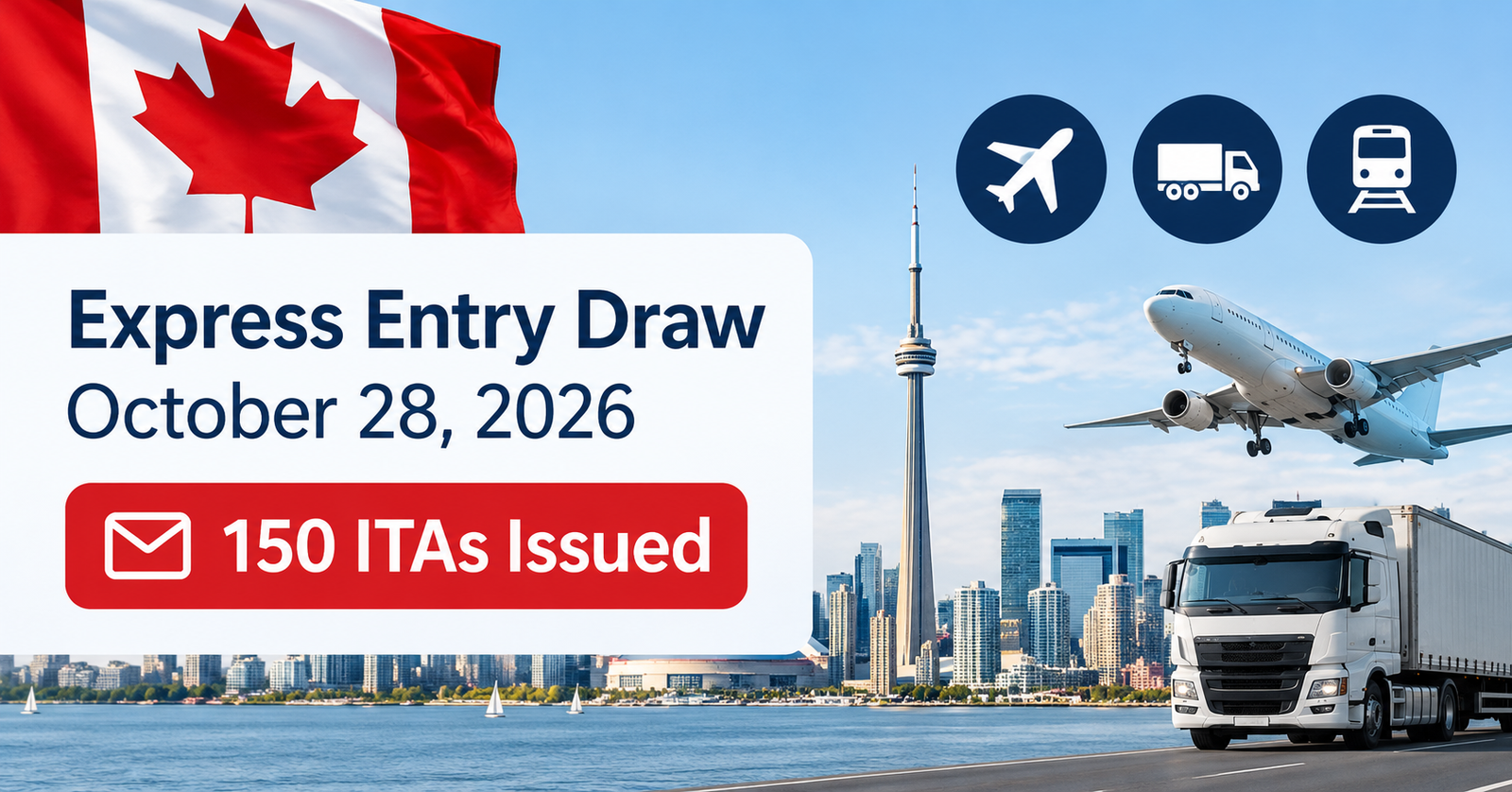
Canada’s latest Express Entry draw has created another opportunity for skilled workers in the transport sector. On October 28, 2026, Immigration, Refugees and Citizenship Canada (IRCC) issued 150 Invitations to Apply (ITAs) for Canadian permanent residence through its Transport Occupations category. The minimum Comprehensive Ranking System (CRS) score was 477, and candidates also had to meet the applicable category requirements and tie-breaking rule.
This was the third Express Entry draw of the week, following a large French-language selection round and a Provincial Nominee Program (PNP) draw. The results highlight why candidates should look beyond the headline CRS score and understand which selection category applies to their profile.
Latest Express Entry Draw Results: October 28, 2026
IRCC conducted Express Entry Draw #453 for candidates eligible under the Transport Occupations, 2026 – Version 2 category. The round focused on eligible candidates with qualifying transport-related work experience rather than inviting candidates from the entire pool without category restrictions.
Here are the key details from the latest draw.
| Draw detail | Results |
|---|---|
| Draw number | 453 |
| Draw date | October 28, 2026 |
| Immigration authority | Immigration, Refugees and Citizenship Canada (IRCC) |
| Draw category | Transport Occupations, 2026 – Version 2 |
| Invitations issued | 150 |
| Minimum CRS score | 477 |
| Tie-breaking date and time | June 4, 2026, at 21:48:22 UTC |
The CRS cutoff of 477 represents the score of the lowest-ranked candidate invited in this particular round. It does not mean every Express Entry candidate needs 477 points to receive an invitation in another category or future draw. IRCC determines selection criteria and invitation numbers for each round, so the next cutoff may be different.
The tie-breaking rule also matters. Candidates who had the same CRS score as the cutoff were not automatically guaranteed an invitation. Where the rule applies, the date and time their profiles were submitted help determine which candidates are selected.
What Makes This Express Entry Draw Different?
Express Entry uses different types of selection rounds. Some focus on candidates eligible under a specific immigration program, while category-based draws target candidates who meet additional criteria, such as particular work experience or French-language proficiency. The October 28 round focused on transport occupations, making category eligibility a key part of the selection process.
For example, an applicant with a CRS score above 477 would not necessarily have been invited if they did not meet the requirements for this transport category. Meanwhile, a candidate with a lower score might have a different opportunity in a future round targeting another eligible group. This is why checking the category requirements is just as important as calculating a CRS score.
An Invitation to Apply is also not the same as permanent residence approval. Selected candidates must submit their application with the required documents and satisfy IRCC’s eligibility and admissibility requirements before a final decision can be made.
Who Can Qualify for the Transport Occupations Category?
Candidates must meet two separate sets of requirements to be considered in a transport occupations draw. First, they must qualify for at least one of the federal immigration programs managed through Express Entry. Second, they must satisfy the specific eligibility conditions for the transport category used in the draw. Having a job in the transportation industry alone does not establish eligibility.
The three federal programs managed through Express Entry are:
- Federal Skilled Worker Program (FSWP): For eligible skilled workers who meet the program’s requirements.
- Canadian Experience Class (CEC): For eligible skilled workers with qualifying Canadian work experience.
- Federal Skilled Trades Program (FSTP): For eligible skilled tradespeople who meet the program’s criteria.
Meeting the minimum requirements of one of these programs does not automatically qualify someone for a category-based invitation. Candidates must also check the specific instructions for the transport occupations round.
Work Experience Requirements
For the 2026 transport occupations category, candidates must have at least 12 months of full-time work experience, or an equivalent amount of part-time experience, in an eligible occupation during the previous three years. The experience does not have to be continuous, and it may have been gained in Canada or abroad. The qualifying experience must be in one occupation included in the category.
The listed occupations include the following examples:
| Occupation | National Occupational Classification (NOC) |
|---|---|
| Aircraft mechanics and aircraft inspectors | 72404 |
| Air pilots, flight engineers and flying instructors | 72600 |
| Aircraft instrument, electrical and avionics mechanics, technicians and inspectors | 22313 |
| Automotive service technicians, truck and bus mechanics, and mechanical repairers | 72410 |
A practical point for applicants: Check your actual job duties against the relevant NOC description before relying on your job title. Similar-sounding positions can have different responsibilities, and the title alone is not enough to prove that your experience qualifies. Keep employment letters and other supporting records that accurately describe your duties, work dates and hours.
Candidates should confirm the complete list of eligible occupations and current requirements before making decisions about their immigration plans.
How the October 28 Draw Compares With Recent Express Entry Results
The latest transport draw followed two different selection rounds earlier in the week. On October 27, IRCC issued 5,000 invitations to candidates selected under the French-language proficiency category. A day earlier, the department issued 792 invitations in a Provincial Nominee Program round.
The recent results show how invitation numbers and CRS cutoffs can vary depending on the type of draw.
| Draw number | Date | Category | Invitations issued | Minimum CRS |
|---|---|---|---|---|
| 453 | October 28, 2026 | Transport Occupations | 150 | 477 |
| 452 | October 27, 2026 | French-language proficiency | 5,000 | 407 |
| 451 | October 26, 2026 | Provincial Nominee Program | 792 | 761 |
| 450 | October 16, 2026 | French-language proficiency | 5,000 | 435 |
| 449 | October 15, 2026 | Canadian Experience Class | 2,500 | 519 |
These figures should not be interpreted as a direct ranking of which immigration pathway is easiest. The rounds select different groups of candidates, and each has its own eligibility conditions. For instance, the high CRS cutoff in the PNP draw reflects a different selection context from the transport and French-language rounds.
For applicants, the more useful approach is to identify the rounds they may qualify for, calculate their CRS score accurately and monitor the results for those categories. Comparing scores without considering eligibility can create unrealistic expectations.
Previous Transport Occupations Draw: August 7, 2026
IRCC also held a Transport Occupations, 2026 – Version 2 draw on August 7, 2026. That round issued 300 invitations, with a minimum CRS score of 470.
The October 28 round was smaller, issuing 150 invitations instead of 300. Its minimum CRS score was also seven points higher, increasing from 470 to 477.
| Draw detail | August 7, 2026 | October 28, 2026 |
|---|---|---|
| Invitations issued | 300 | 150 |
| Minimum CRS score | 470 | 477 |
| Difference in invitations | — | 150 fewer |
| Difference in CRS cutoff | — | 7 points higher |
The change shows that candidates should avoid treating a previous cutoff as a prediction for the next draw. Invitation numbers, the eligible candidate pool and the ranking of profiles can all influence the results. A future round may have a different cutoff even if IRCC selects candidates under the same category.
There is also no guarantee that the next transport occupations draw will take place on a particular date. Applicants should follow official IRCC announcements rather than making plans around an assumed schedule.
What Should Candidates Do After Receiving an Invitation?
Receiving an ITA is an important step, but candidates must still prepare and submit a complete permanent residence application. IRCC generally gives invited Express Entry candidates 60 days to submit their application, so it is sensible to begin reviewing documents as soon as the invitation arrives.
Candidates should take the following steps:
1. Review the invitation in their IRCC account. Confirm the applicable program, category and submission deadline, and read the instructions carefully.
2. Check employment records. Ensure that work history, job duties, employment dates and hours are accurate and consistent with the information in the Express Entry profile.
3. Prepare supporting documents. Review language test results, educational documents, employment letters and other records required for the application.
4. Check additional requirements. Depending on individual circumstances, applicants may need police certificates, medical examinations, proof of funds or other supporting documents.
5. Review everything before submitting. Make sure the application is complete, accurate and supported by the required evidence.
Applicants should not assume that an invitation guarantees permanent residence. IRCC reviews the submitted application and makes a decision based on the applicable eligibility, documentation and admissibility requirements.
What If Your CRS Score Is Below 477?
Candidates who were not invited in Draw #453 still have options, provided their Express Entry profiles remain valid and they continue to meet the relevant requirements. A score below 477 only means that the candidate did not meet the score threshold for this particular round. It does not automatically make them ineligible for future Express Entry draws.
Depending on their circumstances, candidates may be able to improve their CRS scores through better language test results, additional qualifying work experience or further education. They should also check whether they qualify for other selection categories or provincial immigration pathways. Any changes made to an Express Entry profile must be accurate and supported by appropriate documentation.
It is worth reviewing your profile regularly rather than focusing only on the latest cutoff. Immigration selection rules, category requirements and invitation numbers can change, and a strategy that suits one applicant may not be appropriate for another.
What Does the Latest Draw Mean for Transport Workers?
The October 28 draw confirms that transport occupations were included in Canada’s Express Entry category-based selection rounds in 2026. However, the issuance of 150 invitations does not guarantee that another transport draw will happen soon or that the next cutoff will be lower.
For transport workers planning to immigrate to Canada, the most useful next step is to confirm their NOC classification and work experience eligibility. They should then check whether they qualify for an Express Entry program and calculate their CRS score using their current details. Candidates who are not yet eligible should focus on meeting the relevant requirements rather than assuming that working in the transport sector alone will lead to an invitation.
Keeping documents organized, monitoring official announcements and maintaining an accurate profile can help applicants respond when a suitable opportunity becomes available.
Frequently Asked Questions
IRCC issued 150 Invitations to Apply for permanent residence in Draw #453 on October 28, 2026. The round targeted candidates eligible under the Transport Occupations, 2026 – Version 2 category.
The minimum CRS score was 477. Candidates also had to meet the transport category’s eligibility requirements and the applicable tie-breaking rule to be selected in this round.
The tie-breaking cutoff was June 4, 2026, at 21:48:22 UTC. When candidates have the same CRS score as the cutoff, the tie-breaking rule helps determine which profiles receive invitations.
The category requirements for the 2026 round included at least 12 months of full-time work experience, or an equivalent amount of part-time experience, in one eligible occupation during the previous three years. The experience did not have to be continuous and could have been gained in Canada or abroad. Candidates should verify the complete requirements before applying.
There is no guarantee of another transport occupations draw on a particular date. IRCC determines the timing, category and number of invitations for individual rounds. Candidates should monitor official immigration announcements for confirmed updates.
Fact Check: The draw results, CRS cutoff, invitation count, tie-breaking timestamp and historical comparisons in this article are based on the October 28, 2026, Express Entry Draw #453 announcement and the corresponding IRCC rounds of invitations information. Readers should verify the latest details through official Canadian immigration announcements.
Disclaimer: This article is for general informational purposes only and does not constitute legal or immigration advice. Immigration requirements can change, so readers should verify the information with IRCC or consult an authorized Canadian immigration professional for advice specific to their circumstances.