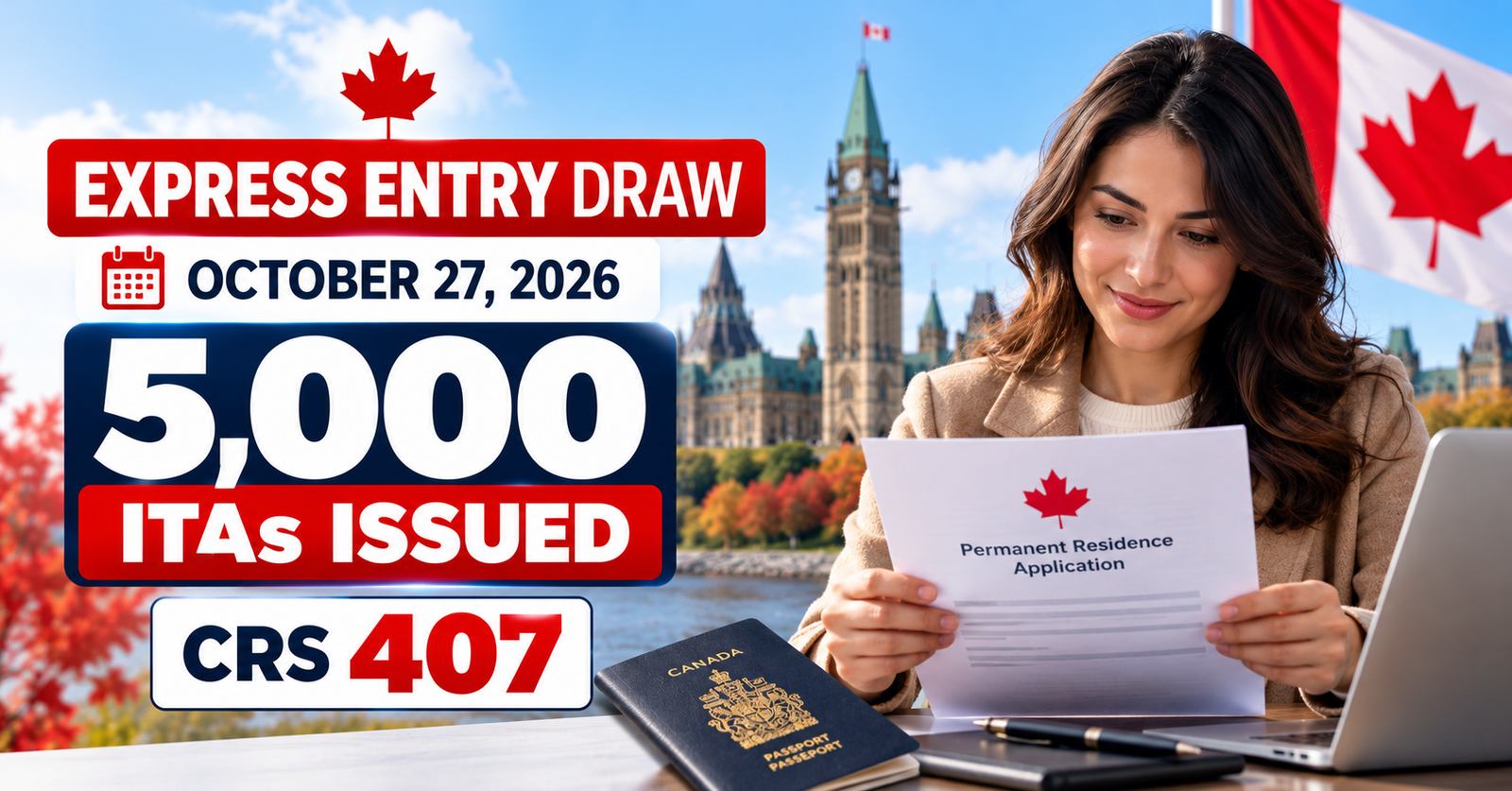
Canada has issued 5,000 invitations to apply for permanent residence in its latest Express Entry draw, held on October 27, 2026. The round targeted candidates with French-language proficiency and recorded a minimum Comprehensive Ranking System (CRS) score of 407, offering an important update for French-speaking applicants hoping to immigrate to Canada.
The cut-off is 28 points lower than the previous French-language draw on October 16, when 5,000 candidates were invited at a minimum CRS score of 435. This latest selection is also the second consecutive Express Entry round held this week, following the October 26 Provincial Nominee Program draw. Here is what the new results mean, who may qualify for French-language selection, and what candidates should consider next.
October 27, 2026, Express Entry Draw: Complete Results
Immigration, Refugees and Citizenship Canada (IRCC) conducted Express Entry Draw #452 under the French-Language Proficiency category. The department issued 5,000 Invitations to Apply (ITAs) for permanent residence, with the lowest-ranked invited candidate recording a CRS score of 407.
| Draw Detail | Result |
|---|---|
| Express Entry draw number | #452 |
| Draw date | October 27, 2026 |
| Selection category | French-language proficiency |
| Invitations issued | 5,000 |
| Minimum CRS score | 407 |
| Tie-breaking date | July 13, 2026 |
| Tie-breaking time | 19:22:00 UTC |
These results apply to candidates who met the requirements for the French-language category and an eligible Express Entry-managed immigration program. A CRS score of 407 alone was not enough to qualify someone for an invitation. Candidates also needed to satisfy the language requirements and, where relevant, the tie-breaking rule used to determine which profiles fell within the invitation limit.
The latest draw is particularly relevant for people who have demonstrated French-language proficiency through an approved test. For eligible candidates, category-based selection provides another opportunity to compete for permanent residence, separate from rounds focused on provincial nominees or Canadian work experience.
CRS Cut-Off Drops by 28 Points From the Previous French-Language Draw
The October 27 result stands out because IRCC issued the same number of invitations as it did in the previous French-language round, but the minimum CRS score was lower. On October 16, 2026, the department invited 5,000 candidates with a minimum score of 435. In the latest round, the invitation total remained at 5,000 while the cut-off fell to 407.
| Draw Date | Invitations Issued | Minimum CRS Score |
|---|---|---|
| October 27, 2026 | 5,000 | 407 |
| October 16, 2026 | 5,000 | 435 |
| August 19, 2026 | 5,000 | 382 |
| August 6, 2026 | 5,000 | 391 |
| July 22, 2026 | 5,000 | 399 |
| July 9, 2026 | 5,000 | 420 |
The latest cut-off is 28 points below the October 16 threshold, but it remains higher than the 382 recorded on August 19. This shows that French-language CRS cut-offs can vary considerably even when the number of invitations remains unchanged. A lower cut-off allows the department to reach further down the ranking of eligible candidates, but it does not mean that all applicants with a score above 407 will automatically receive an invitation.
For candidates whose scores fall between 407 and 434, the October 27 result is especially relevant. Some may have been below the minimum score in the October 16 round but could meet the score threshold in the latest round, provided they satisfied the category requirements and applicable tie-breaking rule. Candidates should still check their own profile details before drawing conclusions about eligibility.
What Is the Tie-Breaking Rule for the October 27 Draw?
IRCC set the tie-breaking timestamp for this round at July 13, 2026, at 19:22:00 UTC. This rule is used when multiple candidates have the same CRS score as the lowest-ranked invited candidate. In this draw, it is relevant to candidates with exactly 407 points.
If two eligible candidates have 407 CRS points, the date and time they submitted their Express Entry profiles can determine which candidate falls within the invitation limit. A candidate whose profile was submitted before the specified timestamp may be selected, provided they meet all other applicable requirements. A candidate who submitted their profile later may not receive an invitation in this particular round, even with the same CRS score.
This is why candidates should pay attention to both the cut-off score and the tie-breaking date when reviewing draw results. The CRS score is only one part of the selection process, and meeting the minimum score does not independently guarantee an invitation.
Who Qualifies for French-Language Express Entry Draws?
French-language category-based selection is designed to identify eligible Express Entry candidates who demonstrate strong French-language ability. Under the applicable French-language proficiency category requirements, candidates must achieve at least NCLC level 7 in all four language abilities: speaking, listening, reading and writing.
Applicants must demonstrate their proficiency through an approved French-language test, and their results must be less than two years old. They must also qualify under an immigration program managed through Express Entry. Meeting the French-language threshold does not remove the other eligibility requirements for the relevant program.
Candidates should review the following requirements before relying on a French-language draw as part of their permanent residence plans.
- French-language results: You must achieve at least NCLC 7 in speaking, listening, reading and writing.
- Approved test: Your language assessment must come from an approved testing organization.
- Valid results: Your test results must be less than two years old.
- Express Entry eligibility: You must qualify for an eligible Express Entry-managed immigration program.
- CRS ranking: You must have a sufficiently competitive score to fall within the invitation limit for the relevant round.
- Tie-breaking rule: If your score matches the lowest invited score, the profile submission timestamp may affect your selection.
French-language category draws can offer an additional opportunity for eligible candidates, but they are not a separate immigration program that guarantees permanent residence. Candidates must still satisfy the requirements of the applicable program and submit a complete application if invited.
For more immigration updates and practical guides, explore the Canada Immigration News section on cikh.ca.
How the Latest Draw Compares With Other Express Entry Categories
The October 27 draw was the second Express Entry round conducted on consecutive days. On October 26, IRCC issued 792 invitations to candidates under the Provincial Nominee Program, with a minimum CRS score of 761. Together, the two rounds resulted in 5,792 invitations over two consecutive days.
The difference between the CRS scores is substantial, but the two draws targeted different groups of candidates. Provincial nominees generally receive 600 additional CRS points for an eligible nomination, which helps explain why PNP-specific rounds tend to have much higher cut-offs than French-language selections.
Here is how the latest draw compares with several recent Express Entry rounds.
| Draw Number | Date | Category | Invitations | Minimum CRS |
|---|---|---|---|---|
| #452 | October 27, 2026 | French-language proficiency | 5,000 | 407 |
| #451 | October 26, 2026 | Provincial Nominee Program | 792 | 761 |
| #450 | October 16, 2026 | French-language proficiency | 5,000 | 435 |
| #449 | October 15, 2026 | Canadian Experience Class | 2,500 | 519 |
| #448 | October 13, 2026 | Provincial Nominee Program | 752 | 772 |
| #447 | October 1, 2026 | Trades occupations | 3,500 | 476 |
| #446 | September 29, 2026 | Canadian Experience Class | 2,000 | 518 |
| #445 | September 28, 2026 | Provincial Nominee Program | 733 | 725 |
| #444 | September 16, 2026 | Senior managers with Canadian work experience | 250 | 389 |
| #443 | September 15, 2026 | Canadian Experience Class | 2,000 | 519 |
The table illustrates why candidates should compare like-for-like rounds rather than treat every CRS cut-off as interchangeable. A French-language draw considers candidates who meet specific language criteria, while a Canadian Experience Class round selects eligible candidates under that program. A PNP round has a different eligibility profile again.
The October 27 result therefore does not mean that the general CRS threshold for permanent residence has fallen to 407. It means that eligible candidates selected through this French-language category could be invited at that score in this particular round. The cut-off in a future draw may be higher or lower, depending on IRCC’s selection decisions and the candidates eligible at that time.
Why French-Language Proficiency Matters for Canadian Immigration
Canada uses category-based Express Entry selection to support specific immigration objectives, including Francophone immigration outside Quebec. French-language proficiency can therefore create an additional route to an invitation for candidates who meet the category requirements and qualify under an eligible Express Entry program.
The latest round is a reminder that language ability can play an important role in an immigration strategy. Candidates who are already proficient in French may be able to demonstrate that ability through an approved test. Those who are considering learning French should understand that reaching the required level takes preparation and that language results must meet IRCC’s test and validity requirements.
However, applicants should avoid assuming that French-language proficiency alone guarantees an invitation. Candidates still need to qualify for an Express Entry-managed program, maintain accurate profile information and achieve a score that places them within the invitation limit. They must also meet the requirements for permanent residence when submitting their application.
For applicants who speak both English and French, it may be worth reviewing how their language results affect their overall CRS profile and category eligibility. The value of improving a language score depends on the candidate’s existing qualifications, test results and immigration circumstances, so it is sensible to assess the full profile rather than focus on a single draw result.
What Should Express Entry Candidates Do After the October 27 Draw?
The latest result gives eligible French-speaking candidates useful information, but the right next step depends on their individual circumstances. Some candidates may already meet the requirements and be waiting for a suitable round. Others may need to improve their CRS score, obtain valid language results or confirm that they qualify under an Express Entry-managed program.
Consider these practical steps:
- Check your CRS score. Review your current score and confirm that the information in your Express Entry profile is accurate. Do not rely on an old calculation if your language results, work experience, education or other circumstances have changed.
- Review your French-language test results. Confirm that you meet at least NCLC 7 in all four abilities for the French-language category and that your approved test results are less than two years old.
- Confirm your program eligibility. Meeting the French-language category requirements does not automatically make you eligible for Express Entry. Check that you qualify under an eligible immigration program.
- Understand the tie-breaking rule. If your CRS score is exactly 407, compare your profile submission date and time with the tie-breaking timestamp for this round. A matching score alone does not guarantee selection.
- Keep your profile information current. Update relevant details when your circumstances change and follow the applicable rules for maintaining an accurate profile.
- Prepare for the next step if invited. An Invitation to Apply is not the same as permanent residence approval. Candidates who receive an invitation must submit their application and supporting documents within the applicable deadline and satisfy all relevant requirements.
The most useful approach is to treat each draw as new information about IRCC’s selection activity, not as a promise about the next round. Keeping your profile accurate and understanding the category requirements will help you assess your options more reliably than relying on predictions about future CRS cut-offs.
What Could Happen in the Next Express Entry Draw?
IRCC has not confirmed the date, category or number of invitations for its next Express Entry round following the October 27 draw. The department may select candidates through another French-language round, a program-specific draw or a different category, depending on its immigration priorities.
The latest results show that French-language selection remains an important part of the Express Entry system. The department issued 5,000 invitations in both the October 16 and October 27 French-language rounds, while the CRS cut-off moved from 435 to 407. Nevertheless, two recent results do not establish a reliable pattern for predicting the next minimum score.
Candidates should also remember that the number of invitations and the CRS cut-off are related but distinct measures. A draw can issue the same number of invitations as a previous round while producing a different cut-off because the scores and eligibility of candidates in the pool may have changed.
For now, eligible French-speaking candidates should review their profiles and remain informed about new announcements. Applicants who do not qualify for this category may still have other options through the Canadian Experience Class, Provincial Nominee Program or other applicable Express Entry selection categories, depending on their circumstances.
Frequently Asked Questions
IRCC issued 5,000 Invitations to Apply for permanent residence in Express Entry Draw #452 on October 27, 2026. The round targeted candidates under the French-language proficiency category and had a minimum CRS score of 407.
The minimum CRS score was 407, which was 28 points lower than the 435 cut-off recorded in the October 16 French-language draw. Candidates also needed to meet the category requirements and the applicable tie-breaking rule.
Yes, candidates with 407 points could receive an invitation if they met the French-language category requirements, qualified under an eligible Express Entry program and satisfied the tie-breaking rule. For this draw, the tie-breaking timestamp was July 13, 2026, at 19:22:00 UTC.
Yes. Under the applicable French-language category requirements, candidates must demonstrate at least NCLC level 7 in speaking, listening, reading and writing through an approved French-language test. The results must be less than two years old, and candidates must meet the other applicable Express Entry requirements.
No. An Invitation to Apply allows a candidate to submit an application for permanent residence, but it is not an approval. The applicant must submit the required documents within the applicable deadline and meet IRCC’s eligibility and admissibility requirements before permanent residence can be granted.
Fact Check: The October 27, 2026, Express Entry draw results, including 5,000 invitations, the minimum CRS score of 407 and the tie-breaking timestamp of July 13, 2026, at 19:22:00 UTC, are based on the reported draw information. French-language eligibility requirements and historical draw comparisons should be verified against the latest published Immigration, Refugees and Citizenship Canada information.
Disclaimer: This article is intended for general informational purposes only and does not constitute legal or immigration advice. Express Entry eligibility and invitation outcomes depend on individual circumstances and the applicable program rules. Always verify the latest requirements through official Government of Canada information or consult a qualified Canadian immigration professional before making immigration decisions.