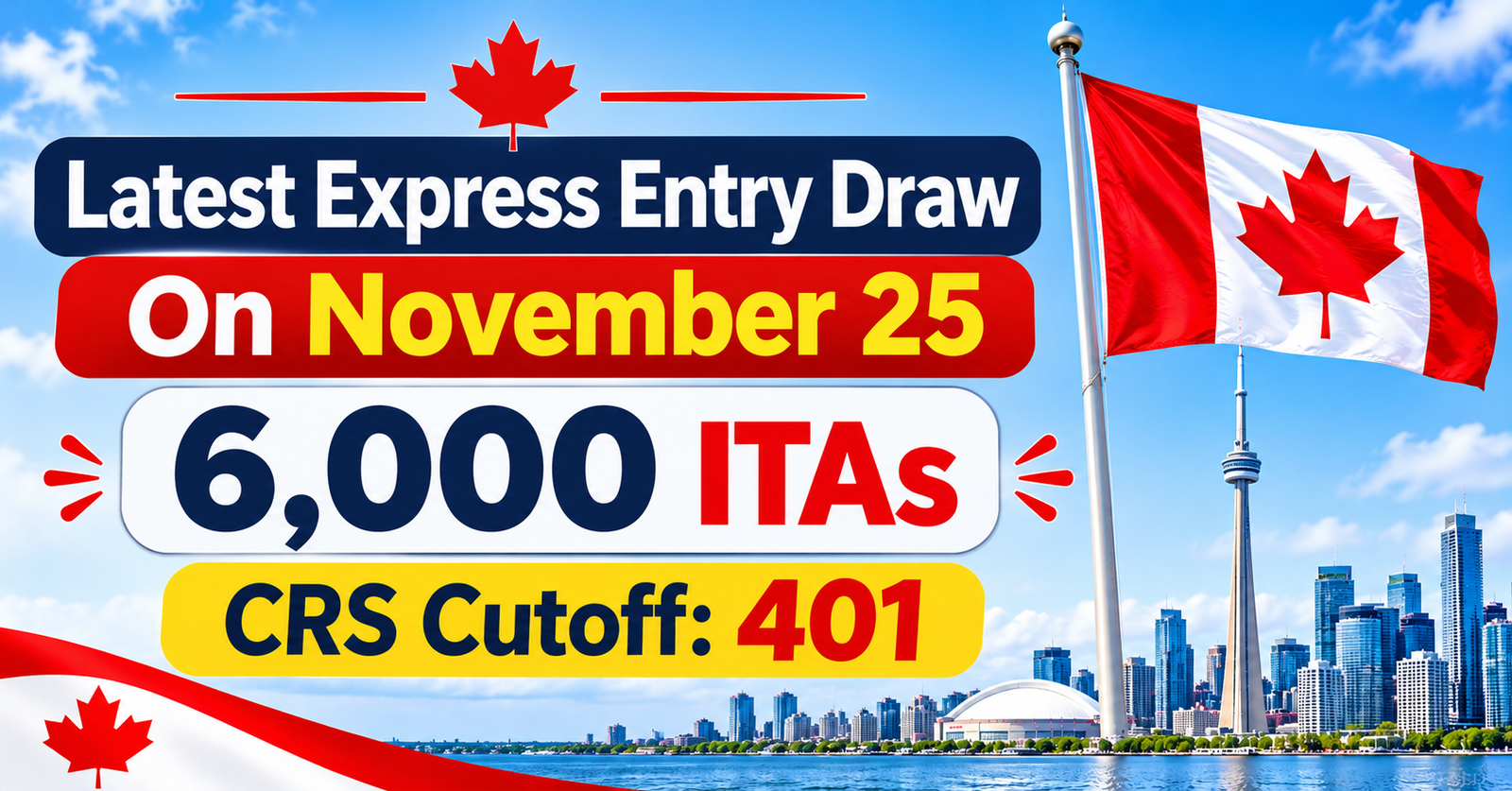
Canada’s latest Express Entry draw brought a significant opportunity for French-speaking immigration candidates. On November 25, 2026, Immigration, Refugees and Citizenship Canada (IRCC) issued 6,000 Invitations to Apply (ITAs) for permanent residence, selecting eligible candidates under the French-language proficiency category with a minimum Comprehensive Ranking System (CRS) score of 401.
This round stands out because the cutoff was lower and the invitation count higher than in the previous French-language draw. However, the result does not mean that every Express Entry candidate with 401 CRS points could receive an invitation. Applicants also had to meet the French-language category criteria and qualify for an eligible Express Entry program.
For candidates planning their next steps, the draw highlights the importance of language ability, accurate profile information and understanding which invitation categories apply to their circumstances.
Express Entry Draw On November 25, 2026: Key Results
IRCC conducted the latest round on November 25, selecting candidates who met the requirements for the French-language proficiency category. The round included candidates eligible under the Federal Skilled Worker Program, Canadian Experience Class and Federal Skilled Trades Program.
Here are the main details reported for this invitation round:
| Draw information | November 25 result |
|---|---|
| Draw date | November 25, 2026 |
| Selection category | French-language proficiency, 2026-Version 2 |
| Invitations issued | 6,000 |
| Lowest CRS score invited | 401 |
| Draw time | 14:01:50 UTC |
| Tie-breaking timestamp | September 12, 2026, at 21:59:55 UTC |
| Programs included | Federal Skilled Worker, Canadian Experience Class and Federal Skilled Trades |
The CRS score of 401 represents the lowest score invited in this particular round. It should not be treated as a general Express Entry cutoff because the selection was limited to candidates who met the French-language category requirements.
IRCC uses different types of invitation rounds throughout the year. Depending on the round, candidates may be selected through general, program-specific or category-based invitations.
Why The November 25 Express Entry Draw Matters
The latest round issued 1,000 more invitations than the previous French-language selection on October 27. That represents a 20% increase in invitation volume, while the CRS cutoff moved down from 407 to 401.
The change is relevant for eligible French-speaking candidates because a lower cutoff can bring more profiles within the selection range. However, it does not guarantee that future French-language draws will continue to have similar invitation numbers or CRS requirements.
The November 25 result also needs to be viewed alongside other recent Express Entry rounds. For example, the November 23 Provincial Nominee Program draw invited 1,999 candidates with a CRS cutoff of 673. Although that score was considerably higher, it is not a direct comparison because PNP candidates receive additional CRS points for a provincial or territorial nomination.
Comparison With Recent Express Entry Draws
| Draw date | Selection category | ITAs issued | CRS cutoff |
|---|---|---|---|
| November 25, 2026 | French-language proficiency | 6,000 | 401 |
| November 23, 2026 | Provincial Nominee Program | 1,999 | 673 |
| October 28, 2026 | Transport occupations | 150 | 477 |
| October 27, 2026 | French-language proficiency | 5,000 | 407 |
| October 16, 2026 | French-language proficiency | 5,000 | 435 |
| October 15, 2026 | Canadian Experience Class | 2,500 | 519 |
One important detail is the difference between a category-based draw and a program-specific draw. A French-language round focuses on candidates who meet the language category criteria, while a Canadian Experience Class or PNP round has its own eligibility conditions.
For that reason, candidates should compare their CRS score with previous rounds that match their eligibility rather than relying on the lowest score reported across all Express Entry categories.
Who Qualified For The French-Language Express Entry Draw?
The November 25 round was not limited to candidates working in a particular occupation. Instead, it focused on French-language ability.
To qualify for the French-language proficiency category, candidates needed to demonstrate a minimum level of NCLC 7 in all four language abilities:
- Speaking
- Listening
- Reading
- Writing
Meeting the language requirement was only one part of the eligibility process. Candidates also needed to qualify for one of the three immigration programs managed through Express Entry and satisfy the specific instructions for the invitation round.
This distinction is important. Someone may have strong French test results but still be ineligible if they do not qualify for an Express Entry program or fail to meet another requirement.
Which French Language Tests Does IRCC Accept?
IRCC accepts two French-language tests for Express Entry:
- TEF Canada – Test d’évaluation de français
- TCF Canada – Test de connaissance du français
Candidates must enter their test results accurately in their Express Entry profiles. They should also check that the results remain valid when submitting their permanent residence application.
Language test results generally need to be less than two years old both when the Express Entry profile is completed and when the permanent residence application is submitted.
Applicants should check the official IRCC language-test instructions before relying on a particular score or test result. A small data-entry mistake or an expired result can create problems during the application process.
French-Language Draws Do Not Require A Specific Occupation
One feature that makes the French-language category different from occupation-based selection is that it does not require candidates to have work experience in a designated occupation list.
For example, occupation-based categories may require qualifying work experience in specific fields. The French-language category instead focuses on the candidate’s French-language test results, alongside the general Express Entry program requirements.
This means eligible candidates from different professional backgrounds may be considered. Their occupation alone does not determine whether they qualify for this language category.
However, candidates should not assume that French proficiency automatically makes them eligible for permanent residence. They must first meet the requirements of an Express Entry-managed program and then satisfy the conditions of the specific draw.
What The CRS Cutoff Of 401 Means For Candidates
A CRS cutoff of 401 means that 401 was the minimum score among candidates invited in the November 25 round. It does not mean that every person with 401 points received an invitation.
IRCC ranks eligible candidates and invites the highest-ranked profiles according to the number of invitations available for that round. Category eligibility is also necessary in a category-based selection.
For candidates with a score above 401, the tie-breaking timestamp was not the deciding factor, provided they met the other requirements of the round. Candidates with exactly 401 points needed to have submitted their Express Entry profile before the specified tie-breaking date and time.
For candidates below 401, this result does not permanently remove them from consideration. They may still be eligible for future invitation rounds, depending on their profile, CRS score and the categories selected by IRCC.
There is no confirmed guarantee that the next French-language draw will have a lower cutoff or issue the same number of invitations.
Understanding The Tie-Breaking Rule
When multiple candidates have the same CRS score at the bottom of an invitation round, IRCC uses a tie-breaking rule to determine which profiles fall within the available invitations.
For the November 25 draw, the tie-breaking timestamp was:
September 12, 2026, at 21:59:55 UTC.
This timestamp is particularly relevant to candidates who had exactly 401 CRS points. Their profile submission date and time determined whether they were within the selection range when the tie-breaking rule applied.
Candidates with a score higher than 401 were not excluded simply because their profiles were submitted after this timestamp. The tie-break is used to separate candidates who share the lowest CRS score in the round.
Applicants should therefore keep a record of their profile submission details and check the exact invitation-round instructions rather than relying only on the CRS cutoff.
What Should You Do After Receiving An ITA?
Receiving an Invitation to Apply is an important step, but it is not the same as receiving permanent residence approval. Candidates must still submit a complete application and provide evidence supporting the information in their Express Entry profiles.
IRCC gives invited candidates 60 days to submit their permanent residence application. Waiting until the final days can create unnecessary pressure, particularly when documents need to be obtained from different countries or institutions.
After receiving an invitation, candidates should take the following steps:
- Review the invitation: Sign in to the IRCC account and confirm which Express Entry program the invitation relates to.
- Recheck the CRS information: Make sure the information used to calculate the score remains correct, including language results, work experience, education and other relevant details.
- Prepare supporting documents: Gather the documents requested in the personalized application checklist. These may include language test results, education records, employment evidence, police certificates and other supporting documents, depending on the applicant’s circumstances.
- Check language test validity: Confirm that the test results will still be valid when the permanent residence application is submitted.
- Review changes in personal circumstances: If employment, marital status, a provincial nomination or another relevant factor has changed, recalculate the CRS score and review how the change affects eligibility.
- Submit before the deadline: Complete the forms, upload the required documents, pay the applicable fees and submit the application within the 60-day period.
Candidates should never claim points they cannot support with valid documentation. If their circumstances have changed and their recalculated CRS score falls below the minimum required for the invitation round, they should carefully review IRCC’s instructions before submitting an application.
For a broader understanding of how different provincial and territorial selection systems can support a permanent residence strategy, read our guide on Canada’s Expression of Interest programs.
What Can Express Entry Candidates Expect Next?
The November 25 result shows that French-language proficiency remains an important selection route within Canada’s Express Entry system. The combination of 6,000 invitations and a 401 CRS cutoff created an opportunity for a substantial number of eligible French-speaking candidates.
However, applicants should avoid treating one draw as a prediction of the next round. IRCC decides the category, invitation number and selection criteria for each round. These details can change, and previous CRS cutoffs do not establish a guaranteed threshold for future invitations.
Candidates who are not yet eligible for the French-language category can review the requirements of other Express Entry pathways and assess whether improving their language results, education credentials or qualifying work experience could strengthen their profiles.
Those who already qualify for French-language selection should ensure that their test results are correctly entered, remain valid and meet the required NCLC level in every ability.
Applicants can also follow changes to the CRS system and related immigration rules. For additional background, read our coverage of Canada’s November 2026 Express Entry changes.
The most practical approach is to keep an Express Entry profile accurate and up to date, prepare supporting documents early and rely on official IRCC announcements when making immigration decisions.
Frequently Asked Questions
IRCC issued 6,000 Invitations to Apply for permanent residence in the November 25, 2026, Express Entry draw. The round targeted candidates who met the French-language proficiency category requirements.
The lowest CRS score invited was 401. Candidates also needed to meet the French-language category criteria and qualify under an eligible Express Entry program.
Candidates needed a minimum of NCLC 7 in speaking, listening, reading and writing. They also had to satisfy the other requirements of the applicable Express Entry program and invitation round.
Yes, a candidate below 401 may be invited in a future round if they meet that round’s requirements and their profile ranks within the available invitations. However, IRCC has not guaranteed a future cutoff or invitation schedule.
Invited candidates have 60 days to submit a complete permanent residence application. They should review their invitation, confirm their eligibility and prepare the documents listed in their IRCC account as early as possible.
Fact Check: The November 25, 2026, draw figures are based on the reported IRCC invitation-round results. French-language eligibility, accepted language tests, tie-breaking procedures and the 60-day application period were checked against official Government of Canada guidance reviewed on November 26, 2026.
Disclaimer: This article is for general informational purposes only and does not constitute legal or immigration advice. Immigration requirements and invitation-round criteria can change. Always verify the latest information through official IRCC sources or consult an authorized Canadian immigration professional about your individual circumstances.