

On June 4, 2025, Immigration, Refugees, and Citizenship Canada (IRCC) held its latest Express Entry draw—the second one this week. This round targeted candidates with at least six months of experience in 37 eligible healthcare and social services occupations. A total of 500 Invitations to Apply (ITAs) were issued, with a Comprehensive Ranking System (CRS) cutoff score of 504. This marks a 6-point drop compared to the similar category-based draw held on May 2, 2025. Despite the lower cutoff, the competition remains intense as Canada continues to address ongoing gaps in the healthcare workforce. Book Your Consultation for Canadian Immigration Earlier this week, on June 2, IRCC issued 277 ITAs under the Provincial Nominee Program (PNP) with a higher CRS cutoff of 726. Draw Details – June 4 and June 2, 2025 Details June 4 – Healthcare/Social Services June 2 – Provincial Nominee Program Number of Invitations 500 277 CRS Cutoff Score 504 726 Tie-breaking Rule March 31, 2025 – 06:47:23 UTC September 24, 2024 – 15:46:19 UTC Both draws reflect IRCC’s targeted immigration strategy under the 2025–2027 Immigration Levels Plan, which emphasizes quality over quantity in permanent resident admissions. With a reduced PR target of 395,000 for 2025, priority is being given to candidates with provincial nominations, Canadian work experience, and French-language skills. CRS Score Distribution – June 1 vs May 13 CRS Score Range June 1, 2025 May 13, 2025 Change 601–1200 274 28 +246 501–600 24,650 22,435 +2,215 451–500 75,330 73,741 +1,589 401–450 71,068 69,673 +1,395 351–400 53,714 53,684 +30 301–350 21,682 22,069 -387 0–300 8,312 8,452 -140 Total 255,030 250,082 +4,948 Key Observations: All Express Entry Draws in 2025 (YTD) Date Draw Type Invitations CRS Cutoff June 4 Healthcare & Social Services 500 504 June 2 Provincial Nominee Program 277 726 May 13 Canadian Experience Class 500 547 May 12 Provincial Nominee Program 511 706 May 2 Healthcare & Social Services 500 510 May 1 Education Occupations 1,000 479 April 28 Provincial Nominee Program 421 727 April 14 Provincial Nominee Program 825 764 March 21 French Language Proficiency 7,500 379 March 17 Provincial Nominee Program 536 736 March 6 French Language Proficiency 4,500 410 March 3 Provincial Nominee Program 725 667 Feb 19 French Language Proficiency 6,500 428 Feb 17 Provincial Nominee Program 646 750 Feb 5 Canadian Experience Class 4,000 521 Feb 4 Provincial Nominee Program 455 802 Jan 23 Canadian Experience Class 4,000 527 Jan 8 Canadian Experience Class 1,350 542 Jan 7 Provincial Nominee Program 471 793 Total ITAs in 2025 so far: 34,717 What’s Ahead for Express Entry? Analysts expect future draws may focus on: With no all-program draws in 2025 so far, candidates outside targeted categories may face challenges unless they enhance their profiles through work experience, education, or French proficiency. Is a CRS Score of 450 Competitive in 2025? Last Express Entry Draw The most recent draw was held on June 4, 2025, issuing 500 invitations under the healthcare and social services category with a CRS cutoff of 504. Before that, on June 2, 277 invitations went to PNP candidates with scores of 726 or higher. Tip: Visit the IRCC website to update your Express Entry profile and explore category-based opportunities aligned with Canada’s labour market priorities.

More French Express Entry Draws Expected to Boost Francophone PRs to 12%
Canada is ramping up its efforts to increase Francophone immigration outside Quebec, with a goal to raise French-speaking permanent resident admissions to 12% by 2029, up from the projected 8.5% in 2025. This ambitious direction was announced on June 2, 2025, by Lena Metlege Diab, the newly appointed Minister of Immigration, Refugees, and Citizenship. Her announcement marks a significant policy shift aimed at making Canada a more accessible destination for French-speaking skilled workers. Book Your Consultation for Canadian Immigration Strengthening Francophone Communities Across Canada During a session in the House of Commons, MP Guillaume Deschênes-Thériault underscored the importance of French-speaking immigrants in bolstering minority Francophone communities (FMCs) and contributing to the economy. Minister Diab responded by outlining Canada’s expanding targets for French-speaking immigration outside Quebec: 8.5% in 2025, followed by 9.5% in 2026, 10% in 2027, and reaching 12% by 2029. This initiative is part of a larger strategy to counter the ongoing decline of French-speaking populations outside Quebec, which dropped from 6.1% in 1971 to just 3.5% in 2021, according to Statistics Canada. Since 2003, Canada has welcomed over 132,000 French-speaking permanent residents outside Quebec. The government now seeks to accelerate this trend to revitalize FMCs both culturally and economically. Surge in French-Focused Express Entry Draws The Express Entry system is a critical part of Canada’s approach to supporting Francophone immigration. In 2025 alone, 18,500 Invitations to Apply (ITAs) have been issued through French-language draws—accounting for more than half of all Express Entry invitations so far this year. These draws also feature notably lower Comprehensive Ranking System (CRS) scores compared to other streams, making them particularly appealing for French-speaking candidates. Recent French-language Express Entry draws in 2025 include: In contrast, general draws have seen reduced activity—for instance, the June 2, 2025 PNP draw issued only 277 invitations, nearly half the typical size. As highlighted by Minister Diab, more French-targeted draws are expected throughout 2025, providing skilled French-speaking workers with a more streamlined path to permanent residence. Why Francophone Immigration Matters French-speaking communities outside Quebec are a vital aspect of Canada’s linguistic and cultural heritage. However, their numbers have steadily declined due to limited population growth, language shifts, and low international migration. The revised Official Languages Act calls for action to restore the proportion of Francophones outside Quebec to 6.1%, the level recorded in 1971. Francophone immigration is a cornerstone of this strategy. To meet these goals, Immigration, Refugees and Citizenship Canada (IRCC) has set phased targets for French-speaking admissions outside Quebec: These milestones follow a successful 2023, where Canada surpassed its goal of 4.4%, reaching 4.7% with over 19,600 French-speaking newcomers. Progress and Long-Term Immigration Goals Between 2003 and September 2024, Canada admitted around 132,195 French-speaking immigrants outside Quebec. In 2024, IRCC aimed for a 6% target and remains on track to meet it. The 2025–2027 Immigration Levels Plan lays out realistic yet optimistic targets, balancing ambition with sustainable growth. While organizations like the Fédération des communautés francophones et acadienne du Canada (FCFA) advocate for a faster pace (12% in 2024 and 20% by 2036), IRCC’s gradual strategy is intended to maintain integration capacity and support community infrastructure. Key Initiatives Supporting Francophone Immigration Several immigration streams and pilot programs have been developed to attract and retain French-speaking newcomers: 1. Express Entry (French Language Priority) This system gives preference to candidates proficient in French. From January to September 2024, more than 21,700 ITAs (26% of total) were issued to French-speaking applicants. In 2025, 18,500 ITAs have already been issued through French-focused draws. 2. Provincial Nominee Program (PNP) The PNP has significantly contributed to Francophone immigration in provinces like New Brunswick, Manitoba, and Nova Scotia. In 2023, 24% of French-speaking admissions outside Quebec came through this program. 3. Francophone Community Immigration Pilot Set to launch in late 2024, this initiative will provide French-speaking or bilingual applicants with a path to permanent residence in rural communities. It aims to address labor shortages while increasing the demographic weight of FMCs. 4. Francophone Student Pilot Program Launched in August 2024, this program works with French-language and bilingual colleges outside Quebec to support international students and their families. It offers a direct route to permanent residence after graduation. 5. Francophone Mobility Program Expanded in June 2023, this program allows Canadian employers to hire moderately French-proficient workers for most occupations (excluding some agricultural jobs). It offers a path to work experience and eventual permanent residency. Looking Ahead: A Promising Future for Francophone Immigration Although overall immigration targets have been moderated, the focus on French-speaking immigrants remains strong. IRCC’s measured increase in targets—from 8.5% in 2025 to 12% in 2029—demonstrates a long-term commitment to reinforcing Francophone communities outside Quebec. Through collaboration with provinces, academic institutions, and local organizations, Canada aims to support the growth of Francophone communities while meeting labor market demands. With favorable CRS cutoffs and dedicated programs, French-speaking skilled workers, students, and professionals are uniquely positioned to benefit from these changes. Provinces such as New Brunswick and Manitoba continue to lead the way in welcoming Francophones, enhancing their local economies and cultural diversity.

Canada Conducts First Express Entry Draw Under New Immigration Minister
Immigration, Refugees and Citizenship Canada (IRCC) Issues More Invitations to Apply (ITA) through Express Entry System IRCC has recently issued 277 Invitations to Apply (ITAs) to candidates in a Provincial Nominee Program (PNP) draw. Book Your Consultation for Canadian Immigration To be eligible for this draw, candidates had to meet the following criteria: Summary of 2025 Express Entry Draws Date Draw Type Number of ITAs Cut-off CRS score June 3 Provincial Nominee Program 277 726 May 13 Canadian Experience Class 500 547 May 12 Provincial Nominee Program 511 706 May 2 Healthcare and Social Services 500 510 May 1 Education 1,000 479 April 28 Provincial Nominee Program 421 727 April 14 Provincial Nominee Program 825 764 March 21 French Language Proficiency 7,500 379 March 17 Provincial Nominee Program 536 736 March 6 French Language Proficiency 4,500 410 March 3 Provincial Nominee Program 725 667 February 19 French Language Proficiency 6,500 428 February 17 Provincial Nominee Program 646 750 February 5 Canadian Experience Class 4,000 521 February 4 Provincial Nominee Program 455 802 January 23 Canadian Experience Class 4,000 527 January 8 Canadian Experience Class 1,350 542 January 7 Provincial Nominee Program 471 793 Today’s draw marks the first of June and follows a Canadian Experience Class (CEC) draw on May 13, a Provincial Nominee Program (PNP) draw on May 12, and two category-based selections (for healthcare and education). So far in 2025, IRCC has issued 34,717 ITAs through Express Entry. In 2025, the majority of Express Entry draws have targeted PNP candidates. The remaining ITAs have been issued to candidates in the Canadian Experience Class (CEC), those with French-language proficiency, and those in priority categories such as education, healthcare, and social services. Draw Type Number of Draws Provincial Nominee Program (PNP) 9 Canadian Experience Class (CEC) 4 French-language proficiency 3 Education 1 Healthcare and Social Services 1 Why Does Canada Use the Comprehensive Ranking System (CRS)? Canada uses the CRS to identify skilled workers most likely to thrive in the Canadian job market. The CRS is designed to benefit both Canada and its immigrants by selecting individuals who are expected to make significant contributions to Canada’s economy. The CRS uses a detailed, evidence-based scoring and ranking system based on decades of research into the labour market outcomes of immigrants. Studies have shown that newcomers who are younger, have strong work experience, solid education, and proficiency in English or French tend to integrate well into Canada’s workforce. Evidence supporting the CRS’s effectiveness includes a 2020 report by IRCC. The report examined the labour market performance of Express Entry immigrants since its inception in 2015. The findings highlighted that these immigrants enjoy high employment rates, strong earnings, and low unemployment—outcomes directly linked to the CRS’s targeted selection criteria.

June 2025: Overview of the Express Entry Pool
After a quieter April, Express Entry draws saw a significant increase in activity during May. In total, 2,511 Invitations to Apply (ITAs) were issued across four draws—more than double the number of ITAs given out in April. Book Your Consultation for Canadian Immigration This article covers the following: What Draws Took Place in May 2025? May was a busy month for Express Entry, with four draws taking place. Along with the usual draws, there were a couple of noteworthy changes: Here’s a summary of the ITAs issued and the CRS cut-off scores for each draw in May: Date of Draw Draw Type ITAs Issued CRS Cut-off Scores May 1, 2025 Education Occupations 1,000 479 May 2, 2025 Healthcare and Social Services 500 510 May 12, 2025 Provincial Nominee Program (PNP) 511 706 May 13, 2025 Canadian Experience Class (CEC) 500 547 While the total ITAs issued in May (2,511) is more than double that of April (1,246), it’s still lower than the numbers seen in January, February, and March 2025. Month ITAs Issued January 2025 5,821 February 2025 11,601 March 2025 13,261 April 2025 1,246 May 2025 2,511 The May draws also deviated from the alternating pattern seen in March and April, which focused heavily on French proficiency and Provincial Nominee Program (PNP) draws. Current Composition of the Express Entry Pool As of May 13, 2025, the Express Entry pool consists of 250,082 candidates. Below is a breakdown of candidates by CRS score range: CRS Score Range Number of Candidates 0-300 8,452 301-350 22,069 351-400 53,684 401-410 12,686 411-420 13,589 421-430 13,718 431-440 15,241 441-450 14,439 451-460 15,276 461-470 16,691 471-480 16,641 481-490 12,704 491-500 12,429 501-600 22,435 601-1200 28 Total 250,082 Notably, the number of candidates in the 601-1200 CRS range has dropped to just 28, while the 501-600 range has grown by more than 1,300 profiles since April 27. How Do Scores Rank in the Express Entry Pool? Below is a table detailing the distribution of CRS scores across percentiles in the pool, as of May 13, 2025: CRS Score Range Number of Candidates Percentile Range Percentage 0–300 8,452 0–3.38% 3.38% 301–350 22,069 3.38%–12.20% 8.82% 351–400 53,684 12.20%–33.67% 21.47% 401–410 12,686 33.67%–38.74% 5.07% 411–420 13,589 38.74%–44.18% 5.43% 421–430 13,718 44.18%–49.66% 5.49% 431–440 15,241 49.66%–55.76% 6.09% 441–450 14,439 55.76%–61.53% 5.77% 451–460 15,276 61.53%–67.64% 6.11% 461–470 16,691 67.64%–74.31% 6.67% 471–480 16,641 74.31%–80.97% 6.65% 481–490 12,704 80.97%–86.05% 5.08% 491–500 12,429 86.05%–91.02% 4.97% 501–600 22,435 91.02%–99.99% 8.97% 601–1200 28 99.99%–100% 0.01% The percentiles in the table were calculated based on the highest CRS score in each range. These percentiles represent the percentage of candidates with a score at or below that score. Summary May 2025 saw increased activity in Express Entry draws, with a total of 2,511 ITAs issued. The pool composition reflects some changes, with a noticeable increase in candidates in the 501-600 CRS range. While the draws of May were fewer than the numbers in early 2025, there was more diversity in the draw types, including targeted categories for education, healthcare, and social services. If you’re actively tracking your CRS score or looking to apply, now is a good time to assess your ranking in the pool and keep an eye on future draw patterns.
Do You Have the Right Language Proof for Canadian Citizenship?
Are you between 18 and 54 years old and applying for Canadian citizenship? Then providing language proficiency proof is a mandatory requirement. You must demonstrate that you can speak and listen at Canadian Language Benchmarks (CLB) Level 4 or higher in English or French. But how do you know if your documents meet the requirement? Why Language Proof Matters for Canadian Citizenship Language ability is one of the core eligibility requirements for becoming a Canadian citizen. It helps the government assess your ability to integrate into Canadian society, communicate effectively, and contribute actively to your community. Book Your Consultation for Canadian Immigration What Documents Are Accepted as Language Proof? To avoid application delays or rejection, you must include valid and readable language documents. Submitting: …can lead to your entire application being returned. Step 1: Did You Study in English or French? You may already have acceptable proof if you completed secondary or post-secondary education in English or French — inside or outside Canada. Accepted Education Documents: Important: Your documents must clearly show the language of instruction was English or French. If not, submit a certified English or French translation specifying the instruction language. What If You Didn’t Study in English or French? No problem. There are other ways to prove language proficiency for Canadian citizenship: Step 2: Do You Have a Valid Language Test Result? If you haven’t studied in English or French, you can meet the citizenship requirement by submitting an approved test score showing CLB Level 4 or higher in listening and speaking. Accepted English Language Tests 1. CELPIP – General 2. IELTS – General Training Note: IELTS Academic is NOT accepted. 3. PTE Core Accepted French Language Tests 1. TEF (Test d’évaluation de français) 2. TEFAQ 3. DALF (Diplôme approfondi de langue française) 4. DELF (Diplôme d’études en langue française) 5. TCF / TCFQ (Test de connaissance du français / pour le Québec) Step 3: Did You Complete LINC or CLIC Language Training? If you completed Language Instruction for Newcomers to Canada (LINC) or Cours de langue pour les immigrants au Canada (CLIC), you might already meet the language requirement for citizenship — if your CLB level was 4 or higher in speaking and listening. Here’s how to submit it based on when you completed the training: This is a widely accepted and recognized language proof by IRCC, especially for permanent residents who completed government-funded language programs in Canada. Step 4: Did You Complete a Provincial Language Program? If you completed a provincial language training program in British Columbia, Saskatchewan, Manitoba, Nova Scotia, Ontario, or Quebec, your certificate might be accepted as valid language proof for Canadian citizenship. The required documentation depends on the province and the program. British Columbia If you completed English Language Services for Adults (ELSA): Note: Only results from ELSA are accepted. Other language courses from different providers are not eligible. Saskatchewan If you completed the Canadian Language Benchmarks Placement Test (CLBPT) Level 4 or above: Manitoba Provide a copy of the Manitoba Canadian Language Benchmark Report from an Adult English as an Additional Language (EAL) program funded by the Manitoba government. Nova Scotia Submit a copy of the Proficiency in English in Nova Scotia (PENS) learner certificate. Ontario Submit a certificate from one of the following Adult Non-Credit Language Training Programs: Note: Certificates must: Quebec Submit a copy of your results from one of the following: Step 5: Do You Still Need to Provide Language Proof? Based on your answers to the previous steps, you may still need to get language proof to submit with your Canadian citizenship application. If you believe you can speak and understand English or French well enough for citizenship, the best option is to take an approved language test. Accepted Language Tests and Required Scores The Canadian government accepts results from the following language tests. You must meet or exceed the Canadian Language Benchmarks (CLB) Level 4 in both speaking and listening. Accepted English Language Tests Test Minimum Score (CLB 4+) CELPIP – General Test (CELPIP-G) or General LS Test (CELPIP-G LS) Score of 4 or higher (up to 12) in listening and speaking IELTS – General Training Speaking: 4.0 or higherListening: 4.5 or higher Pearson Test of English (PTE Core) Speaking: 42 or higherListening: 28 or higher Accepted French Language Tests Test Minimum Score (CLB/NCLC 4+) TEF (Test d’évaluation de français) B1 or higher (B2, C1, C2 also accepted) TEFAQ (Test d’évaluation du français adapté au Québec) B1 or higher in listening and speaking TCF (Test de connaissance du français) B1 or higher TCFQ (Test de connaissance du français pour le Québec) B1 or higher TEF IRN (Test d’évaluation de français pour l’intégration, la résidence et la nationalité) B1 or higher (this was previously known as TEF pour naturalisation) DALF (Diplôme approfondi de langue française) All levels accepted DELF (Diplôme d’études en langue française) B1 or higher Can’t Meet the Required Score? Get Free Language Training If your test results don’t meet the required scores, or you want to improve your skills before applying, consider taking language training. Free Language Training Options: These programs can help you achieve CLB 4 or higher and strengthen your future application for Canadian citizenship. What If Your Language Test Result Has Expired? Good news! Expired test results are still accepted for Canadian citizenship — as long as you include a copy of the original test result in your application. Lost Your Test Results? Contact your test provider (CELPIP, IELTS, TEF, etc.) and request: Didn’t Meet the Required Score? You still have options: Need Help With Language Proof or Your Canadian Citizenship Application? We’re here to help! Whether you’re unsure about your documents or need full support with your Canadian citizenship application, our experts can guide you every step of the way.

Canada Introduces New Work Permit Policy Effective May 2025
On May 27, 2025, Canada launched a transformative temporary public policy designed to simplify job transitions for temporary foreign workers (TFWs) already in the country. The new policy allows eligible TFWs to begin working in a new job or with a new employer while their work permit application is being processed. Introduced under section 25.2 of the Immigration and Refugee Protection Act (IRPA), this policy addresses labor shortages and enhances job flexibility, stability, and economic integration for foreign workers. Book Your Consultation for Canadian Immigration What’s Changed? Previously, TFWs had to wait for a new work permit to be fully approved before starting a new job—causing delays, unemployment, and financial stress. This new policy eliminates that waiting period. Now, eligible TFWs can start working in a new role or with a new employer immediately after applying for a new work permit and exemption. This measure replaces an earlier temporary policy introduced during the COVID-19 pandemic (May 6, 2020), offering a more robust and permanent solution for today’s labor market challenges. Why This Policy Matters Canada depends on TFWs to fill critical labor gaps in sectors like: However, outdated work permit restrictions tied workers to specific employers, making it hard to adapt to layoffs, workplace issues, or career advancement opportunities. Even changing roles with the same employer required a new permit. This new policy gives workers greater mobility and allows employers to quickly hire skilled talent already in Canada. Policy Goals Who Is Eligible? To qualify for the exemption, the worker must: Who Benefits? This policy helps: Key Exemptions Granted To enable immediate employment transitions, the policy waives: These exemptions apply until the IRCC makes a decision or the application is withdrawn. How the Policy Works – Step by Step This approach removes delays and helps workers stay employed while supporting business continuity. Potential Challenges While the policy is widely welcomed, there are some concerns: Some critics argue deeper reforms are needed, including more pathways to permanent residency and less dependency on TFWs in key industries.

Canada Reduces Indian Student Visas by 31% in 2025
Canada has long been a popular destination for Indian students seeking high-quality education and global opportunities. However, as of early 2025, the dream of studying in Canada has become more difficult for many. According to Immigration, Refugees and Citizenship Canada (IRCC), the number of study permits issued to Indian nationals dropped by 31% in the first quarter of 2025, falling from 44,295 in 2024 to just 30,640. This steep decline is attributed to Canada’s updated immigration policies, stricter financial requirements, and more stringent verification processes—changes that are reshaping the international student landscape. Book Your Consultation for Canadian Immigration Why Are Indian Student Visas Declining? The 31% drop in study permits for Indian students is part of a broader shift in Canada’s immigration policies. In the first quarter of 2025, Canada issued a total of 96,015 study permits, a significant decrease from 121,070 in the same period of 2024. This reduction aligns with Canada’s commitment to limit the number of temporary residents—including international students and workers—to 5% of its population by 2027. The goal is to alleviate pressure on housing, healthcare, and public services, which have been increasingly strained in recent years. Key Factors Driving the Decline Stricter Immigration Caps In 2025, Canada implemented a lower annual cap of 437,000 study permits, down from 485,000 in 2024. This cap is expected to remain in place through 2026, signaling a long-term strategy to limit the influx of international students. Indian students, who have historically made up a large portion of this group, are facing the brunt of these restrictions. Higher Financial Requirements Starting January 1, 2024, international students are required to show proof of at least CA$20,635 (approximately ₹12.7 lakh) in funds to cover living expenses—double the previous threshold of CA$10,000 (₹8 lakh). This increase has made it more difficult for many Indian students to meet the financial criteria for study permits. Enhanced Verification Processes A new verification system introduced in December 2023 requires Canadian institutions to authenticate every student’s letter of acceptance before issuing a study permit. While this measure is designed to reduce fraudulent applications, it has added extra steps to the application process, potentially deterring some applicants. Indian Students: Still the Largest Group, But Facing Greater Challenges Despite the visa drop, Indian students remain the largest group of international students in Canada. In 2023, they accounted for 278,045 study permits, making up nearly 41% of the total international student population. However, this number fell to 188,465 in 2024—a 32% decline even before the latest restrictions took effect. The combination of stricter caps, higher financial thresholds, and rigorous verification processes is making Canada a less accessible destination for Indian students, who have long viewed it as a gateway to high-quality education and potential permanent residency. The Bigger Picture: Canada’s Immigration Policy Overhaul Canada’s recent immigration policy changes reflect a broader goal of balancing economic growth with domestic sustainability. The decision to cap temporary residents at 5% of the population by 2027 is a key part of this strategy. While international students contribute significantly to Canada’s economy and diversity, the government is tightening controls to address public concerns about the pressure on resources like housing and healthcare. Canada plans to reduce the number of study permits issued, dropping from 516,275 in 2024 to 437,000 in 2025. Since Indian students represent the largest share, they will face the greatest impact from these changes. The Impact on Indian Students The drop in study permits has significant implications for Indian students and their families: 1. Increased Financial Burden The new requirement of CA$20,635 for living expenses, on top of tuition fees that range from CA$15,000 to CA$40,000 annually, makes studying in Canada much more expensive. For many Indian families, this represents a substantial financial investment. 2. Fewer Paths to Permanent Residency Historically, Canada’s International Student Program has been a key pathway to permanent residency, with options like the Post-Graduation Work Permit (PGWP) allowing students to stay and work after completing their studies. However, with fewer study permits being issued, this pathway to residency is becoming narrower, prompting students to explore other countries like Australia, the UK, or the US. 3. Heightened Competition With the reduced cap on study permits, competition for spots at Canadian institutions is intensifying. Students must meet higher standards for admission and visa approval, including proving financial stability and academic excellence. 4. Shift to Other Countries As Canada becomes less accessible, Indian students are increasingly turning to other study-abroad destinations. Countries like the US, despite its own visa challenges, and Germany, with its low-cost education, are gaining popularity. How Indian Students Can Navigate the New Rules For Indian students still hoping to study in Canada, proper preparation is crucial. Here are some tips to improve the chances of securing a study permit: 1. Plan Finances Early Start saving and gathering proof of funds well in advance. Ensure that you can show CA$20,635, in addition to tuition and travel expenses, through bank statements, fixed deposits, or education loans. 2. Choose Designated Learning Institutions (DLIs) Only Designated Learning Institutions (DLIs) are authorized to host international students and offer post-graduation work permits. Check that your chosen institution is on the IRCC’s approved list to avoid complications with your visa application. 3. Strengthen Your Application Submit a complete and accurate application, including a verified letter of acceptance, proof of funds, and a compelling Statement of Purpose (SOP) that outlines your academic goals and your intention to return to India. 4. Explore Alternative Destinations If Canada’s requirements seem difficult to meet, consider other countries with more flexible visa policies, such as Germany, Ireland, or New Zealand, which also offer high-quality education and post-study work opportunities. 5. Stay Updated on Policy Changes Immigration policies can change rapidly, so it’s essential to stay informed. Regularly check the IRCC website and consult with certified immigration consultants to ensure you’re up to date on the latest requirements. Global Study-Abroad Landscape Canada’s tightening immigration policies come at a time when competition for international students is intensifying worldwide. Countries like Australia

Alberta Conducts Two Draws, Invites Provincial Immigration Candidates
The Alberta Advantage Immigration Program (AAIP) has issued a total of 158 invitations to immigration candidates through two separate draws held on May 13 and May 15, 2025. Book Your Consultation for Canadian Immigration Summary of AAIP Draws: Draw Date Stream Number of Invitations Minimum Score May 15 Tourism and Hospitality Stream 33 72 May 13 Alberta Opportunity Stream 125 76 This marks the second round of invitations issued under the Tourism and Hospitality Stream in 2025. Introduced in 2024, this stream was designed to address ongoing labour shortages in Alberta’s tourism and hospitality sector and help employers retain skilled workers. To qualify, applicants must: The May 13 draw was the second general round held this year under the Alberta Opportunity Stream, which previously focused on occupations such as aviation and construction. 2025 Nomination Allocations and Current Statistics: Alberta has been allocated 4,875 nomination spaces for 2025. So far, 2,077 nominations have been issued. AAIP regularly updates its website with statistics for each stream, including the number of nomination spaces remaining and the number of Expressions of Interest (EOIs) in the candidate pool. As of the latest update: Stream 2025 Allocation Spaces Remaining EOIs in Pool Tourism and Hospitality Stream 245 122 5,755 Alberta Opportunity Stream 2,592 1,376 37,934 Candidates who receive an invitation may apply for a provincial nomination. If approved, they can then submit an application for Canadian permanent residence using the nomination.
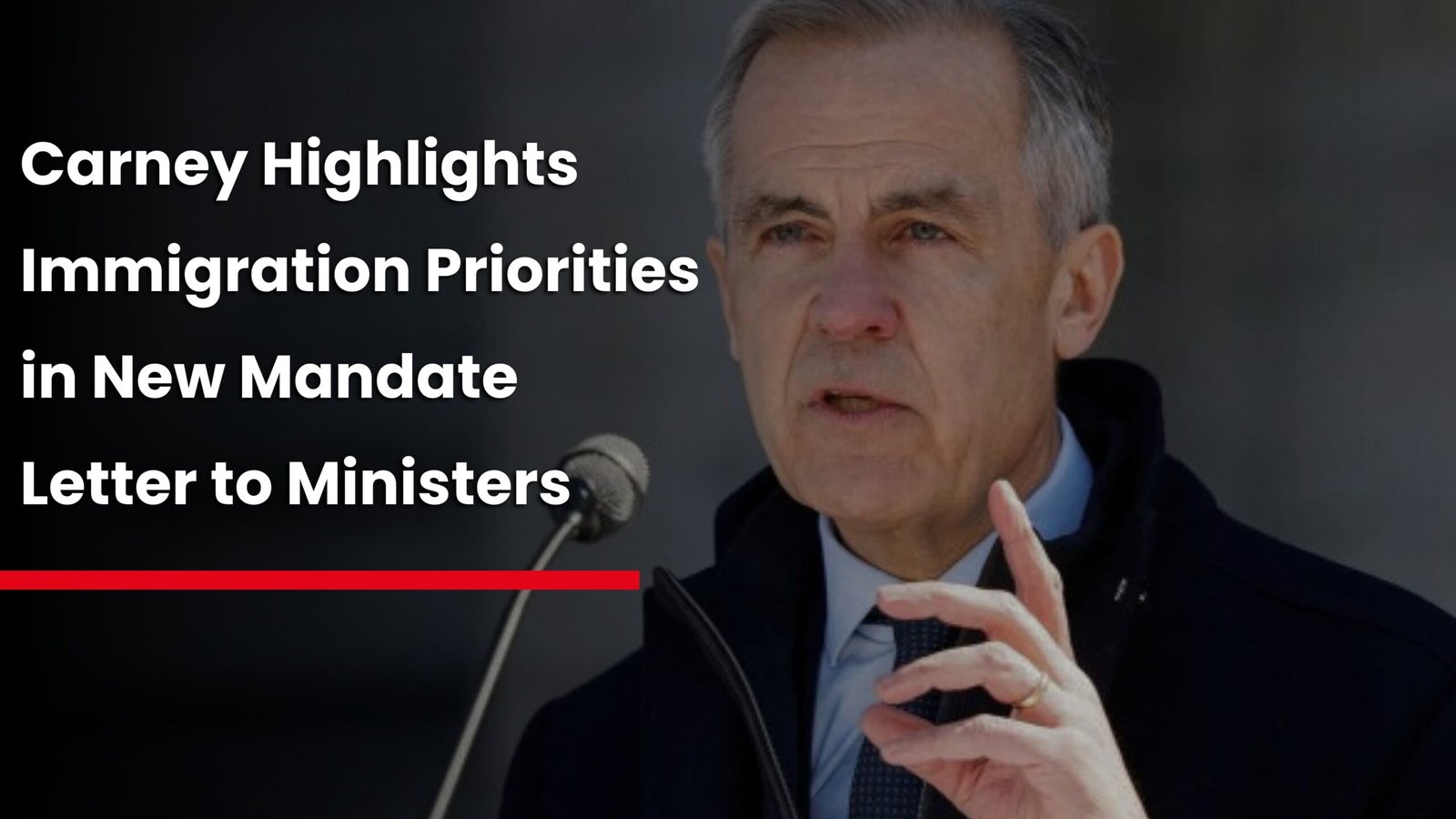
Carney Highlights Immigration Priorities in New Mandate Letter to Ministers
In a recent mandate letter to his cabinet, Prime Minister Mark Carney reaffirmed his overarching vision for Canada’s immigration system. The letter emphasized two primary goals: These objectives were presented as a unified directive and ranked among the top seven priorities for the federal cabinet. Book Your Consultation for Canadian Immigration Mandate Letters: Purpose and Context Mandate letters are official instructions from the prime minister to cabinet ministers, outlining government priorities, policy goals, and in some cases, specific implementation strategies. Traditionally, Canadian prime ministers have issued separate mandate letters to each minister. It remains uncertain whether Carney will continue this practice. Reducing Immigration to Sustainable Levels Carney’s mandate underscores the need to bring immigration levels down to what he describes as “sustainable.” During the election campaign, the Liberal Party acknowledged that immigration had increased to levels deemed unsustainable under the previous Liberal government, straining housing availability and public services. To address this, the party proposed to stabilize permanent resident admissions to under 1% of Canada’s population per year beyond 2027. With Canada’s population projected to reach 41.5 million in 2025, targets outlined in the 2025–2027 Immigration Levels Plan already fall below this threshold: Attracting Top International Talent In tandem with stabilizing immigration levels, the mandate letter also emphasizes attracting highly skilled individuals from around the world—a message that echoes campaign promises made by the Liberal Party. A key element of this strategy involves enhancing the Global Skills Strategy (GSS)—a federal program that expedites work permits for qualified foreign professionals. The GSS offers eligible Canadian employers faster processing times, typically within two weeks. The Liberals also pledged to: These steps aim to ensure smoother and quicker integration of foreign professionals into the Canadian labour market. Policy Continuity and Context Carney’s proposed immigration direction builds on the foundation laid by former Immigration Minister Marc Miller, during the final phase of Justin Trudeau’s administration. In response to rising concerns over housing affordability and service capacity, the Liberal government had already begun scaling back both temporary and permanent resident admissions.

List of PNP Provinces Supporting Open and Closed Work Permits in Canada
As of May 2025, several Canadian provinces and territories support work permit extensions for Provincial Nominee Program (PNP) candidates through a temporary public policy. This policy allows eligible foreign nationals to obtain open work permits (OWPs) valid for up to two years, facilitating continued employment while their permanent residency applications are processed. Book Your Consultation for Canadian Immigration Provinces and Territories Supporting Work Permit Extensions for PNP Candidates Eligibility Criteria for Open Work Permits To qualify for an open work permit under this policy, applicants must: Application Process Eligible candidates should: For more detailed information and to apply, please visit the official IRCC website: Open work permit for prospective Provincial Nominee Program candidates. Many Canadian provinces and territories offer Provincial Nominee Program (PNP) streams that support employer-specific (closed) work permits. These permits are typically tied to a specific employer and position, allowing nominees to work while their permanent residence applications are processed. Below is a list of PNPs that provide such support: Provincial Nominee Programs Offering Employer-Specific Work Permit Support 1. Ontario Immigrant Nominee Program (OINP) 2. British Columbia Provincial Nominee Program (BC PNP) 3. Alberta Advantage Immigration Program (AAIP) 4. Manitoba Provincial Nominee Program (MPNP) 5. Saskatchewan Immigrant Nominee Program (SINP) 6. Newfoundland and Labrador Provincial Nominee Program (NLPNP) 7. Nova Scotia Nominee Program (NSNP) 8. New Brunswick Provincial Nominee Program (NBPNP) 9. Prince Edward Island Provincial Nominee Program (PEI PNP) 10. Northwest Territories Nominee Program (NTNP) Important Notes •LMIA Exemption: Most PNPs provide a work permit support letter that allows nominees to apply for a closed work permit without the need for a Labour Market Impact Assessment (LMIA), under exemption code T13. •Employer Requirements: Employers must meet specific criteria set by the respective PNP, including being established and operating in the province or territory. •Application Process: After receiving a nomination and work permit support letter, applicants must apply to Immigration, Refugees and Citizenship Canada (IRCC) for the closed work permit. For detailed information on each PNP and their specific requirements, you can visit the official IRCC page on Provincial Nominee Programs: Immigrate as a provincial nominee. If you need assistance identifying the most suitable PNP stream based on your occupation, qualifications, and job offer, feel free to provide more details, and we can offer more tailored guidance.