
Immigration, Refugees and Citizenship Canada (IRCC) has invited more candidates to apply for permanent residency through the Express Entry system. In the latest round, 2,500 Invitations to Apply (ITAs) were issued to candidates under the Healthcare and Social Services occupation category. To qualify for this draw, candidates needed: This marks the fifth draw of the month and the second one this week. Since May 2025, IRCC has been conducting one draw per month specifically for Healthcare and Social Services occupations. Before that, no draws were held in this category this year, showing a clear shift toward prioritizing professionals in these fields. Details of the August 19, 2025, Express Entry Draw The key details for the latest draw are: Tie-breaking Rule: April 23, 2025, at 20:08:53 UTCProgram: Healthcare and social services occupations (Version 2)Date & Time: August 19, 2025CRS Score (Lowest Ranked Candidate): 470Total Invitations Issued: 2,500 This category-based selection comes after three other draws earlier this month: a Provincial Nominee Program (PNP) draw on August 18, a French language proficiency draw on August 8, and a Canadian Experience Class (CEC) draw on August 7. So far in 2025, IRCC has issued a total of 55,820 ITAs through Express Entry. Summary of Express Entry draws in 2025 What Happens After Receiving an ITA? After receiving an ITA, candidates must submit a complete application within 60 days, including required documents like police certificates, medical exams, and proof of funds. Key Steps to Complete the Process: What is the Express Entry System? The Express Entry system is Canada’s main immigration pathway for skilled workers seeking permanent residency. Launched in 2015, it manages applications for three key economic immigration programs: Conclusion: The latest draw highlights Canada’s growing focus on healthcare and social services professionals, reflecting the country’s ongoing need for skilled workers in these essential sectors. With over 55,000 ITAs already issued this year, Express Entry continues to be a key pathway for candidates aiming to build their future in Canada.

Latest MPNP Draw: 276 PR Invitations Announced | 27 Dec 2024
On December 27, 2024, the Manitoba Provincial Nominee Program (MPNP) held its most recent draw, sending 276 invites for permanent residency across many streams. Candidates with valid Express Entry profile numbers were invited to 56 of these. The specifics of this draw are broken down as follows: Skilled Worker in Manitoba Stream All eligible profiles under the Skilled Worker in Manitoba category were considered. Occupation-Specific Selection This round also focused on specific occupations, targeting candidates currently employed in Manitoba within designated National Occupational Classification (NOC) 2021 unit groups. 1. Selected NOC Groups Candidates employed in the following professions received invitations: 2. Restaurant and Food Service Managers Candidates working as restaurant and food service managers in Manitoba were also targeted. This draw reflects Manitoba’s ongoing efforts to prioritize skilled workers in key occupations, ensuring the province’s labor market needs are effectively met. Previous MPNP Draws
Latest OINP News: Ontario PNP Achieves 2024 Nomination Target
By December 23, 2024, the Ontario Immigrant Nominee Program (OINP) successfully met its annual nomination target for permanent residency. The Federal Government assigned 21,500 nominations to the OINP for 2024 across various streams. On December 23, the Ontario Immigrant Nominee Program (OINP) announced that all 21,500 nomination slots for 2024 have been allocated. According to the update, new applications and those already submitted will now be considered under the program’s 2025 nomination allocation. Eligible candidates can submit an Expression of Interest (EOI) for one of OINP’s five main streams. Each profile is assigned a score, and draws are conducted to establish the cut-off score for issuing Invitations to Apply (ITA). Additionally, the OINP selects Express Entry profiles by sending Notifications of Interest (NOIs) to candidates with competitive Comprehensive Ranking System (CRS) scores under three specific streams. Comprehensive Overview of OINP Draws in 2024 What Awaits from OINP in 2025 Due to the federal government’s revised immigration levels plan, a significant decrease in invitations from the Ontario Immigrant Nominee Program (OINP) is anticipated for 2025. The Canadian government has lowered the overall annual target for provincial nominee programs (PNPs) by approximately 54%, from 110,000 in 2024 to 55,000 in 2025. Of the 2024 PNP quota, Ontario received 21,500 nominations, accounting for 19.54% of the total allocation. Applying the same proportion, Ontario’s nomination quota for 2025 is projected to shrink significantly to approximately 10,747. This figure is comparable to the 2022 nomination allocation of 9,750, suggesting that OINP will likely issue fewer invitations in 2025 compared to 2024. In 2022, OINP distributed the following invitations to apply and notifications of interest across its streams: As a result, potential applicants can expect heightened competition for nominations in 2025. Express Entry Notifications of Interest Issued in 2022 Stream Invitations Human Capital Priorities stream 4,012 French-Speaking Skilled Worker stream 1,539 Skilled Trades stream 7,506 If you’re considering applying to the OINP, be prepared for a significant decrease in the number of invitations, which will likely lead to higher cut-off scores.
No LMIA Points for Express Entry in Spring 2025
Immigration, Refugees, and Citizenship Canada (IRCC) has shared more details about its plan to eliminate points for job offers in the Express Entry system. In a recent announcement, IRCC confirmed that this change will take effect in the spring of 2025. Currently, candidates in the Express Entry pool can earn an additional 50 or 200 Comprehensive Ranking System (CRS) points for having a valid job offer. These extra points often play a crucial role in determining whether a candidate receives an Invitation to Apply (ITA) for permanent residence. The department also clarified that removing points for job offers is intended as a “temporary measure.” However, no specific timeline has been provided for this measure’s end. Who Will Be Affected? Once the change to remove CRS points for job offers takes effect, it will impact all current and future candidates in the Express Entry pool, including those already working temporarily in Canada. IRCC’s announcement did not make a distinction between job offers in different sectors, stating that the change will apply to all candidates with a job offer. However, this change will not affect those who: *Note: In the Express Entry system, there is a difference between “candidates” and “applicants.” A newcomer is a candidate when they submit a profile to the Express Entry pool. Once they receive an ITA based on their profile, they can apply for PR. After submitting their application to IRCC, they become an applicant. Official statement On December 17, Immigration Minister Marc Miller announced that Express Entry candidates applying for Canadian permanent residence would no longer earn extra points in the Comprehensive Ranking System (CRS) for holding a job offer supported by a Labour Market Impact Assessment (LMIA). Currently, candidates in the Express Entry pool can gain an additional 50 or 200 CRS points if they have a valid job offer. However, Miller did not specify a timeline or provide further details on how the change would be implemented, nor did he clarify which candidates would be affected. What is the Reason for This Change? The LMIA process, which is meant to evaluate the necessity of hiring foreign workers when qualified Canadians are unavailable, has been exploited by dishonest individuals. Offering extra Express Entry points for LMIA-supported job offers unintentionally created an opportunity for fraud, as some people began illegally buying or selling LMIAs to increase their chances of receiving an Invitation to Apply (ITA) for permanent residency. Minister Marc Miller stressed that removing LMIA points would help reduce fraud and promote fairness and transparency in the immigration system. “Immigration is vital to our country’s economic growth and success,” Miller said. “These changes are part of our commitment to maintaining a fair, responsive, and well-managed immigration system.” Flagpoling for Work and Study Permits Ends December 23, 2024 In a major change, the Canadian government has announced the termination of “flagpoling” for obtaining or renewing work and study permits. Starting December 23, 2024, at 11:59 PM ET, individuals will no longer be able to use the method of temporarily leaving and re-entering Canada at ports of entry to access immigration services. What is the Reason for Its Discontinuation? The Canadian Border Services Agency (CBSA) processed more than 69,300 flagpoling requests between April 1, 2023, and March 31, 2024. Most of these requests were concentrated in high-traffic areas such as Southern Ontario, Quebec, and the Pacific region. The government has stated that flagpoling diverted valuable resources from essential border enforcement tasks and caused delays for other travelers crossing the border. By discontinuing this practice, Canada aims to: Main Points to Remember As Canada continues to update its immigration policies, these changes focus on ensuring transparency, fairness, and security in welcoming newcomers.

How does removing LMIA job offer points affect Express Entry?
On December 17, Immigration Minister Marc Miller announced that Express Entry candidates will no longer receive additional points for job offers supported by a Labour Market Impact Assessment (LMIA). Previously, candidates with valid job offers could gain an extra 50 or 200 points in the Comprehensive Ranking System (CRS), giving them a significant advantage. A higher CRS score increases the likelihood of receiving an Invitation to Apply (ITA) for permanent residency through Express Entry. While Minister Miller confirmed removing these job offer points, further details about changes to the CRS scoring system have not yet been provided. It remains unclear how the CRS will function once these changes take effect. Can I still earn CRS points for having arranged employment? Before the recent changes, Canada’s Express Entry system awarded extra points for arranged employment. This applied to candidates under the Federal Skilled Worker Program (FSWP), Canadian Experience Class (CEC), and Federal Skilled Trades Program (FSTP). To earn these points, candidates needed a valid job offer from a Canadian employer. A “valid job offer” had to meet specific requirements, including three possible scenarios, two of which involved LMIA-based jobs. Immigration Minister Marc Miller announced that Immigration, Refugees and Citizenship Canada (IRCC) will no longer award additional points for job offers. While he did not specify an exact date, Miller stated that the changes would be implemented “as quickly as possible.” It remains unclear whether current Express Entry candidates can still benefit from these points before the changes are enforced or if IRCC will pause non-PNP Express Entry draws until the new system is in place. How will removing CRS points for job offers impact Express Entry? Once this change is implemented, candidates with valid job offers will see their CRS scores decrease, reducing their likelihood of receiving Invitations to Apply (ITAs) through Express Entry. Conversely, candidates without valid job offers may see their chances improve, as the scores of those with job offers will drop. For instance, consider two hypothetical candidates, Aisha and Daniel. Aisha has a valid job offer in NOC 1, while Daniel does not. Before the change, their scores might look like this: After the change, Aisha’s score would drop to 480, while Daniel’s score would remain at 490. As a result, Daniel would have a better chance of receiving an ITA than Aisha. Additionally, we can expect CRS cut-off scores for Express Entry draws to decrease, as candidates with job offers will no longer benefit from the extra points. How can I boost my CRS score? Here are some ways to increase your CRS score:

Top 10 Occupations with High Vacancy Rates in Canada
As job openings in Canada steadily decrease, aspiring immigrants and job seekers must concentrate on industries showing positive growth trends. According to Statistics Canada’s report on December 16, there were 546,100 unfilled positions by the end of Q3 2024. This marks the ninth consecutive quarter of decline from the peak of 983,600 job vacancies recorded in the second quarter of 2022. This ongoing shift underscores the importance of targeting high-demand occupations, which present better opportunities for individuals seeking Canadian permanent residency or employment. Aligning your skills with these in-demand roles can significantly enhance your chances of success. Understanding Canada’s Job Market As of December 16, job vacancies in the third quarter of 2024 declined across both permanent (-27,800; -5.9%) and temporary (-4,100; -4.0%) positions. These decreases affected both full-time jobs (-19,300; -4.5%) and part-time roles (-12,600; -8.5%). The unemployment-to-job vacancy ratio rose to 2.6, indicating that there are now 2.6 unemployed individuals for every available job, compared to a ratio of 2 in the first quarter of 2024. Notably, four of the ten major occupational categories experienced significant drops in job vacancies: Despite these declines, some industries have shown notable growth in job opportunities, offering hope for job seekers and immigrants. Top 10 Occupations in Canada With Highest Job Vacancies Occupation Job Vacancies At The End Of the Third quarter of 2024 Average offered hourly wage ($) Food counter attendants, kitchen helpers and related support occupations [65201] 30,130 $16.85 Registered nurses and registered psychiatric nurses [31301] 23,905 $35.40 Retail salespersons and visual merchandisers [64100] 19,970 $17.55 Nurse aides, orderlies and patient service associates [33102] 17,170 $24.15 Cooks [63200] 13,820 $19.10 Transport truck drivers [73300] 13,170 $27.10 Construction trades helpers and labourers [75110] 12,285 $23.45 Social and community service workers [42201] 10,860 $24.80 Licensed practical nurses [32101] 10,615 $30.05 Food and beverage servers [65200] 9,575 $16.00 Top 10 Occupations With Highest Job Vacancies For those planning to immigrate to Canada or explore new job opportunities, targeting occupations with growing demand can greatly improve career prospects. Consider focusing on industries such as logistics, engineering, finance, healthcare, and education to increase your chances of securing rewarding employment. The 10 Jobs with the Highest Yearly Growth in Vacancies Occupation average offered hourly wage ($) Job Vacancies At The End Of the Third quarter of 2024 Job Vacancies At The End Of Third Quarter of 2023 Percentage Change (Year-on-Year) Firefighters $37.65 1,170 605 93.4% Instructors of persons with disabilities $26.65 1,170 670 74.6% Production and transportation logistics coordinators $29.50 915 530 72.6% Banking, insurance and other financial clerks $24.45 1,475 940 56.9% Dental assistants and dental laboratory assistants $29.00 1,655 1,145 44.5% Medical radiation technologists $34.90 1,450 1,045 38.8% Civil engineers $44.90 2,590 1,875 38.1% Shippers and receivers $19.85 4,365 3,335 30.9% Retail sales supervisors $19.55 3,525 3,000 17.5% The 10 occupations with the largest annual increases in vacancies What is the unemployment rate in Canada? As of November 2024, Canada’s unemployment rate stands at 6.8%. Which province in Canada has the highest unemployment rate? Newfoundland and Labrador has the highest unemployment rate in the country at 10.8%, followed by Prince Edward Island (8%), Ontario (7.6%), Alberta (7.5%), and New Brunswick (6.9%). Which province in Canada has the lowest unemployment rate? Saskatchewan has the lowest unemployment rate in Canada at 5.6% as of November 2024. It is closely followed by British Columbia (5.7%), Manitoba (5.8%), Quebec (5.9%), and Nova Scotia (6.1%).

The 2025 International Experience Canada (IEC) season is now open
The 2025 International Experience Canada (IEC) season has started, with pools open to eligible candidates from December 16, 2024. If you want to work and explore Canada, now is the time to apply! Candidates can create their profiles online and prepare for the first round of invitations, which will be sent out on January 13, 2025. It’s important to apply early to increase your chances, as Canada plans to reduce the number of IEC spots in 2025. What is International Experience Canada (IEC)? International Experience Canada (IEC) is a program that offers young people from partner countries the opportunity to work and explore Canada. The program has three main categories: Working HolidayThis option is ideal for those who want the freedom to work with any employer in Canada. Participants receive an open work permit, allowing them to change jobs and locations throughout their time in Canada. Young ProfessionalsThis program is designed for those looking to gain valuable professional experience in Canada. To apply, you must have a job offer from a Canadian employer. It provides an employer-specific work permit, meaning you’ll work for the same employer at a set location. International Co-opThis category is for international students who need to complete an internship or work placement in Canada as part of their academic program. Participation is limited to work placements that are required for the student’s studies. What’s Changing for IEC 2025? The 2025 IEC season introduces several changes, including updates to program fees and quotas. Here’s a closer look at the key updates: Increased IEC FeeThe IEC fee has increased to CAD $179.75, up from CAD $172 in 2024. Quotas and Allocation ChangesAlthough full quotas and timelines for all countries haven’t been fully announced, here are some key updates based on available information: Why Should You Apply Early for IEC 2025? Submitting your profile early boosts your chances of getting an invitation. Invitations are sent through a random lottery system, and applying early ensures your profile is included in multiple invitation rounds. The first round will begin the week of January 13, 2025, for certain countries. How to Prepare for IEC 2025 If you’re planning to join IEC 2025, follow these steps to get ready: Check Your EligibilityMake sure you qualify for one of the three IEC programs. Use free online tools or visit the IRCC website to review the eligibility requirements. Create Your IEC ProfileLog in to your IRCC account and create a new profile. If you’ve participated in past IEC seasons, you’ll need to create a fresh profile for 2025. Submit Your ProfileOnce your profile is complete, submit it to the IEC pools. Submitting early increases your chances of being considered in all invitation rounds. Prepare for the Work Permit ApplicationIf you receive an invitation, you must respond quickly. You’ll have 10 days to accept or decline the invitation, and once accepted, you’ll have 20 days to submit your work permit application. Stay InformedKeep an eye on updates from IRCC regarding quotas and invitation rounds so you can adjust your plans accordingly. How IEC Works The IEC process is simple but requires attention to detail. Here’s how it works: Submit a ProfileCreate and submit your profile through your IRCC account. Double-check that all the details are accurate and complete. Receive an InvitationInvitations are sent out weekly through a randomized lottery. Applying early increases your chances of being selected. Submit a Work Permit ApplicationOnce you receive an invitation, accept it within 10 days. Then, submit your work permit application within the next 20 days. Eligible Countries for Working Holiday Visas (IEC 2025) Andorra Australia Croatia Czech Republic Denmark Estonia Finland Germany Greece Iceland Ireland Italy Korea Republic Luxembourg Netherlands New Zealand Norway Poland Portugal San Marino Slovenia Spain Sweden United Kingdom Austria Belgium Chile Costa Rica France Hong Kong Japan Latvia Lithuania Slovakia Taiwan List of countries eligible for working holiday visa What is the processing time for International Experience Canada The average processing time for most International Experience Canada work permits is around 6 weeks, with 80% of applications processed within this period.

Marc Miller Announces 3 Recent Updates to Canada Immigration Policy
On December 17, 2024, Canada’s Immigration Minister, Marc Miller, announced major changes to Canada’s immigration system. These updates aim to make the process fairer, more secure, and more efficient while tackling important issues like border challenges and immigration fraud. Here’s a simple breakdown of the announcements and what they mean. 1. Ending ‘Flagpoling’ for a Smoother Process The government has decided to stop ‘flagpoling, ‘ in which temporary residents leave Canada and re-enter through a border crossing to get faster immigration services. Minister Miller explained that this practice causes delays at the border, disrupts traffic, and uses up resources meant for enforcement. From now on, temporary residents must apply online to extend their stay in Canada. This will free border officers to focus on important tasks and improve efficiency. 2. Tougher Rules to Protect Immigration Documents To prevent fraud and security risks, changes to immigration laws are being proposed. These changes will allow Immigration, Refugees and Citizenship Canada (IRCC) to: This will help ensure that Canada’s immigration system remains secure and fair. 3. Changing Express Entry to Stop LMIA Fraud In the Express Entry system, extra points for having a job offer backed by a Labour Market Impact Assessment (LMIA) will be removed. This change will: The government announced this update to reduce fraud and maintain the integrity of Express Entry. Tackling Border Issues and Irregular Migration Canada is also working on reducing irregular migration by strengthening the Safe Third Country Agreement (STCA). This agreement requires asylum seekers to claim refugee status in the first safe country they enter, whether Canada or the U.S. Key results so far: Canada is also partnering with the U.S. to share information, improve border security, and stop organized crime. New Rules for Emergencies and Fraud The government is introducing laws to handle big cases of fraud or emergencies. These changes will let IRCC quickly cancel or pause applications when needed. This will protect the immigration system from being misused and ensure it stays strong. Results So Far Here are some of the successes from these efforts: A Warning to Asylum Seekers Marc Miller urged people not to attempt crossing the border illegally, especially during winter. It is dangerous and will likely make their asylum claims invalid. Canada wants to help those in need but also ensure its borders are secure. What’s Next? These changes are a big step toward modernizing Canada’s immigration system. By improving border security, stopping fraud, and simplifying processes, the government is creating a fairer and more efficient system. These updates will also strengthen Canada’s relationship with the U.S. and other countries while keeping Canada a welcoming and secure destination for newcomers.
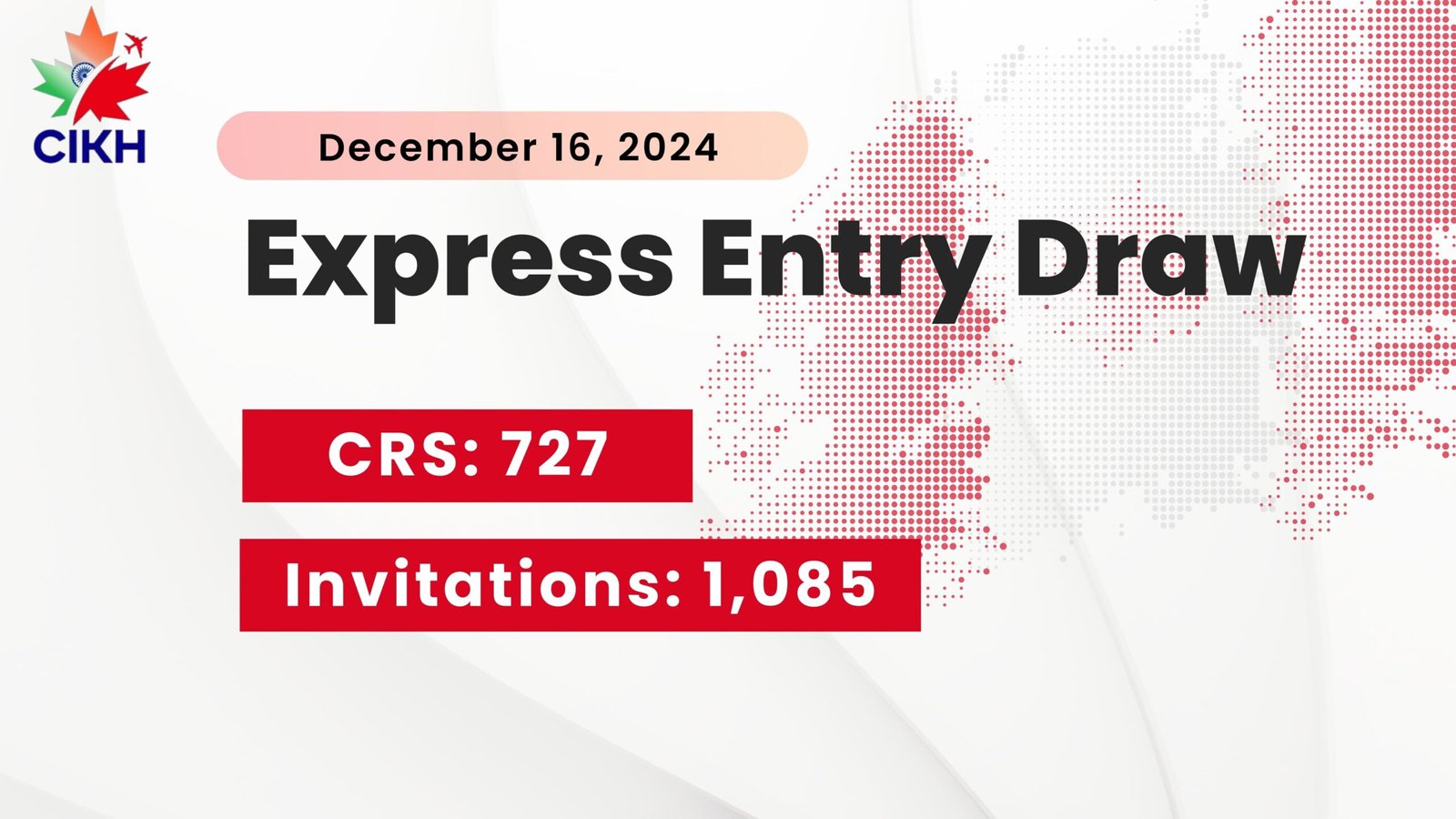
1,085 PNP Candidates Invited in Dec 16 Express Entry Draw
Immigration, Refugees, and Citizenship Canada (IRCC) held its first Express Entry draw of the week, inviting 1,085 candidates through the Provincial Nominee Program (PNP). To qualify, candidates needed a minimum Comprehensive Ranking System (CRS) score of 727. This marks the third Express Entry draw in December. Earlier draws this month included: In November, IRCC conducted six Express Entry draws, issuing 5,507 Invitations to Apply (ITAs) for permanent residency. Looking Ahead to 2025 This trend is expected to align with Canada’s Immigration Levels Plan 2025-2027. The newly introduced “In-Canada” focus category will prioritize candidates from: By 2025, the “In-Canada” category will account for 82,980 permanent resident admissions, representing over 40% of Canada’s planned annual admissions. Full Details of the Express Entry Draw: December 16, 2024 Provincial Nominee ProgramDate and Time: December 16, 2024CRS Score of Lowest-Ranked Candidate Invited: 727Number of Invitations Issued: 1,085Rank Needed: 1,085 or aboveTie-Breaking Rule: September 18, 2024, at 13:39:10 UT Summary of Express Entry Draws in 2024

Work permit holders can study in Canada without a study permit, says IRCC
Certain work permit holders in Canada can continue their studies without obtaining a study permit. On December 6, Immigration, Refugees, and Citizenship Canada (IRCC) updated its guidelines to confirm that individuals who applied for a work permit before June 7, 2023, are allowed to study without needing a separate license. This measure extends the temporary policy introduced in 2023, which will remain in effect until June 27, 2026. Can I study in Canada without a study permit? To qualify for a study permit exemption as a work permit holder under this policy, you must meet one of the following conditions: If you applied for a work permit after June 7, 2023, you are not eligible under this policy. *IRCC issues work authorizations to certain individuals while their applications are under review. These letters allow the holder to work in Canada while waiting for a decision on their application. If you applied for an extension before your current work permit expired, you may continue working under-maintained status while waiting for IRCC’s decision. For those holding both a valid study permit and a co-op work permit that aligns with the above conditions, you may be eligible to take additional study programs under this policy if: How long can work permit holders study in Canada without needing a study permit? If you qualify for the study permit exemption under this temporary public policy, you can study in Canada without a study permit until one of the following occurs: How do I prove study permit exemption to my school? As a work permit holder or applicant for a work permit extension, you can provide one of the following documents to your Designated Learning Institution (DLI) to prove your study permit exemption: The advantages of pursuing further education in Canada Continuing your education in Canada as a newcomer offers numerous economic and immigration advantages. According to research by Statistics Canada, newcomers who gain Canadian study experience before obtaining permanent residence (PR) have a significantly better performance in the Canadian job market compared to those without this experience. The study, titled “International students as a source of labour supply,” shows that in the first 1-2 years after receiving PR, individuals who graduated from Canadian institutions earned 27% more than those who studied abroad. These benefits continue long-term. Ten to eleven years after arriving in Canada, newcomers with at least one year of pre-landing work experience earned 9-12% more than those without, even after considering pre-landing work experience. Furthering your education in Canada can also improve your chances of qualifying for PR. In immigration programs like Express Entry, the Comprehensive Ranking System (CRS) awards points based on human capital factors, including education. Higher education levels result in more CRS points, increasing the chances of receiving an invitation to apply for PR. If you do not have an accompanying spouse or partner, you can earn up to 150 CRS points, and up to 140 points if you do have a spouse or partner. Level of Education Points awarded with a spouse or common-law partner(Maximum 140 points) Points awarded without a spouse or common-law partner(Maximum 150 points) Less than secondary school (high school) 0 0 Secondary diploma (high school graduation) 28 30 One-year degree, diploma or certificate from a university, college, trade or technical school, or other institute 84 90 Two-year program at a university, college, trade or technical school, or other institute 91 98 Bachelor’s degree OR a three or more year program at a university, college, trade or technical school, or other institute 112 120 Two or more certificates, diplomas, or degrees. One must be for a program of three or more years 119 128 Master’s degree, OR professional degree needed to practice in a licensed profession (For “professional degree,” the degree program must have been in: medicine, veterinary medicine, dentistry, optometry, law, chiropractic medicine, or pharmacy.) 126 135 Doctoral level university degree (Ph.D.) 140 150 Additionally, the CRS offers: Beyond boosting your CRS score, pursuing education in Canada can also make you eligible for provincial immigration pathways that are specifically aimed at international graduates from those provinces. Many of these provincial programs also provide points for work experience and arranged employment within the province. Some examples of these programs include: Provincial pathway Provincial pathway Employer Job Offer: International Student stream Ontario Master’s Graduate stream Ontario PhD Graduate stream Ontario International Graduate stream British Columbia International Post-Graduate stream British Columbia Graduate Entrepreneur stream Alberta International Education Stream Manitoba International GraduateEntrepreneur stream Nova Scotia International Graduates in Demand stream Nova Scotia New Brunswick Student Connection New Brunswick