

In April 2024, Immigration Minister Marc Miller revealed plans to raise the limit on off-campus work hours for international students to 24 hours per week starting this fall. Key details have yet to be disclosed, leaving students, educational institutions, and employers uncertain about the changes. September marks the start of both the fall season in Canada and the beginning of fall sessions for international students. It’s important for students to understand that the specifics and the exact implementation date of this policy have not been announced. The press release and announcement did not confirm a September 1 start date, but instead mentioned that the change will take effect “this fall,” with more details to follow. Therefore, students should not begin working 24 hours per week until Immigration, Refugees, and Citizenship Canada officially announces that the new limit is in effect. We anticipate that the specifics of this policy may be released later this month. However, as of now, students are still restricted to working no more than 20 hours per week if their permit indicates they are eligible for off-campus employment. Questions Awaiting Clarity The lack of detailed information has left several important questions unanswered, including: To move forward, the Canadian government needs to provide clear and comprehensive guidelines on how the 24-hour work policy will be rolled out. These guidelines should outline specific eligibility criteria, monitoring processes, and support systems for students. The proposed 24-hour work policy for international students in Canada could significantly impact by offering greater flexibility and financial stability for students while addressing labour shortages. However, the current lack of detailed information has left students and other stakeholders in a state of uncertainty. As the Canadian government prepares to reveal the specifics of this policy, it’s essential to find a balance between meeting economic demands and ensuring the well-being of international students. In the meantime, the international student community and their supporters will be closely monitoring developments, hoping for clear guidance and equitable implementation of this important policy change.

New minimum wage for gig workers in B.C. takes effect on September 3.
Starting September 3, app-based ride-hailing and food delivery workers across British Columbia will experience significant improvements in their working conditions due to new regulations. These changes will introduce essential employment standards and protections for gig workers, including a notable increase in the minimum wage. Gig Workers’ Minimum Wage Boost According to the new regulations, the minimum wage for ride-hailing and food-delivery workers will be established at 120% of B.C.’s current minimum wage. With the provincial minimum wage currently set at $17.40 per hour, gig workers will soon earn a minimum of $20.88 per hour. This rate applies to those working for platforms like Uber Eats, Instacart, SkipTheDishes, Lyft, and Uber. The minimum wage is calculated based on “engaged time”—the period from when a worker accepts an assignment until its completion. Time spent waiting between assignments is not included, which is why a 20% premium has been added. Platform companies will be required to top up workers’ pay if their earnings fall below the minimum wage standard during a pay period. Extra Compensation and Benefits In addition to the wage increase, the new regulations also provide compensation for expenses gig workers incur while using their personal vehicles for work. Ride-hailing workers will be reimbursed $0.45 per kilometre, while delivery workers will receive $0.35 per kilometre. These rates are intended to cover the costs of operating a vehicle in B.C., with higher rates for ride-hailing due to the legal requirement that vehicles must be less than 10 years old. Furthermore, the regulations include protections for workers’ tips, prohibiting platform companies from withholding or deducting any portion of them. Openness and Worker Rights The new regulations prioritize transparency, requiring platform companies to disclose the estimated earnings for a task when offering it to a worker. Additionally, workers will receive detailed wage statements with each pay period to verify their earnings. For the first time, gig workers will also have destination transparency. Platform companies must provide pickup and delivery locations within 300 meters before a worker accepts an assignment. Once the task is accepted, the final destination must also be revealed, enabling workers to assess the safety and desirability of the job. Worker Safeguards and Compensation Coverage Regarding job security, the new regulations mandate that platform companies provide written notice to workers explaining the reasons for any suspension or termination. Companies are no longer allowed to suspend workers indefinitely; they must either reinstate them or terminate their accounts within 14 days. Workers who are terminated without just cause are entitled to written notice or compensation based on their length of service. Additionally, the regulations ensure that workers’ compensation coverage from WorkSafeBC will extend to ride-hailing and delivery workers. This means that workers will be eligible for compensation benefits, including vocational rehabilitation services, for any work-related injuries.

As of April 1, 2025, expired documents for refugee protection claimants will no longer be considered valid.
Ottawa, August 29, 2024— Effective April 1, 2025, expired Refugee Protection Claimant Documents (RPCDs) will no longer be valid. Asylum claimants can renew an expired RPCD or replace one that is lost, destroyed, or stolen by using the web form provided by Immigration, Refugees and Citizenship Canada (IRCC). Detailed information and step-by-step instructions for completing the web form can be found on the “Replace your refugee protection claimant document” page. Please be aware that old paper application forms for RPCDs sent by mail to IRCC will no longer be processed and will be returned to the sender. Information about alternative options for those requiring accommodations will be posted on the RPCD replacement page in the coming weeks. Once a request is processed, clients will receive their renewed document by mail or may be asked to pick it up at a local IRCC office. An RPCD is a crucial and secure Canadian photo identification. It is issued to asylum claimants whose claims have been deemed eligible and referred to the Immigration and Refugee Board of Canada. It is also provided to ineligible claimants who may later apply for a pre-removal risk assessment. Asylum claimants use their RPCD (or their acknowledgment of claim letter) to access the Interim Federal Health Program and other services in Canada. Replace your refugee protection claimant document after claiming refugee status in Canada. Apply for a new RPCD To renew or replace your Refugee Protection Claimant Document (RPCD), you must be in Canada. This applies if: Ensure you’re eligible before applying for a new RPCD. You should only apply if: Otherwise, your application may not be processed. Follow these steps to replace your Refugee Protection Claimant Document (RPCD): Did IRCC ask you to add the document(s) to your application?Choose “No, I want to add the document(s) to support or complete my application.” Who are you?Select “I’m the principal applicant,” even if you’re applying on behalf of your spouse or children. What is your application number?Enter the number from the top right corner of your current RPCD, which starts with a letter followed by 9 digits. What did you apply for?Choose “Refugee.” What application did you submit?Select “Refugee claim.” Did IRCC ask you to add the document(s) to your application?Choose “No, I want to add the document(s) to support or complete my application.” You must enter the following in the text box: IRCC will refuse your request if your mailing address is incomplete. 2. Upload a photo that meets our specifications if the applicant was under 18 when the claim was made. We may request updated photos for other applicants, and we’ll notify you if more photos are needed. If you’re uploading a photo, ensure that you’ve entered either your refugee claim application number or your unique client identifier (UCI). 3. Complete the consent section and submit your request. Once we receive your request, IRCC will either: After receiving your new RPCD, destroy the old one as it will no longer be valid. Your claim or PRRA was approved You might not need a new RPCD if: In these situations, you can apply for permanent residence immediately without requiring an RPCD. Health insurance You can apply for provincial or territorial health care coverage while your permanent residence application is being processed. If your application for health coverage is denied by your province or territory, you can request a new RPCD and use it to reapply for health coverage. Photo Specifications Photographs must be: The maximum file size for each file is 2 MB. If your file exceeds 2 MB, you’ll need to reduce its size. If you upload multiple files, the combined total file size must not exceed 3.5 MB.

IRCC Update: Canada’s Immigration Backlog Now Over 1 Million
The Immigration, Refugees, and Citizenship Canada (IRCC) has released its latest data on the immigration application backlog as of August 29, 2024. The report highlights a record 2,364,700 citizenship, immigration, and visa applications under processing as of July 31, with the data reflecting a month’s delay. Significantly, the backlog—applications exceeding the normal IRCC service standards—has surged beyond 1 million, reaching 1,002,400, marking the first time this has occurred since November 2022. This data encompasses various application categories, including citizenship, permanent residence, and temporary residence. Category-Wise Backlog Summary As of July 31, 2024, the total number of applications across all categories reached 2,364,700. Among these, 1,002,400 applications are classified as backlogged, exceeding the standard service times, while 1,362,300 are still being processed within the expected service standards. Application Type Applications With Backlog Applications Within Service Standards Total Applications Citizenship 39,000 193,500 232,500 Permanent Residence 299,000 467,200 766,200 Temporary Residence 664,400 701,600 1,366,000 Total 1,002,400 1,362,300 2,364,700 Comparison with Earlier Data A month-on-month comparison with previous backlog data as of June 30 and May 31, 2024, reveals significant changes across all application types. Applications in Backlog Comparison: Application Type Backlog (July 31) Backlog (June 30) (June 30)June 30 to Aug 29 Change (%) Citizenship 39,000 40,500 -3.70% Permanent Residence 299,000 301,800 -0.93% Temporary Residence 664,400 594,300 11.80% Total 1,002,400 936,600 7.02% The data indicates a reduction in the backlog for citizenship and permanent residence applications between June 30 and July 31, with citizenship applications decreasing by 3.70% and permanent residence applications by 0.93%. In contrast, temporary residence applications experienced a notable rise of 11.80%, leading to an overall backlog increase of 7.02% over the two-month period. Applications Within Service Standards Comparison Application Type Within Service Standards (July 31) Within Service Standards (June 30) June 30 to July 31 Change (%) Citizenship 193,500 198,900 -2.71% Permanent Residence 467,200 451,900 3.38% Temporary Residence 701,600 705,000 -0.48% Total 1,362,300 1,355,800 0.49% The data shows a slight decline of 2.71% in citizenship applications processed within service standards from June 30 to July 31. On the other hand, permanent residence applications processed within standards rose by 3.38%, while temporary residence applications saw a small decrease of 0.48% during the same period. This suggests that a growing number of temporary residence applications have shifted into the backlog, surpassing their standard processing times. Impact on Applicants The IRCC aims to process 80% of applications within their service standards, considering any backlog below 20% as normal. Current backlogs and future projections indicate that IRCC has achieved this goal for citizenship, express entry, and family sponsorship applications. However, the department continues to face challenges with temporary residence applications, primarily due to the rising number of new submissions. These applications include temporary resident visas (TRVs), study permits, and work permits, with TRV and work permit applicants being most affected. Conclusion The July 2024 backlog data underscores both the challenges and advancements within the Canadian immigration system. Although some categories have shown progress, the rise in temporary residence applications signals a continued need for targeted efforts by the IRCC. As future projections suggest possible improvements, applicants are advised to stay updated on their application status and any IRCC announcements. What is the IRCC backlog? The IRCC backlog refers to the number of applications that are currently being processed but exceed the standard processing times set by the IRCC for specific application categories. How many immigration applications are currently being processed by IRCC? As of July 31, the most recent IRCC data released on August 29 shows that 2,364,700 citizenship, immigration, and visa applications were under processing.

New 2024 IRCC Work Permit Extension Policy for Provincial Nominee Program (PNP) Candidates
Canada’s Minister of Citizenship and Immigration, Marc Miller, has announced a new public policy for work permits. Starting August 11, 2024, this policy will simplify the process for issuing open work permits to qualified foreign nationals currently living in Canada under Provincial Nominee Programs (PNP). The goal of this initiative is to strengthen the Canadian economy by keeping skilled workers who have already shown their ability to contribute economically and integrate socially into Canadian society. Watch this in-depth video covering the latest updates to New 2024 IRCC Work Permit Extension Policy for Provincial Nominee Program (PNP) Candidates Policy Overview This new public policy, created under Section 25.2 of the Immigration and Refugee Protection Act (IRPA), offers a faster route for temporary residents who have received endorsement from their provincial or territorial authorities through the Provincial Nominee Program (PNP). The policy is aimed at individuals with a valid work permit, those whose permits have recently expired, and those who were authorized to work under paragraph 186(u) of the Regulations as of May 7, 2024. Eligibility Criteria Here are the official policy conditions and eligibility criteria outlined by the Immigration Minister: Under this public policy, delegated officers may grant an exemption from certain regulatory requirements if the foreign national meets the following conditions: Exemptions and Eligibility The policy permits exemptions from certain regulatory requirements, specifically those detailed in paragraph 200(1)(c) and paragraph 200(3)(e) of the Regulations. Eligible foreign nationals can benefit from these exemptions, allowing them to continue working legally in Canada while their PNP application is processed. Nevertheless, all other legislative eligibility and admissibility criteria that are not covered by this or another public policy continue to apply. Effect and Expiration This policy is scheduled to expire on December 31, 2024, but it can be revoked at any time without prior notice. The initiative is part of Canada’s larger effort to adjust the ratio of temporary to permanent residents by keeping skilled workers who are already making valuable contributions to the labor market. By providing a more direct path to permanent residency, the government seeks to attract and retain a skilled workforce essential for the nation’s economic growth and community development.

New Policy: Visitors in Canada Can No Longer Apply for Work Permits from Within the Country
As of August 28, temporary residents in Canada holding visitor visas are no longer allowed to apply for work permits from within the country. This policy was initially introduced in August 2020 to support visitors who were unable to leave Canada due to COVID-19-related border closures. The policy allowed these visitors to apply for work permits without needing to exit Canada. Additionally, individuals who had held a work permit within the previous 12 months but had changed their status to “visitor” were permitted to work legally in Canada while awaiting a decision on their new work permit application. Although this policy was originally set to expire on February 28, 2025, Immigration, Refugees, and Citizenship Canada (IRCC) has decided to end it early as part of broader efforts to manage the number of temporary residents in Canada and maintain the integrity of the immigration system. The IRCC confirms that applications submitted before August 28 under this policy will still be processed. Action against bad actors The IRCC explains that the early rollback of the policy is partly due to concerns that “bad actors were exploiting the policy to deceive foreign nationals into working in Canada without proper authorization.” This move aligns with the department’s ongoing efforts to crack down on widespread immigration fraud and manage the number of temporary residents in the country. For instance, last year, 700 Indian international students were found to have entered Canada with fake letters of acceptance from Designated Learning Institutions (DLIs), many of whom were unaware that their letters were fraudulent. In response, the IRCC now mandates that DLIs verify all letters of acceptance within 10 days of receiving an international student application. Additionally, the department has imposed a cap on the number of international students Canada will accept over the next two years. Major adjustments to temporary foreign worker levels in Canada The termination of the temporary policy allowing some visitors to apply for work permits comes during a week of significant changes aimed at lowering the number of temporary foreign workers in Canada. On August 26th, the Department announced that it would suspend the processing of certain Labour Market Impact Assessment (LMIA) applications for applicants under the Low-Wage stream of the Temporary Foreign Worker Program (TFWP) by September 26th, 2024. This suspension will affect applicants in Census Metropolitan Areas with an unemployment rate of 6% or higher. The IRCC also introduced limits on the number of foreign workers that Canadian employers can hire through the TFWP, capping it at 10% of their total workforce. Additionally, the maximum employment term for workers in the Low-Wage stream will be reduced from two years to one. These changes, like today’s announcement, represent a rollback of pandemic-era immigration policies that the Government of Canada introduced to address labor shortages at the time. For example, during the pandemic, the IRCC, in collaboration with Employment and Social Development Canada (ESDC), implemented temporary measures allowing Canadian employers to hire up to 30% of their workforce through the Low-Wage stream of the TFWP and extended the validity period of an LMIA to 12 months. In May, IRCC and ESDC began to reverse these pandemic-era policies following a joint press conference held by Employment Minister Randy Boissonnault and Immigration Minister Marc Miller. During the same press conference, Minister Miller announced the historic inclusion of temporary resident levels in the annual Immigration Levels Plan, marking a first in Canadian immigration history. Immigration has become a major focus in Canada, with this year seeing numerous announcements about managing and reducing the number of temporary residents in the country. This week, Minister Miller also revealed his intention to consider changes to permanent residence levels in Canada in the coming years.

The immigration minister indicates major adjustments to permanent resident numbers in the upcoming Levels Plan.
In an interview with CTV News on August 26, Minister of Immigration, Refugees, and Citizenship Marc Miller revealed that he is considering changes to Canada’s permanent immigration levels. Miller mentioned that he is “exploring a variety of options” to manage permanent immigration and emphasized that any adjustments would be “substantial” rather than merely “cosmetic.” When pressed for details on what these “substantial” changes might involve, the Minister indicated that “all options are on the table.” In the upcoming Immigration Levels Plan, Minister Miller explained that there would be “deliberations on whether to reduce certain types of immigration,” noting that 60% of immigration is currently focused on economic immigrants—a proportion he described as “unprecedented” compared to other countries similar to Canada. However, he also stressed the importance of avoiding an “overcorrection” in future levels. Miller highlighted that immigration played a crucial role in helping Canada stave off a recession during the COVID-19 pandemic and assured that any future decisions would be made “thoughtfully.” The Immigration Levels Plan, published annually by the federal immigration department, outlines the number of new permanent residents Canada aims to welcome. This plan is updated each year, setting targets for the upcoming year and the following two years, and serves as a key operational guide for IRCC. A year of transformation Immigration Minister Marc Miller’s remarks come amid declining public support for immigration in Canada. Multiple polls over the past year have indicated a drop in support during 2023, largely due to heightened pressures on housing availability and overall affordability. In response to these concerns, Immigration, Refugees, and Citizenship Canada (IRCC) has already taken steps to reduce the influx of temporary residents (those on work or study permits, or with visitor visas/electronic Travel Authorizations (eTAs)). This includes the unprecedented decision to include temporary resident levels in the upcoming Immigration Levels Plan. To further this objective, the immigration department has implemented several measures, such as: During his interview with CTV, Minister Miller also elaborated on these ongoing efforts: “I still have adjustments to make in the International Student Program… as part of a comprehensive package that we are continuing to roll out,” Miller stated. He added that some of the measures under consideration by the immigration department would be announced “in the fall.” These views were echoed by Prime Minister Justin Trudeau, who recently stated, “We’re exploring various avenues to ensure that Canada remains a welcoming nation with positive support for immigration, while also being responsible in how we integrate and provide pathways to success for everyone.” Additionally, as of last year, IRCC has frozen permanent resident immigration levels at the 2025 targets, maintaining these levels through 2026. The immigration levels for 2025 and 2026 are currently set at 500,000 per year, but they may be adjusted to meet Canada’s evolving immigration needs. The necessity of immigration As immigration emerges as a key issue for Canadians in 2024, it has significant effects on various facets of Canadian society. For instance, nearly all of Canada’s labor market growth is attributed to immigration. The need for immigrant workers becomes increasingly critical in light of the country’s aging population and the substantial number of workers approaching retirement who will exit the workforce in the coming years. Moreover, considering Canada’s publicly funded healthcare, pension, education, and housing systems, a slowdown in population growth could have adverse downstream impacts on these essential services.

BC PNP Draw August 27, 2024: 158 Invitations Issued for PR Applications
Here’s the rephrased text: The latest BC PNP draw on August 27 issued approximately 158 Invitations to Apply (ITAs) for permanent residency (PR) across targeted invitation rounds. A total of 69 invitations were extended in a targeted draw for 35 tech occupations under the Skilled Worker and International Graduate streams, including their Express Entry variants. The cutoff score for this draw dropped by 2 points compared to the previous BC PNP tech draw on August 13. Additionally, 40 invitations were issued to candidates with experience as early childhood educators’ assistants or instructors (NOC 42202). Eighteen candidates with experience in 39 healthcare-related occupations received invitations to apply for PR. Lastly, 31 applicants with experience in 25 construction-related occupations were invited under British Columbia’s newly introduced category-based draw, launched in late 2023. Full Details of Latest BC PNP Draw: August 27 Previous BC PNP Draw : 2024

Canada extends 3,300 Invitations to Apply (ITAs) to Canadian Experience Class candidates in the most recent Express Entry draw.
In its second Express Entry draw of the week, Immigration, Refugees, and Citizenship Canada (IRCC) has extended Invitations to Apply (ITAs) to 3,300 candidates exclusively from the Canadian Experience Class (CEC). Eligible candidates needed a minimum Comprehensive Ranking System (CRS) score of 507 to receive an invitation. On August 26, Immigration, Refugees, and Citizenship Canada (IRCC) issued 1,121 Invitations to Apply (ITAs) in a Provincial Nominee Program (PNP) exclusive draw. To be eligible, candidates needed a minimum Comprehensive Ranking System (CRS) score of 694. The previous series of Express Entry draws occurred between August 13-15. On August 15, a category-based selection draw targeted candidates with French-speaking proficiency. On August 13, 763 candidates were invited in a PNP-only draw, requiring a minimum score of 690. The draw on August 14 saw 3,200 Canadian Experience Class (CEC) candidates invited, with a minimum score of 509. IRCC has recently adopted a pattern of conducting multiple Express Entry draws every other week, with a noticeable increase in PNP and CEC draws in recent months. This aligns with the department’s goal to focus on domestic draws, aiming to reduce the number of temporary residents in Canada while striving to meet the permanent resident admissions targets set in the Immigration Levels Plan 2024-2026. IRCC plans to welcome 110,770 newcomers through Express Entry in 2024 and 117,500 in 2025. Candidates receiving ITAs in the latter half of the year are more likely to contribute to the 2025 target, as IRCC aims to process finalized Express Entry applications within a six-month service standard. Full Details of Express Entry Draw: 27 August 2024 Program: Canadian Experience Class (CEC)Number of Invitations Issued: 3,300Rank Required to be Invited: 3,300 or aboveDate and Time of Round: August 27, 2024, at 17:44:02 UTCCRS Score of Lowest-Ranked Candidate Invited: 507Tie-Breaking Rule: June 05, 2024, at 01:08:58 UTC Summary of Express Entry draw results in 2024
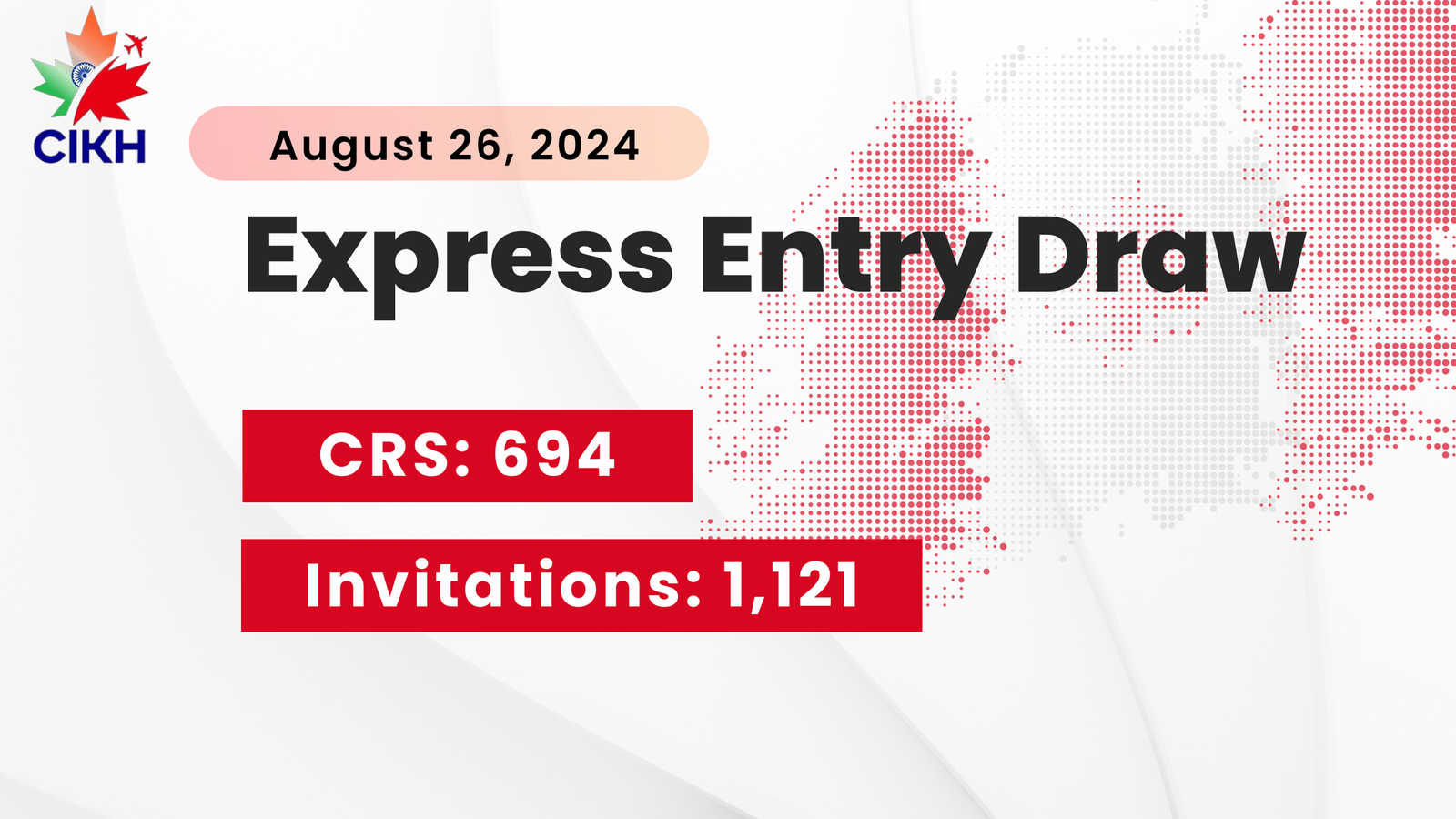
IRCC invites 1,121 candidates from the Provincial Nominee Program in the most recent Express Entry draw
Immigration, Refugees, and Citizenship Canada (IRCC) has released invitations to apply (ITAs) in the most recent Express Entry draw. This draw specifically targeted Provincial Nominee Program (PNP) candidates, with 1,121 invitations issued. To qualify, candidates needed a minimum Comprehensive Ranking System (CRS) score of 694. This latest draw is the fourth of the month. The previous Express Entry draw, on August 15, was a category-based selection for candidates with French-speaking proficiency. Earlier in the same week, two other draws occurred. On August 13, Canada invited 763 candidates in a Provincial Nominee Program (PNP)-only draw, requiring a minimum Comprehensive Ranking System (CRS) score of 690. The day before, on August 14, 3,200 Canadian Experience Class (CEC) candidates were invited with a minimum score of 509. Recently, IRCC has adopted a pattern of holding multiple draws every other week, with a notable increase in PNP and CEC draws over the past few months. This approach aligns with the department’s goal to prioritize domestic draws to reduce the number of temporary residents in Canada and to meet the permanent resident admissions targets set in the Immigration Levels Plan 2024-2026. IRCC aims to welcome 110,770 newcomers through Express Entry in 2024 and 117,500 in 2025. Candidates receiving invitations to apply (ITAs) later in the year are likely to contribute towards meeting the 2025 target, as IRCC has a six-month processing standard for finalizing Express Entry applications. Details of Express Entry Draw: 26 August 2024 Program: Provincial Nominee ProgramNumber of Invitations Issued: 1,121Rank Required to be Invited to Apply: 1,121 or aboveDate and Time of Round: August 26, 2024, at 14:46:49 UTCCRS Score of Lowest-Ranked Candidate Invited: 694Tie-Breaking Rule: August 03, 2024, at 18:54:27 UTC Summary of Express Entry draw results in 2024