

Immigration, Refugees, and Citizenship Canada (IRCC) has issued Invitations to Apply (ITAs) in the third Express Entry draw this week. The department issued 1,800 ITAs in a category-based selection draw for candidates with French language proficiency, requiring a minimum Comprehensive Ranking System (CRS) score of 400. This score is one of the lowest this year for any Express Entry draw. In yesterday’s program-specific draw, 6,300 Canadian Experience Class candidates were invited with a minimum CRS score of 515, the lowest score of any non-category-based selection draw this year. Earlier this week, IRCC invited 1,391 candidates in a Provincial Nominee Program (PNP)-only draw with a minimum CRS score of 670. Prior to that, on July 8, IRCC invited 3,200 candidates in a category-based selection draw for French proficiency. CRS scores for PNP-only Express Entry draws tend to be higher because candidates who are successfully nominated for the PNP receive an additional 600 CRS points. For instance, an Express Entry candidate with an initial score of 300 would have a total CRS score of 900 after receiving a PNP nomination. Details of Draw July 19,2024 · Draw Date: July 18, 2024 · Program: French Language Proficiency (Version 1) · Number of Invitations Issued: 1,800 · Rank Required to be Invited to Apply: 1,800 or above · Date and Time of Round: July 18, 2024, at 14:58:28 UTC · CRS Score of Lowest-Ranked Candidate Invited: 400 · Tie-Breaking Rule: March 8, 2024, at 19:51:40 UTC Summary of Express Entry Draws 2024

Canada’s Immigration Minister to Foreign Students: Not Everyone Can Stay
Canada’s Immigration Minister, Marc Miller, has indicated that the country is reconsidering the number of long-term visas issued to foreign students. This reflects the government’s intention to curb immigration and control population growth. In a phone interview, Miller stated that federal and provincial officials are discussing ways to align labor market needs with the influx of international students. He emphasized that study visas should not imply a guaranteed path to residency or citizenship, suggesting that students should consider returning home with the skills they’ve acquired. The Trudeau administration is facing increased pressure due to the rising cost of living, housing shortages, and higher unemployment rates. In response, Canada has capped the number of international student visas, projecting fewer than 300,000 new permits this year, compared to approximately 437,000 last year. Officials are now evaluating which students should be allowed to stay post-graduation. Miller highlighted the need to ensure that international students’ jobs align with their studies and address labor shortages in various provinces. He asserted that the rationale for unlimited international student admissions no longer holds. The number of Post-Graduation Work Permit (PGWP) holders has surged, with 132,000 new permits issued in 2022, a 78% increase over four years. Miller mentioned that changes to immigration policies would require discussions with government and business leaders. Additionally, the Trudeau administration is scrutinizing the Temporary Foreign Worker Program, aiming to reduce the proportion of temporary residents in Canada from nearly 7% to 5%. In recent weeks, foreign workers in Prince Edward Island have protested against cuts in permanent residency nominations for sales and service positions, with some resorting to hunger strikes.

IRCC issues invitations to 6,300 Canadian Experience Class candidates in the latest Express Entry draw
Immigration, Refugees, and Citizenship Canada (IRCC) has issued invitations to apply (ITAs) in the latest Express Entry draw. The second Express Entry draw of the year for the Canadian Experience Class (CEC) distributed 6,300 permanent residency invitations, more than doubling the number from the first CEC-only draw in May 2024. This increase brings new hope to CEC candidates in the pool. The Comprehensive Ranking System (CRS) cutoff score for today’s draw was 515, which is five points lower than predicted due to the higher number of invitations. This is the lowest CRS score of the year for a non-category-based selection draw and is also lower than the previous CEC-only draw on May 31, which had a cutoff of 522. This month, IRCC has issued a total of 17,361 ITAs across six separate draws. Yesterday, IRCC invited 1,391 candidates in a Provincial Nominee Program (PNP)-only draw with a minimum CRS of 670. Prior to that, on July 8, 3,200 candidates were invited in a category-based selection draw for French proficiency. CRS scores for PNP-only Express Entry draws tend to be higher than average because candidates who are successfully nominated for the PNP receive an additional 600 CRS points. For instance, an Express Entry candidate with a score of 300 would have an overall CRS of 900 after nomination. Details of the Draw July 17, 2024 Summary of Express Entry Draws 2024

Latest BC PNP Draw for July 16, 2024 | British Columbia Provincial Nominee Program Draws
In the latest BC PNP draw on July 16, over 67 invitations to apply (ITAs) for permanent residency (PR) were issued in both general and targeted rounds of invitations. B.C. has consistently conducted weekly draws without breaks since we began covering immigration news. However, a new trend has emerged: the number of invitations has decreased (now less than half), while the cutoff score has increased. A total of 34 invitations were sent to profiles with job offers in one of 35 tech occupations, maintaining the same cutoff score as the previous BC PNP general draw. Additionally, 14 profiles with experience in 39 healthcare-related occupations received invitations to apply for permanent residency. Furthermore, 9 invitations were issued to profiles with experience as early childhood educators’ assistants or instructors (NOC 42202), and 10 applicants with experience in 25 construction-related occupations were invited in British Columbia’s newest category-based draw, introduced in late 2023. Summary of BC Draws 2024
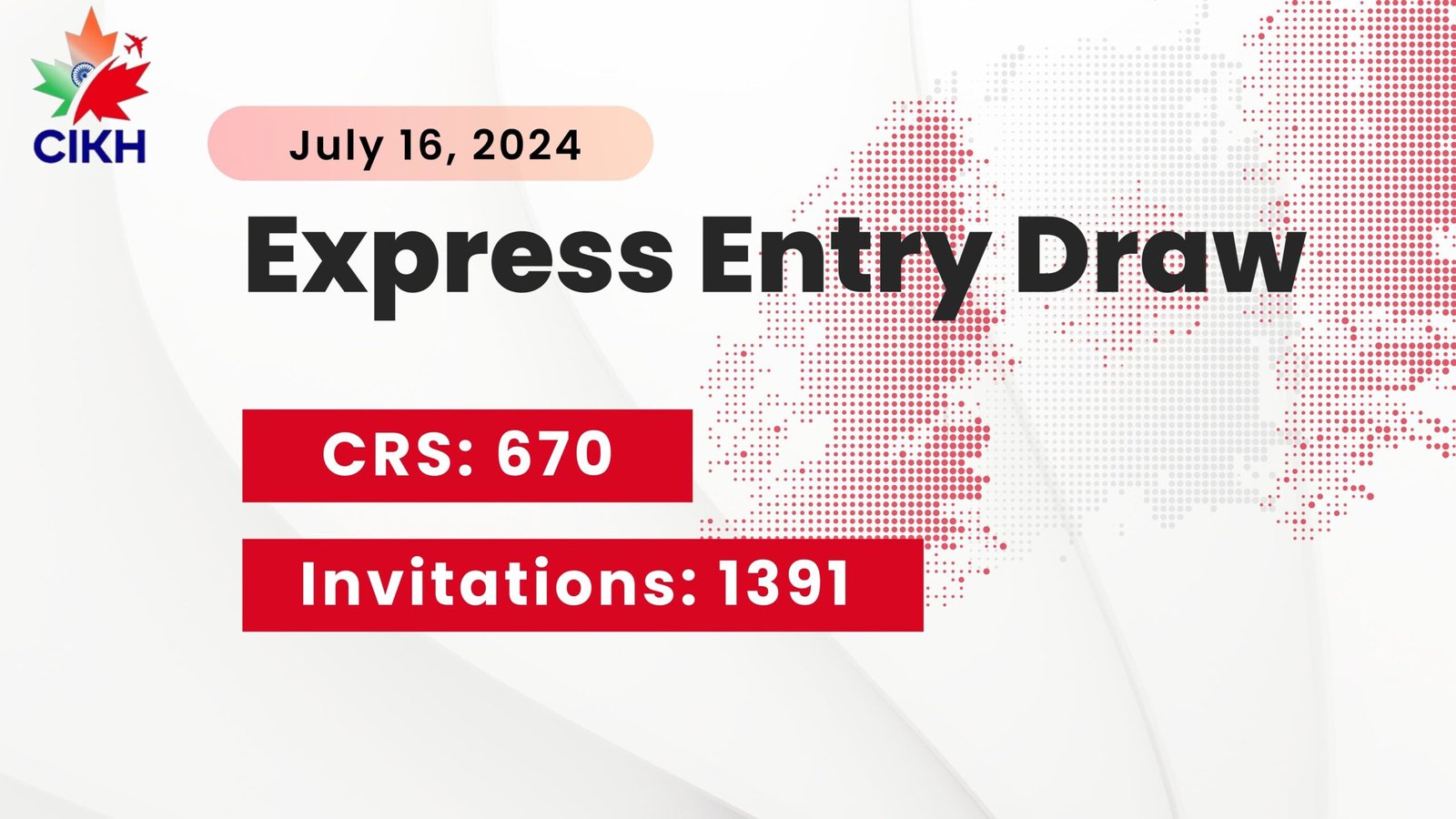
Express Entry: Latest PNP-only draw invites 1,391 candidates
Immigration, Refugees, and Citizenship Canada (IRCC) has issued invitations to apply (ITAs) in the latest Express Entry draw. On July 16, 2024, IRCC conducted a Provincial Nominee Program (PNP)-only draw, inviting 1,391 candidates to apply for permanent residency. This draw marks the third consecutive week of IRCC holding rounds of invitations. Candidates required a minimum Comprehensive Ranking System (CRS) score of 670 to be considered. Details of Recent Express Entry Draw: July 8, 2024: French Proficiency Draw The most recent category-based draw before today’s event took place on July 8, 2024, where IRCC invited 3,200 candidates based on their French language proficiency. This specific draw highlights Canada’s commitment to welcoming French-speaking immigrants, which enriches the country’s cultural diversity and supports the Francophone communities outside Quebec. July 2, 2024: Another PNP-Only Draw Earlier in the month, on July 2, 2024, another PNP-only draw was held, inviting 920 candidates with a minimum CRS score of 739. The higher CRS scores for PNP-only draws can be attributed to the additional 600 CRS points automatically awarded to Express Entry candidates who receive a provincial nomination. New Express Entry Draw Category for 2025 in making IRCC is currently holding consultations to introduce a new category for Express Entry draws in 2025, specifically targeting the following occupations in the education sector: Summary of Express Entry draw results in 2024

International Student Caps Essential to Immigration Strategy, Says Minister Marc Miller
Federal immigration minister Marc Miller, during a visit to Calgary, declared that the era of unlimited intake of international students has ended. He emphasized that provincial investment in education must offset the lost revenue for post-secondary institutions due to the reduced number of international students. “We need to prioritize quality in our system,” Miller told Postmedia. “We must ensure diversity and attract highly qualified and talented individuals, while also making it clear that Canada is an expensive place to live.” Following a citizenship ceremony at the Stampede where 25 individuals were granted Canadian citizenship, Miller highlighted the lengthy and challenging journey to citizenship. “They will contribute to making Canada, already the best country in the world, even better,” he said, stressing that citizenship is a privilege, not a right for everyone who enters the country. Miller underscored the need to consider the impact of high immigration volumes on housing, healthcare, education, and infrastructure. He acknowledged that many immigrants are crucial for maintaining Canada’s healthcare system, a key part of the national identity. In 2023, Canada’s population grew by 1.3 million, or 3.2%, largely driven by temporary immigration, with over 800,000 temporary residents. International students represent a significant portion of this growth. In January, the federal government proposed reducing student permits by 35% to alleviate pressure on housing and infrastructure. The new program, which adjusts the cap on student permits for each province, granted Alberta more permits than its usual share of international students. Masters and PhD students are exempt from the cap. The cap is enforced through an attestation letter from a province or territory, separate from the student permit application. While the new program will approve more students, a University of Calgary student union representative expressed concerns about the uncertainty and challenges students face, including securing housing and dealing with unregulated tuition increases. Miller emphasized that post-secondary institutions should not serve as a backdoor to Canadian citizenship. While there may be a case for granting citizenship to some international students, not all should expect it. Miller also pointed out that immigration is not the sole reason for rising living costs and tuition. Historical underfunding in affordable housing and post-secondary institutions has contributed significantly. The federal government’s decision in the 1990s to shift affordable housing funding to provinces has resulted in inadequate investment, failing to meet growing demand. Student housing is also insufficient, with high demand leading the University of Calgary to remove a housing guarantee for second-year students, pushing them into the rental market. A report by Higher Education Strategy Associates in 2022 revealed a 31% decline in provincial funding over the past five years. The University of Calgary’s student union reported a 33% increase in domestic tuition and a 40% rise for international students since 2019. Alberta’s 2024 budget did not increase post-secondary funding despite inflation rising over 10% in the past two years, translating to a per capita funding cut of 7.3%. Miller urged provincial governments to prioritize funding for universities, stating, “If there’s anything we need to invest in, it’s our kids and our world-class institutions. Underfunding them is shameful. Provincial governments need to reassess their balance sheets and invest in their universities, rather than relying on international students for funding.”

Essential Information for International Students about Canada’s Post-Graduation Work Permit (PGWP)
International students at eligible designated learning institutions (DLIs) in Canada can apply for a Post-Graduation Work Permit (PGWP) after completing their studies. A PGWP is an open work permit allowing international graduates to work for nearly any employer in Canada, with exceptions for employers involved in striptease, erotic dance, escort services, or erotic massages. However, some international students may become ineligible for a PGWP despite initial eligibility. If you are a prospective international student, currently studying, or about to complete your program, it’s crucial to understand the key aspects of the PGWP to avoid missing this valuable opportunity. This comprehensive guide will provide you with all the essential information about the PGWP, from eligibility criteria to application processes, ensuring a smooth transition from student to professional life in Canada. Eligibility Criteria for PGWP Canada has recently updated the eligibility criteria for the PGWP. To qualify, you must meet the following requirements: Documents Needed for PGWP Application To apply for a PGWP, you need to provide proof of your program completion, which can be done by submitting: When to Apply for PGWP You have up to 180 days after receiving your final marks to apply for a PGWP. Ensure your study permit remains valid during this period. If it expires before you receive your final marks, you have two options: If your study permit expires before you apply, you can apply for status restoration within 90 days of expiry by paying a processing fee of $255 and a $379 fee for status restoration. You cannot work until IRCC approves your new study and work permits. If you miss the 90-day window, you must leave Canada. Impact of Taking Leave from Studies on PGWP Eligibility Taking unauthorized leave from your study program makes you ineligible for a PGWP. However, you can take an authorized leave of up to 150 days for valid reasons and still qualify. You must have proof that this leave was officially authorized by your DLI. Note that you cannot work during the authorized leave period. Authorized Leave from Studies According to IRCC, examples of authorized leaves include: Ineligibility for PGWP You are not eligible for a PGWP if you: Extending Your PGWP A PGWP is issued either for the duration of your course (up to three years for Master’s, PhD, and professional programs) or until the validity of your passport. If your passport expires before the PGWP duration, you can extend the permit once you renew your passport. Tips for a Successful PGWP Application Study Programs Eligible for a 3-Year PGWP International students graduating from a master’s degree program are eligible for a 3-year PGWP, even if the program is shorter than two years. Impact of Changing DLIs on PGWP Eligibility If you transfer between eligible DLIs, the combined length of your study program must be at least eight months. If you transfer from a non-DLI to a DLI, only the time spent at the eligible DLI counts, and you must spend at least eight months there to qualify for a PGWP.

CBSA Clarifies Reports of Denying Entry to Indian and Nigerian Visitors at Airports
Recent reports indicate that Canada Border Services Agency (CBSA) officials have been turning back many Indian and Nigerian visitors at Canadian airports, offering them the alternative of applying for refugee status. This issue has surfaced amidst CBSA’s increased scrutiny, which has denied entry to genuine family members with approved visitor visas. Some of these individuals are on their second or third visit to reunite with their families. A Recent Incident Reported Multiple incidents have been reported at Toronto and Montreal airports over the past few months. A notable case involved over 40 Indian visitors who arrived on Air Canada Flight AC-51 at Montreal airport on July 8. They were refused entry and asked to return to their home country, or alternatively, they were given the option to apply for refugee status. Some of these individuals were visiting Canada for the second time, and among them were elderly senior citizens who should be respected regardless of nationality, especially considering they may not be fluent in English to explain their purpose of visit. One affected individual reported that their parents and brother-in-law experienced a similar situation. Their parents, on their second visit, were issued a one-month stay instead of the usual six months, despite intending to stay for two months. Their brother-in-law was repeatedly asked to apply for refugee status and after ten hours of questioning, was issued a one-month stay. Similar incidents have been reported by the Nigerian diaspora. One individual reported that a family friend was harassed and sent back to Nigeria the next day. Another incident on June 29 involved a person’s uncle being turned back because he did not travel with his spouse. In May, a group of tourists in Montreal was reportedly forced to apply for refugee status for about 12 hours. CBSA’s Clarification Following a news article published on July 10 by immigration news canada raising these concerns, CBSA spokesperson Luke Reimer reached out via email to provide a clarification. He emphasized that a visa does not guarantee entry into Canada. Even if someone has previously entered Canada with a visa, a valid visa does not guarantee re-entry on a subsequent visit. Clarification from the CBSA Below is the full clarification shared by the CBSA spokesperson via email regarding these ongoing concerns: Good afternoon, Gagandeep, I read your post, “CBSA Turning Back Indian and Nigerian Visitors at Airports,” and would like to clarify a few points: Obtaining a visitor visa or having been previously authorized to enter Canada does not guarantee the right to enter Canada. Upon arrival at a Canadian port of entry, all travelers must demonstrate that they meet the requirements to enter. Only certain individuals have the right to enter Canada, as described in Section 19 of the Immigration and Refugee Protection Act (IRPA). The Canada Border Services Agency (CBSA) does not direct travelers to make refugee claims. Should a traveler seek to make a refugee claim upon arrival in Canada, the CBSA will determine whether the claim is eligible under the Additional Protocol of the Safe Third Country Agreement and the IRPA. If eligible, the person’s file will be referred to the Immigration and Refugee Board of Canada (IRB) for consideration, and the person will be authorized to enter Canada to pursue their claim for protection. If ineligible, they may be removed from Canada. The CBSA’s role at ports of entry is to assess the admissibility of persons coming to Canada. All persons, including Canadian citizens, seeking entry to Canada must present to the CBSA and may be subject to a more in-depth examination. Admissibility of all travelers is decided on a case-by-case basis and based on the information made available at the time of entry. Officers are trained in interview, examination, and investigative techniques. They use proven indicators, advance information, intelligence, innovative technology, and information-sharing to carry out their mandate. The CBSA does not provide comments or details on specific individual cases as an individual’s border and immigration information is considered private and protected by the Privacy Act. However, anyone wishing to provide feedback on our services is invited to do so using the feedback form on our website: Contact us – Feedback (cbsa-asfc.gc.ca). Thank you kindly, Luke Reimer, Spokesperson/Porte-parole, Canada Border Services Agency/Agence des services frontaliers du Canada, Government of Canada/Gouvernement du Canada A Visa is Not a Guarantee of Entry It is important to note that a Canadian visa, including a visitor visa, does not guarantee entry into Canada. According to Canadian law, CBSA officials have the authority to deny entry if they find discrepancies or if the purpose of the visit is not clear. However, a major concern is that CBSA officials are offering individuals the option to apply for refugee status after denying them entry. This adds pressure to Canada’s already strained refugee system and the increasing number of international students applying for asylum. Public Reactions Social media users have expressed confusion and concern. One user on “X” questioned the rationale behind forcing passengers to apply for refugee status, asking, “What am I missing here? What’s the ulterior motive?” Another user asked, “How does filing for refugee status make more sense than allowing them entry? Can you explain the reasoning?” This situation has caused concern and outrage among temporary and permanent residents in Canada who have families planning to visit soon. One user commented, “Threatening people at the airport as soon as they land. And then they say, ‘Come to Canada, land of opportunities when you become refugees.’” Support for CBSA’s Scrutiny Some perspectives support the increased scrutiny by CBSA. One user suggested that officials might have seen something suspicious in previous visits, saying, “Not everything is harassment or racism. CBSA is doing its job keeping us safe.” Another user noted that the image of Indians in Canada might be at an all-time low due to illegal activities by some individuals, causing bona fide citizens to suffer. Other users speculated about ulterior motives, with one suggesting that the government might be using this situation as a
Due to variety of changes, no guarantee of permanent residency for International student.
This year has brought significant changes that have reshaped the experience of studying in Canada as a foreign student. These changes emphasize a crucial point: permanent residence (PR) is not guaranteed for international students and graduates in Canada. While Canada offers several pathways for international graduates to work and potentially settle permanently, this outcome is not assured, particularly considering the country’s immigration priorities. Why is Permanent Residence Not Guaranteed for International Students? International students who graduate from a Designated Learning Institution (DLI) in Canada face several hurdles before achieving PR status, even if they are strong candidates. 1. Work Experience Requirement: Graduates often need to gain work experience to become eligible for many economic PR programs. This usually involves obtaining a Post Graduation Work Permit (PGWP), allowing them to work for most employers in most industries across Canada. PGWPs are generally issued in accordance with the length of the student’s study program, but changes to this program may be forthcoming. 2. Applying for PR: Once eligible, graduates must apply to a relevant PR program. Many international graduates apply to the Canadian Experience Class (CEC) program within the Express Entry system, designed for those with Canadian education and work experience. Other routes include Provincial Nominee Programs (PNPs) in their province or territory, some of which specifically target international graduates. Challenges in the PR Process The transition to PR can involve long wait times and is influenced by Canada’s labour market and demographic needs. For instance, the Express Entry system now includes category-based selections, prioritizing candidates with French language skills and/or experience in one of five in-demand sectors. This system allows the federal immigration system to prioritize these candidates over those with higher Comprehensive Ranking System (CRS) scores. Similar dynamics exist in various PNP streams, where candidates with sought-after professional experience, demographic traits, or family connections in the province/territory may receive PR status over those with high ranking scores. International graduates are also limited by the length of their PGWP. If they do not obtain PR within the validity period of their PGWP and cannot secure new temporary residence status, they must leave Canada. Although their Express Entry profile remains valid if they still meet eligibility criteria, this presents another challenge for those wishing to stay in Canada. Maximizing Chances for PR Despite these challenges, international graduates of Canadian DLIs remain strong candidates for Canadian immigration. To enhance their eligibility for PR, international students should focus on gaining in-demand professional experience and improving their language abilities valued by the government. Under the Express Entry category-based selection, candidates in the following categories can be prioritized for PR, with less emphasis on their CRS score: International graduates should aim to maximize their eligibility under these categories to improve their chances of receiving PR. Additionally, graduates should explore local provincial programs that target international graduates. Examples of such programs include: Alberta: British Columbia: Manitoba: Newfoundland and Labrador: Nova Scotia: Ontario: Saskatchewan: By strategically aligning their qualifications with these programs, international students can improve their chances of obtaining permanent residence in Canada.

Ontario Immigrant Nominee Program (OINP) – Skilled Trades Stream Draw on July 11, 2024
Ontario Conducts Targeted Draw for Skilled Trades Stream The Ontario Immigrant Nominee Program (OINP) held a targeted draw under the Skilled Trades stream on July 11, 2024. This draw aimed to attract skilled workers to address labor shortages in specific trades within Ontario. Draw Highlights: Targeted Occupations: This draw was focused on candidates with experience in specific skilled trades. For a detailed list of the targeted occupations, please refer to the OINP Program Update page. Key Points: Candidates must have work experience in one of the following National Occupational Classification (NOC) codes listed as their primary NOC in their Express Entry profile: Eligible candidates who received a notification of interest (NOI) on July 11, 2024, may apply to the Ontario Express Entry Skilled Trades stream. To apply: It’s important to note that meeting the eligibility criteria does not guarantee receipt of an NOI, and receiving an NOI does not ensure that you meet the stream criteria or that your application will be approved.