

Canada plans to stop processing study permits for colleges and universities that don’t keep track of international students, according to new rules. Schools would need to report to the Immigration Department on whether students attend classes and follow permit rules. If a school fails to monitor international student enrollment, the government will pause study permit processing for post-secondary students. This is part of efforts to rebuild trust in Canada’s international student program. According to the proposed changes in the Canada Gazette, students will need a new study permit if they switch schools or start a new program, reinforcing compliance. This approach must balance federal oversight with provincial control over education. Ottawa designates which colleges and universities can accept international students, but provinces decide who gets these permits. Federal officials struggle to monitor students after they arrive in Canada, often not knowing their enrollment status until they apply for extensions or post-graduation work permits. The proposed regulations aim to help the Immigration Department tackle integrity issues and unethical practices that harm the program’s reputation. In 2023, Canada hosted over one million study permit holders, a big increase from 352,305 in 2015. This growth has raised concerns about aggressive recruitment and misuse of study permits by some students seeking work and residency. To improve oversight, the government plans a “trusted institution framework” this fall to vet colleges and universities more carefully and speed up study permit processing for trustworthy schools. Officials say these changes will ensure only legitimate institutions receive study permits and crack down on rule-breakers. Designated learning institutions would have 10 days to confirm a student’s acceptance and 60 days to report on their enrollment and course progress. Authorities could do random checks or request information if they suspect issues with acceptance letters or past non-compliance. Decisions on suspending institutions and for how long would consider factors like compliance history, efforts to follow rules, and cooperation during checks. The immigration minister would decide whether to publish a suspension list, which could bar non-compliant institutions from getting study permit applications for up to a year. Provincial officials have mixed views on these changes, worried about federal interference in their education responsibilities. The proposed changes are expected to cost nearly $87 million over a decade, covering government implementation, costs for schools, and fees for students changing schools. The amendments also propose increasing international students’ weekly off-campus work hours to 24 from 20, aiming to help them manage higher living costs.

Understanding Study Permit Trends: What Recent Changes Reveal About the Future of Students
Canada has experienced unprecedented changes to its study program and broader temporary resident program in 2024, with further significant changes planned for Fall 2024. These changes will likely impact the source countries of international students in Canada moving forward. Here’s what we know so far. Major Highlights Shifts in Source Countries for International Students The changes announced in 2024 are likely to have lasting impacts on the source countries for international students in Canada. A significant reduction in the number of applications from India, Nepal, and the Philippines has been observed. However, there has been a notable increase in study permit processing for students from: Conversely, processing rates have decreased significantly for students from: Several factors may have influenced these decreases, including reduced interest in studying in Canada due to recent changes, political reasons such as Russia’s war in Ukraine, and the generalized impact of the international student cap. Noteworthy Trends: Indian Students The drop in study permits issued to Indian students in 2024 is particularly striking. Data shows the number of processed applications fell sharply: In 2023: In 2024: This dramatic decrease is likely due to multiple factors, including decreased interest from Indian students amid political tensions between Canada and India. Planned Changes by IRCC IRCC has outlined significant upcoming changes to the study permit programs in their Deputy Minister Transitional Binder: French-Speaking Student Program A pilot program aims to increase the number of French-speaking international students, especially in Francophone Minority Communities. Objectives include: This program is expected to be announced in Fall 2024, although the timeline may change. Recognized Institutions Framework Delayed Initially planned for Fall 2024, the Recognized Institutions Framework (RIF) will now be delayed until 2025 due to significant changes in the study permit program, particularly the international student cap. The RIF will rank post-secondary educators into tiers based on recruitment standards, support for international students, and post-graduate outcomes. IRCC plans to first roll out the RIF to public universities and colleges with more than 50 study permit approvals per year over the last three years, followed by private institutions. Students applying to higher-ranked institutions will benefit from faster processing times. Stay tuned for more updates as these changes unfold and shape the future landscape of international education in Canada.

Spousal Open Work Permits Available for International Students in Nursing Programs
Bachelor of Nursing Programs Now Eligible for Spousal Open Work Permits in Canada: What You Need to Know Starting July 3, 2024, Bachelor of Nursing programs have been added to the list of professional degree programs whose spouses are eligible for open work permits in Canada. Here’s an overview of the key details: Key Takeaways Programs Eligible for Spousal Open Work Permits Earlier this year, significant changes were made to Canada’s study permit program, affecting the eligibility of many international students’ spouses for open work permits. However, there are specific undergraduate programs where spouses are still eligible, providing financial relief and social benefits. IRCC has not specified why certain undergraduate students can bring their spouses, but it likely relates to demand and economic prospects post-graduation. The professional degree programs currently eligible for spousal open work permits include: Clarification on Nursing Programms The addition of Bachelor of Nursing programs is mainly for clarification, as Bachelor of Science in Nursing programs were already on IRCC’s original list. This update helps immigration officers understand which programs are eligible for spousal open work permits, distinguishing Bachelor of Nursing Science programs from Bachelor of Science in Nursing programs, both of which are now eligible. Why Nursing Programs? The inclusion of nursing programs likely stems from the high demand for nurses in Canada. By allowing international students to bring their spouses, Canada becomes a more attractive destination for those interested in studying nursing. Applying for a Spousal Open Work Permit If you applied for a nursing program after April 30, 2024, and did not include a spousal open work permit, you will need to receive your study permit and begin studying in Canada before applying for the spousal permit. If your study permit application is still in process, you could withdraw and resubmit it with the spousal work permit, but this might delay your application. Graduate Programs Graduate students pursuing master’s and doctorate degrees remain eligible for spousal open work permits and are excluded from Canada’s study permit cap. This change aims to support international students in nursing programs, making it easier for them to bring their spouses and enhance their experience while studying in Canada.

Ontario Immigrant Nominee Program: July 9 Draws Issue 1,666 PR Invitations
Today, on July 9, 2024, the Ontario Immigrant Nominee Program (OINP) issued a total of 1,666 invitations to apply for permanent residency (PR) through two separate draws. The first draw, under the Masters Graduate Stream, saw 1,556 invitations issued to candidates with an Expression of Interest (EOI) score of 54 or higher, marking a slight increase of 2 points from the previous draw on March 19. Additionally, 110 invitations were extended under the PhD Graduate Stream to candidates with EOI scores of 50 or above, representing an increase of 8 points compared to March 19. Candidates who had created EOI profiles under these streams between July 9, 2023, and July 9, 2024, were eligible for this draw. Invited applicants now have 14 days to submit their PR applications, confirming the details provided in their Expression of Interest profiles. Since the inception of the OINP Expression of Interest system in 2024, a total of 13,455 invitations to permanent residency have been issued. The International Student Stream received the highest number of invitations at 5,277, followed by the Masters Graduate Stream with 4,270 invitations, and the Foreign Worker Stream with 3,569 invitations. All OINP Masters Graduate Stream Draws for 2024 All The OINP PhD Graduate Stream Draws 2024

New IRCC Express Entry Draw: July 8, 2024
On July 8, 2024, Immigration, Refugees, and Citizenship Canada (IRCC) issued 3,200 invitations to apply for permanent residence through the Express Entry system. This draw targeted candidates with a minimum Comprehensive Ranking System (CRS) score of 420 and at least level 7 proficiency in French. Details of the Draw July 8, 2024 · Category: French language proficiency · Number of invitations issued: 3,200 · Rank required to be invited to apply: 3,200 or above · Date and time of round: July 8, 2024, at 14:01:33 UTC · CRS score of lowest-ranked candidate invited: 420 · Tie-breaking rule: May 30, 2024, at 03:37:43 UTC Summary of Express Entry Draws 2024 What is Express Entry? Express Entry is IRCC’s application management system for three key economic immigration programs: the Federal Skilled Worker Program (FSWP), the Canadian Experience Class (CEC), and the Federal Skilled Trades Program (FSTP). Launched in 2015, it aims to identify immigration candidates most likely to integrate successfully into Canada’s workforce and economy. Each program has its own eligibility criteria, but all candidates are evaluated using the Comprehensive Ranking System (CRS). The CRS assigns scores based on factors such as age, language ability, education, work experience, and occupation. Higher scores increase the likelihood of receiving an Invitation to Apply (ITA) in an Express Entry draw. What is Category-Based Selection? Introduced in 2023, category-based selection draws help IRCC target candidates who can address urgent workforce needs. The six categories, chosen after extensive consultations with stakeholders and governments, include: These categories will be in place until 2025, potentially changing to meet labor market demands. Candidates, except those in the French-proficiency category, need at least six months of relevant work experience under an eligible NOC code. French-speaking candidates must score at least seven in all areas of the French language test (Niveaux de compétence linguistique canadiens).

Why IRCC May Refuse Your Visitor Visa Application: Common Reasons and Tips to Avoid Refusal
Canada, with its stunning landscapes and vibrant cities, is a popular destination for tourists, business travelers, and those visiting family and friends. If you are a foreign national from a visa-required country, you’ll need to obtain a visitor visa to enter Canada. While the application process may seem straightforward, many applicants face refusals for various reasons. Here’s a comprehensive guide to help you avoid common pitfalls and successfully obtain your Canadian visitor visa. Understanding the Essentials: Visitor Visa vs. eTA For residents of visa-required countries, a visitor visa is mandatory to enter Canada. In contrast, travelers from visa-exempt countries must obtain an electronic Travel Authorization (eTA) instead of a visitor visa. Common Reasons for Visitor Visa Refusal and How to Avoid Them By addressing these common issues and ensuring your application is thorough and accurate, you can improve your chances of obtaining a Canadian visitor visa. Taking the time to prepare a complete application with all necessary documentation and being transparent about your history and intentions will help you navigate the process smoothly.
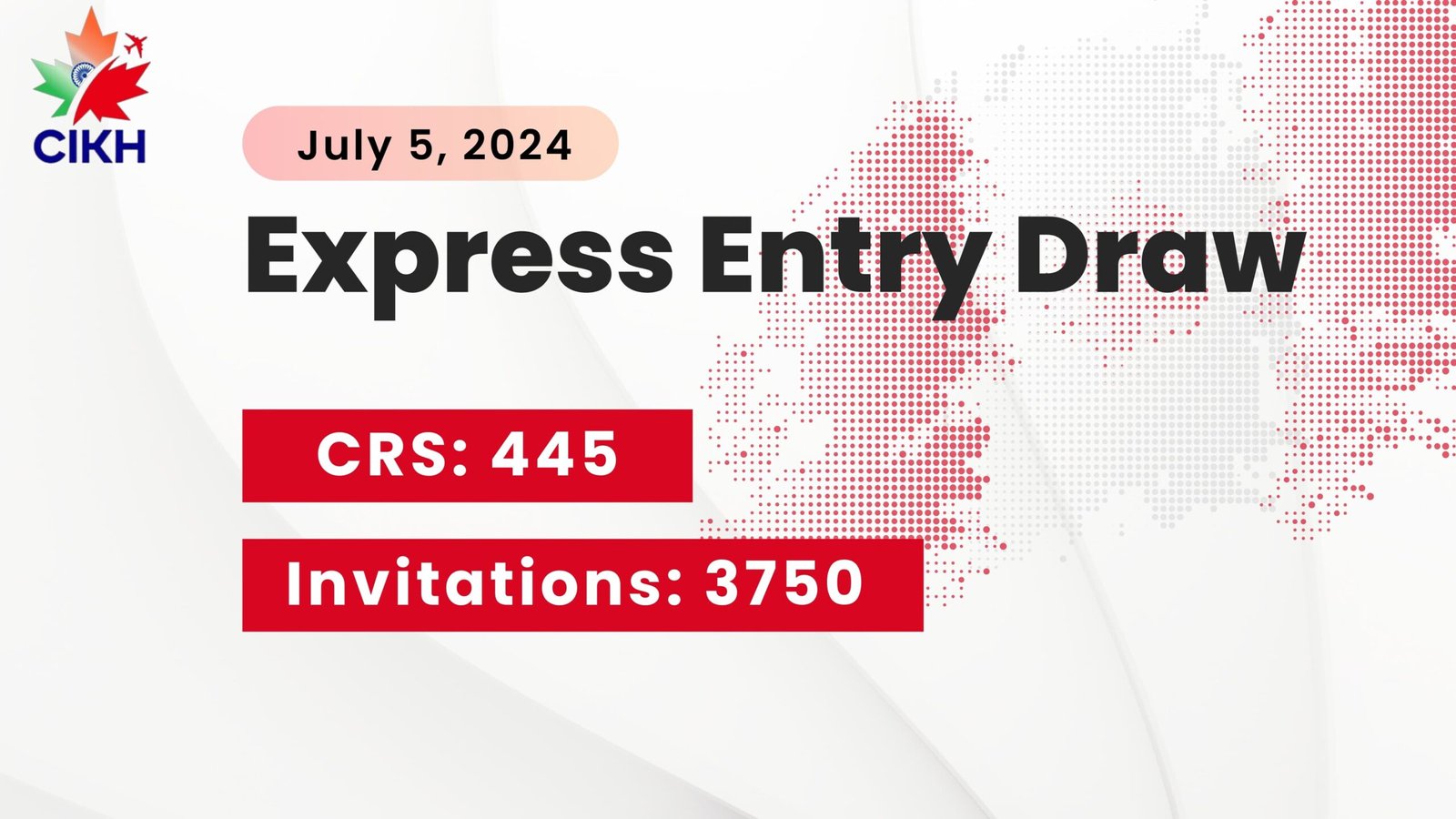
IRCC issues invitations to 3,750 candidates in the third Express Entry draw this week.
Immigration, Refugees, and Citizenship Canada (IRCC) has issued Invitations to Apply (ITAs) in the third Express Entry draw this week. In this category-based selection draw for healthcare occupations, 3,750 ITAs were issued. Candidates needed a minimum Comprehensive Ranking System (CRS) score of 445 to be eligible. This draw marks the second category-based draw of the week, following a July 4 draw that issued 1,800 ITAs to candidates in trade occupations. Details of the Express · Date: July 5, 2024 · Occupation: Healthcare occupations (Version 1) · Number of Invitations Issued: 3,750 · Rank Required to be Invited: 3,750 or above · Date and Time of Round: July 5, 2024, at 16:03:12 UTC · CRS Score of Lowest-Ranked Candidate Invited: 445 · Tie-Breaking Rule Date and Time: May 7, 2024, at 21:27:04 UTC Additionally, on July 2, IRCC conducted a draw exclusively for candidates in the Provincial Nominee Program (PNP), inviting 920 candidates with a minimum CRS score of 739. With a total of 6,470 ITAs issued this week, it is the highest number since April. The recent trend of program-specific draws started earlier this year. Since May 30, IRCC has held four program-specific draws, three of which were for PNP candidates. Program-specific draws consider only those in the Express Entry pool who have applied through programs such as the Canadian Experience Class (CEC), the Federal Skilled Worker Program (FSWP), or the Federal Skilled Trades Program (FSTP). In PNP-only draws, candidates are considered only if they have been nominated through an Express Entry aligned stream of a PNP, known as enhanced nomination. Until recently, category-based selection draws had not occurred since their introduction in May 2023. However, since January this year, IRCC has been working to stabilize the high levels of temporary residents in Canada by offering more pathways for temporary residents, such as those on work or study permits or visitor visas, to become permanent residents (PR). Many temporary residents applying for PR, who are currently living in Canada or have experience living in Canada, do so through the CEC. This is also true for PNP candidates. This allows IRCC to meet its yearly target for “Federal High Skilled Workers” as outlined in the Immigration Levels Plan while also reducing the number of temporary residents in Canada.

Updated Education Requirements for Nurses in Ontario’s OINP Streams
The Ontario Immigrant Nominee Program (OINP) has recently announced significant changes to the educational requirements for nurses applying through the Human Capital Priorities (HCP) and French-Speaking Skilled Worker (FSSW) streams. These changes are set to make the immigration process smoother and more accessible for nurses aiming to settle and work in Ontario. Key Changes: Eligible NOC Codes: Impact on Nurses: This update is particularly beneficial for nurses who are already practicing in Ontario or are in the process of registration. By aligning the educational requirements with the CNO registration and relevant NOC codes, the OINP is acknowledging the professional standards maintained by the College of Nurses of Ontario. This not only simplifies the application process but also speeds up the path to permanent residency for many qualified nurses. The changes to the OINP’s educational requirements for nurses reflect a thoughtful approach to addressing the needs of healthcare professionals in Ontario. By focusing on practical experience and professional registration, the OINP is ensuring that highly skilled nurses can continue to contribute to the province’s healthcare system without unnecessary bureaucratic hurdles. For nurses considering immigration to Ontario, these updates are a welcome change, promising a more straightforward and efficient application process. If you’re a nurse looking to make Ontario your new home, now is the perfect time to explore the opportunities available through the OINP’s Human Capital Priorities and French-Speaking Skilled Worker streams. Contact us today to learn more about how you can take advantage of these new changes and start your journey towards a fulfilling career in Ontario.

IRCC has issued 1,800 Invitations to Apply (ITAs) in an Express Entry draw focused on trade occupations.
Immigration, Refugees, and Citizenship Canada (IRCC) has issued invitations to apply (ITAs) in the second Express Entry draw of the week. July 4, 2024 Express Entry Draw In the latest draw, IRCC issued 1,800 ITAs under a category-based selection for trade occupations. Candidates needed a minimum Comprehensive Ranking System (CRS) score of 436. This was the first trade occupation draw since December 2023 and the first category-based selection since April 24. IRCC aims for trade occupation draws to represent 5% of all category-based selections this year. Details of Express Entry Draw · Date: July 4, 2024 · Category: Trade occupations (Version 1) · Number of invitations issued: 1,800 or above · Rank required to be invited to apply: 1,800 or above · Date and time of round: July 4, 2024, at 13:30:48 UTC · CRS score of lowest-ranked candidate invited: 436 · Tie-breaking rule: July 16, 2023, at 15:44:59 UTC On July 2, a draw focusing on the Provincial Nominee Program (PNP) was held, issuing 920 ITAs to candidates with a minimum CRS score of 739. This follows a trend of program-specific draws that started earlier this year. Since May 30, IRCC has held four program-specific draws, three of which were for PNP candidates. Summary of Express Entry draw results in 2024

From Fast Food to Construction: High Demand for Temporary Foreign Workers
The temporary foreign worker program in Canada has seen a surge in businesses’ demand for temporary workers, with employers being allowed to hire more than double the number of people through the federal program last year compared to five years ago. The program, designed to provide short-term relief to employers, has been scrutinized for its potential impact on the broader economy and the vulnerable position of workers. In 2018, employers were cleared to hire 239,646 temporary foreign workers, a rise from 108,988 in 2018. The growth coincided with the government loosening hiring restrictions to help businesses with post-pandemic labor shortages, which some economists criticized as undermining healthy competition for workers in a market economy. The Canadian labour market impact assessment (LMIA) program has seen increased interest from various industries, with farm and greenhouse workers being the most in-demand roles. However, demand for other jobs is also increasing. Employers have turned to the program to fill roles ranging from administrative assistants to light duty cleaners, construction trade helpers, and labourers. The program has seen a rise in demand across the economy. There aren’t always more temporary foreign workers in the nation just because there are more positive LMIA positions. An authorized employer may decide not to hire someone after all, for example. However, it is indicative of employers’ growing interest in the programme, which is expanding by all measures. The number of temporary foreign workers in the nation reached a record high last year, according to work permit data released by Immigration, Refugees and Citizenship Canada. The records dating back to 2015. Fast food chains and restaurants are a significant source of demand for temporary foreign workers, with roles such as cooks, food service supervisors, food counter attendants, and kitchen helpers receiving the most approvals last year. Food counter attendants saw a significant increase from 170 jobs in 2018 to 8,333 in 2023, with fast food operators being the top 10 employers cleared to hire the highest number of them. The relationship between the food service industry and the temporary foreign worker program has been fraught, with the federal government doubling the proportion of low-wage workers businesses could hire through the program in 2022. Some sectors, like food service, have been greenlighted to hire up to 30% of low-wage staff through the program. Number of positions approved to be filled by temporary foreign workers The temporary foreign worker program in Canada has been criticized for its lack of stability and power imbalance. Workers’ permits are tied to their employer, meaning they cannot easily quit to work for a rival business down the street. This has led to some businesses being cleared to hire more cooks, food service supervisors, and food counter attendants last year. However, some communities often lack the population base to meet the demand for labor, leading some workers to seek work abroad. For workers, a lack of domestic opportunities is typically what pushes people to seek work abroad. Canada is appealing because it is one of the few countries where a temporary job can turn into a permanent residency. However, the experience of being a temporary foreign worker can be mixed. Some employers abide by their contracts and support workers in applying for permanent residency. However, others abuse their power and underpay workers, even withholding pay to compensate for the money spent on an LMIA. Workers are often afraid to speak up for fear of losing their status in Canada. Economist Skuterud believes that the temporary foreign worker program can also affect the broader economy. He points to a paper suggesting the hiring of such workers correlates with lower earnings for Canadian workers in similar jobs and locations. Employers are required to offer temporary foreign workers at least the regional median hourly wage for the job in question. This program is not the only source of temporary workers in the country. International students also hold permits, as do workers under the wide-ranging international mobility program. One way to decrease temporary residents is to make them permanent, ministers suggest. However, Skuterud believes growth in all three programs shows the government is moving away from its points-based immigration system and toward a more ad hoc approach where people try to parlay a work or study permit into permanent status. He believes that “it looks like a lottery and your ticket is a work permit.” This spring, the federal government changed course on the temporary foreign worker program, tightening how many such workers a business could hire, citing changing labour markets and lower vacancies. Most employers are now limited to hiring 20% of low-wage staff through the program. While public pressure has mounted regarding the connection between immigration and housing affordability, ESDC spokesperson Liana Brault said the changes were unrelated and “solely based on employment numbers.” There are different perspectives on how to improve the program. Groups like Migrant Alberta want easier access to permanent residency for migrant workers, while a recent senators’ report called for changes including an end to closed work permits.