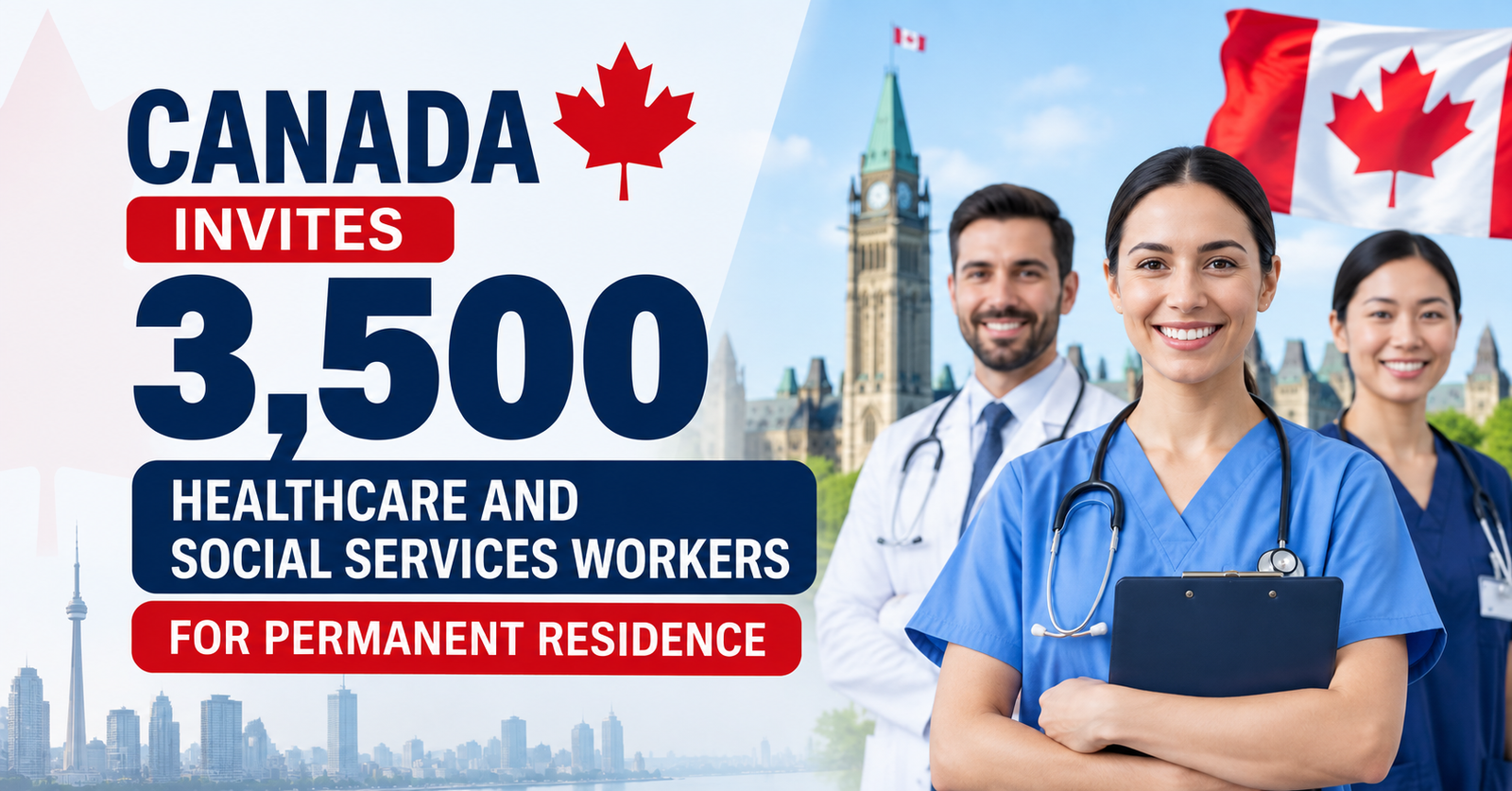
Canada’s latest immigration move gives healthcare professionals another reason to keep their Express Entry profile active. 3,500 candidates working in eligible healthcare and social services occupations received Invitations to Apply (ITAs) for permanent residence on September 4, 2026, showing that this category remains one of IRCC’s biggest priorities this year.
The latest round required a Comprehensive Ranking System (CRS) score of 475, matching the previous healthcare draw rather than introducing a new lower threshold. For thousands of nurses, pharmacists, therapists, physicians and social workers, the draw reinforces that occupation-based invitations continue to create opportunities beyond regular Express Entry selections.
Quick Snapshot of the September 4 Draw
Before looking at what this means for candidates, here’s a quick overview of the latest Express Entry round.
| Draw Detail | September 4, 2026 |
|---|---|
| Draw Type | Healthcare and Social Services |
| Invitations Issued | 3,500 |
| Minimum CRS Score | 475 |
| Draw Date | September 4, 2026 |
| Tie-breaking Rule | June 2, 2026 |
Candidates with exactly 475 CRS points needed to have created their Express Entry profile before the official tie-breaking date to receive an invitation.
Why IRCC Keeps Returning to Healthcare Draws
If you’ve been following Express Entry throughout 2026, one pattern stands out: healthcare keeps coming back.
Instead of relying only on all-program draws, IRCC has repeatedly returned to healthcare-specific selections as Canada continues addressing workforce shortages across hospitals, clinics, long-term care facilities and community services. The latest invitation round is now the third Healthcare and Social Services draw of 2026, showing that this category has become a consistent part of Canada’s immigration strategy.
For candidates working in these occupations, this matters because they are competing within a targeted category instead of depending entirely on broader Express Entry rounds. If you’re still checking whether your profession qualifies, our guide on occupations with the highest chances of gaining PR through Express Entry explains how priority occupations fit into Canada’s current selection strategy.
The CRS Score Stayed at 475
One of the biggest talking points after every Express Entry draw is the cutoff score.
This time, the 475 CRS requirement remained exactly the same as the previous Healthcare and Social Services draw held on June 25, 2026.
| Healthcare Draw | Invitations | CRS |
|---|---|---|
| September 4, 2026 | 3,500 | 475 |
| June 25, 2026 | 4,000 | 475 |
| February 20, 2026 | 4,000 | 467 |
The unchanged score sends an interesting signal. While invitation numbers dropped from 4,000 to 3,500 compared with June, the qualifying threshold stayed steady. That suggests candidates around the mid-470 range remain highly competitive whenever IRCC opens this category.
Which Healthcare Workers Could Benefit?
The category covers much more than doctors and nurses.
Eligible occupations include professionals working across different parts of Canada’s healthcare and social services system, including:
- Registered nurses
- Licensed practical nurses
- Physicians
- Dentists
- Pharmacists
- Medical laboratory professionals
- Physiotherapists
- Occupational therapists
- Social workers
- Other eligible healthcare and social service occupations recognized under IRCC’s category-based selection system
A common misconception is that only hospital workers qualify. In reality, community health professionals, rehabilitation specialists and social service workers may also fall within the eligible occupation list, provided they meet IRCC’s category requirements.
If you’re planning to build your Canadian career in one of these fields, it’s also worth exploring Canadian employers supporting immigration for international students and new graduates , as employer support can strengthen long-term immigration plans.
How Category-Based Draws Work Differently
Many candidates compare healthcare draws directly with Canadian Experience Class or Provincial Nominee Program rounds, but they work differently.
In a category-based selection, IRCC first identifies candidates who qualify under the selected occupation category before applying the CRS cutoff. This allows eligible professionals to compete within their own targeted group instead of being ranked only through a general invitation round.
That distinction can make a meaningful difference for candidates whose occupations match Canada’s labour market priorities.
Healthcare Continues to Be a Major Immigration Priority
The latest draw fits into a broader pattern seen throughout 2026.
Healthcare has remained one of IRCC’s priority categories, alongside other targeted selections such as French-language proficiency, Provincial Nominee Program and Canadian Experience Class draws.
So far this year, Canada has repeatedly used Express Entry to address labour shortages by selecting candidates already working in occupations considered important for the country’s economic and social needs.
How This Draw Fits Into September’s Express Entry Activity
The September healthcare draw did not happen in isolation.
It arrived immediately after several other Express Entry rounds, creating another active week for immigration candidates.
| Date | Draw Type | Invitations | CRS |
|---|---|---|---|
| September 4 | Healthcare and Social Services | 3,500 | 475 |
| September 3 | Physicians with Canadian Work Experience | 229 | 198 |
| September 1 | Canadian Experience Class | 2,000 | 521 |
| August 31 | Provincial Nominee Program | 562 | 697 |
| August 19 | French-language Proficiency | 5,000 | 382 |
| August 18 | Canadian Experience Class | 1,000 | 523 |
The pattern shows that IRCC continues rotating between different candidate groups depending on immigration priorities.
For more context on these recent rounds, you can also read our coverage of the Canadian Experience Class draw and the latest Provincial Nominee Program draw , both of which help explain how different Express Entry categories are being used this year.
Express Entry Invitation Trends in 2026
The latest draw also pushed healthcare invitations higher for the year.
Following September 4, Canada had issued 11,500 invitations through Healthcare and Social Services category-based draws during 2026.
Across all Express Entry categories, IRCC has now issued 117,427 invitations this year.
| Draw Category | ITAs in 2026 |
|---|---|
| Canadian Experience Class | 51,250 |
| French-language proficiency | 50,500 |
| Healthcare and Social Services | 11,500 |
| Provincial Nominee Program | 7,961 |
| Trades | 3,000 |
| Physicians with Canadian Work Experience | 891 |
| Senior Managers with Canadian Work Experience | 750 |
| Transport | 300 |
| Skilled Military Recruits | 4 |
The latest healthcare draw therefore became one of the larger targeted invitation rounds of the year. It also fits into the broader immigration activity taking place across Canada this month, making this an important period for Express Entry applicants.
What Healthcare Candidates Should Do Now
This draw offers one practical reminder: waiting for an invitation is only part of the process.
If you’re already eligible under the Healthcare and Social Services category, keeping your profile updated can make a difference before the next round arrives.
A useful checklist includes:
- Confirm that your occupation remains on IRCC’s eligible healthcare list.
- Keep language test results valid.
- Update work experience whenever your profile changes.
- Make sure educational documents are accurate.
- Monitor future healthcare-specific Express Entry rounds.
Many candidates lose valuable time after receiving an ITA because documents are incomplete. Preparing them early can make the permanent residence application process much smoother. It’s also helpful to understand how to increase your PR chances through Canada’s Expression of Interest programs , especially if you’re considering multiple immigration pathways.
Why Healthcare Remains One of Canada’s Strongest PR Pathways
Healthcare has become one of the few categories where IRCC has shown repeated consistency throughout 2026.
While CRS scores in other Express Entry streams can shift significantly from one draw to another, healthcare professionals continue receiving dedicated invitation rounds that reflect Canada’s long-term workforce needs.
That does not mean every future draw will issue the same number of invitations or keep the same cutoff. However, the repeated use of this category suggests healthcare workers remain well-positioned compared with many occupations that rely solely on general Express Entry competition.
Candidates exploring provincial pathways can also review occupations most likely to receive a provincial nomination through Express Entry-aligned PNPs , since a provincial nomination can significantly strengthen an Express Entry profile.
Frequently Asked Questions
IRCC issued 3,500 Invitations to Apply through the Healthcare and Social Services category-based Express Entry draw.
Candidates needed a minimum CRS score of 475.
No. It is the third Healthcare and Social Services Express Entry draw conducted during 2026.
Eligible occupations include nurses, physicians, dentists, pharmacists, therapists, social workers and other qualifying healthcare and social service professionals recognized under IRCC’s category-based selection system.
Candidates with 475 CRS points needed to have submitted their Express Entry profile before the official June 2, 2026 tie-breaking date to receive an invitation.
What This Means Going Forward
The September 4 draw reinforces an important trend in Canada’s immigration system: healthcare professionals continue receiving dedicated opportunities even as Express Entry rotates between multiple categories.
The combination of 3,500 invitations, a 475 CRS cutoff, and healthcare’s growing share of 2026 invitations shows that IRCC continues treating this sector as a long-term immigration priority. For eligible candidates already in the Express Entry pool, staying prepared could be just as important as waiting for the next draw.
Fact Check: This article is based on the official IRCC Express Entry Healthcare and Social Services draw announced for September 4, 2026, including the official invitation count, CRS score, tie-breaking rule and 2026 draw statistics.
Disclaimer: This article is for general informational purposes only and is not legal or immigration advice. Candidates should verify the latest Express Entry requirements through official Government of Canada sources before making immigration decisions.