
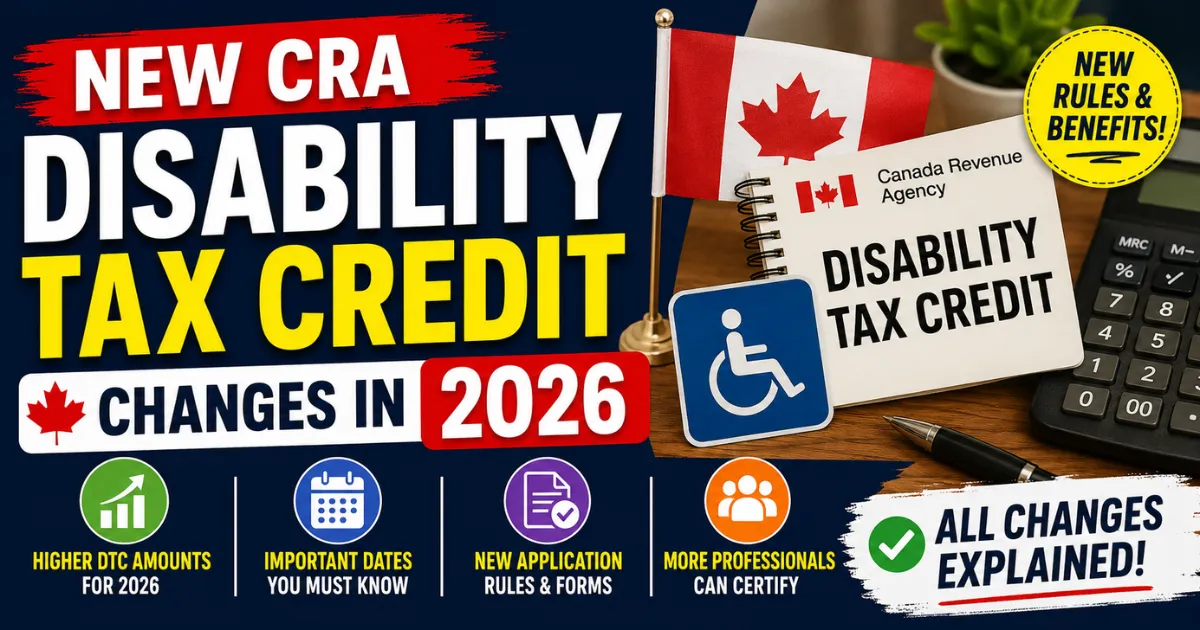
Many people think applying for the Disability Tax Credit is only about filling out a form. I have seen that the process can become confusing because the rules, forms, and benefit amounts change over time. Even a small mistake can delay an application or reduce the benefits someone may receive.
The good news is that several important updates have been introduced for 2026. Some changes have already started, while others will take effect later this year and continue into 2027. If you or a family member plans to apply for the Disability Tax Credit, understanding these updates now can help you avoid unnecessary problems.
What Is Changing in the Disability Tax Credit During 2026?
The Canada Revenue Agency and the federal government have announced several updates to improve the Disability Tax Credit program. Along with annual inflation adjustments, new application rules and future policy changes are expected to make the process easier for many eligible Canadians.
A valid Disability Tax Credit certificate is more than just a tax benefit. It can also help people qualify for other federal support programs such as the Canada Disability Benefit, the Child Disability Benefit, and the Registered Disability Savings Plan.
Government data shows that millions of Canadians live with a disability, but many have not been able to qualify for the credit under the current system. The latest reforms aim to reduce some of these barriers while keeping the existing eligibility rules in place.
Quick Overview of the Main DTC Changes in 2026
Several updates will happen throughout the year instead of all at once. Here are the most important dates to remember.
| Date | Update | Status |
|---|---|---|
| January 1, 2026 | Higher indexed DTC base amount | Already active |
| January 1, 2026 | Higher amount for eligible children under 18 | Already active |
| January 1, 2026 | Federal tax credit rate reduced to 14% | Already active |
| July 14, 2026 | New document submission process begins | Coming soon |
| July 20, 2026 | Canada Disability Benefit payment increases | Coming soon |
| September 8, 2026 | Older T2201 forms will no longer be accepted | Upcoming |
| During 2026 | Easier certification process for many medical conditions | Planned |
| During 2026 | Public guardians can certify certain applications | Planned |
| From 2027 | More healthcare professionals can certify applications | Future update |
Higher Disability Tax Credit Amounts for 2026
Like many other federal tax programs, the Disability Tax Credit is adjusted every year to reflect inflation. For the 2026 tax year, the maximum base amount has increased.
The federal Disability Tax Credit amount has increased from $10,138 in 2025 to $10,341 in 2026.
The additional amount available for eligible children under the age of 18 has also increased from $5,914 to $6,032.
Even though these amounts are higher, the maximum federal tax reduction is slightly lower this year because the lowest federal income tax rate has been reduced from 15 percent to 14 percent.
Why Some People May Receive a Smaller Federal Tax Reduction
Many people assume that a higher Disability Tax Credit amount automatically means a larger tax saving. That is not the case for 2026.
Although the credit amount has increased because of inflation, the federal tax rate used to calculate the credit has been reduced. As a result, the maximum federal tax reduction is now up to $1,448, compared with $1,521 in the previous year.
This does not mean the Disability Tax Credit has been reduced. It simply reflects the change in the federal tax calculation.
Provincial Disability Tax Credits Also Continue
Besides the federal Disability Tax Credit, every province has its own disability tax credit rules and amounts.
Because each province sets its own rates, the final tax savings can be different depending on where you live.
For example:
- Ontario offers a provincial disability amount that can provide around $530 in tax relief.
- British Columbia provides a provincial credit worth about $541.
- Alberta continues to offer one of the largest provincial disability credits, with possible tax savings of around $1,688.
- Quebec operates its own disability tax credit program through Revenu Québec.
When both federal and provincial credits are combined, eligible taxpayers may receive significantly higher overall tax savings.
Can You Transfer an Unused Disability Tax Credit?
Yes. If the person with the disability does not owe enough income tax to use the full credit, the unused amount may be transferred to an eligible supporting family member.
This option helps families receive the full value of the available tax relief instead of losing part of the benefit.
If you are claiming the credit for previous years, the Canada Revenue Agency uses the rates that applied during those years rather than the current year’s amounts.
CRA Is Changing How Disability Tax Credit Documents Are Submitted
One of the biggest administrative updates arrives on July 14, 2026.
From this date, applicants will no longer be able to upload Disability Tax Credit applications through the general document submission section inside CRA My Account.
Instead, that section will only be available when the CRA specifically asks for extra documents related to an existing application.
Anyone submitting a new Disability Tax Credit application should use the dedicated online application system available inside CRA My Account.
The online system also provides a secure reference code that allows the medical practitioner to complete the medical portion of the application electronically.
Many applicants find the online process easier because it checks for missing information before the application is sent. This can help reduce delays caused by incomplete forms.
If you were planning to submit your application using the older document upload method, it is a good idea to complete it before the July deadline or use the new digital application process.
Canada Disability Benefit Will Increase in July 2026
People with an approved Disability Tax Credit certificate may also qualify for the Canada Disability Benefit.
Beginning with the July 20, 2026 payment, the maximum monthly benefit will increase from $200 to $204.20 after the annual inflation adjustment.
The yearly maximum benefit also rises from $2,400 to $2,450.
The income exemption limits for working individuals and couples have also been increased slightly, allowing more people to keep a larger portion of their benefit while earning employment income.
The Canada Disability Benefit is not taxable, and in most provinces it does not reduce provincial disability assistance.
To continue receiving payments without interruption, eligible recipients should make sure they file their 2025 income tax return on time.
Many people focus only on the Disability Tax Credit itself, but keeping an active DTC certificate is also the key to accessing several other federal support programs. That makes these 2026 updates especially important for current applicants and families planning to apply soon.
Older T2201 Forms Will Not Be Accepted After September 8, 2026
If you are planning to apply for the Disability Tax Credit using a paper application, this is one deadline you should not ignore.
Starting September 8, 2026, the Canada Revenue Agency will stop accepting any Form T2201 that was printed before the 2023 version. If an older form is submitted after this date, the CRA may return the application and ask the applicant to complete the latest version.
This can delay the approval process by several weeks or even months. I have noticed that many people keep old government forms saved on their computer or use printed copies that were downloaded years ago. Before filling out the application, always check that you are using the newest version.
If you apply through CRA My Account, you do not need to worry about this problem because the online application always uses the latest form available.
Doctors, nurse practitioners, and clinics that regularly complete DTC applications should also remove older blank copies from their records to avoid mistakes.
Easier Certification Process Planned for Many Medical Conditions
One of the biggest proposed improvements is a simpler certification process for people with certain long lasting medical conditions.
Right now, a medical professional must complete a detailed application explaining how the condition affects a person’s daily life. This often takes time and creates extra paperwork for both patients and healthcare providers.
Under the proposed changes, people diagnosed with more than 40 eligible long term conditions may have a much easier application process.
Instead of writing detailed explanations about every daily limitation, the medical practitioner would mainly need to confirm that the person has one of the listed conditions.
The government says this change is intended to remove unnecessary paperwork while keeping the existing eligibility rules in place.
The proposed list includes several well known conditions, such as:
- Alzheimer’s disease
- Dementia
- Down syndrome
- Advanced Parkinson’s disease
- ALS and other serious neurological conditions
These changes are expected to begin during the 2026 tax year, with many applications processed under the updated system toward the end of 2026 or early 2027.
Even with the simplified process, the CRA will still have the authority to request additional medical information whenever it is needed.
Public Guardians Can Now Support Certain DTC Applications
Another important update will help adults who are under the care of a provincial or territorial public guardian.
In the past, some individuals faced difficulties because they did not have easy access to a family doctor or medical specialist who could complete the required paperwork.
Under the new rules, recognized public guardians and trustees can now certify Disability Tax Credit applications for adults in their care when the required legal conditions are met.
In Quebec, public curators are included under the same recognition.
This update is expected to make the application process more accessible for people who previously had very limited options.
More Healthcare Professionals Will Be Able to Certify Applications
Many applicants have experienced delays because they could only rely on a limited number of healthcare professionals to complete their Disability Tax Credit paperwork.
Beginning with certificates issued for the 2027 tax year, the list of approved professionals will become much broader.
This change is designed to give applicants more choices and reduce waiting times.
Some of the new certification responsibilities include:
- Podiatrists will be able to certify walking related impairments.
- Occupational therapists will be able to certify additional daily living limitations, including certain combined restrictions.
- Physiotherapists will be allowed to certify more types of physical impairments beyond walking.
- Speech language pathologists will be able to certify additional communication, feeding, and hearing related impairments.
For many Canadians, this means they may be able to work with a healthcare professional who already understands their condition instead of waiting for a family physician or specialist.
Why These New Professionals Matter
Many people receive regular treatment from therapists rather than visiting a family doctor every few months.
Because these healthcare professionals often understand a patient’s daily challenges very well, allowing them to complete Disability Tax Credit certifications may make the application process smoother.
It could also reduce delays in areas where finding a family doctor has become difficult.
Applicants should remember that these changes expand who can certify an application. They do not automatically change who qualifies for the Disability Tax Credit.
A DTC Certificate Opens the Door to More Than One Benefit
Many people believe the Disability Tax Credit only helps reduce income tax.
In reality, an approved DTC certificate can also provide access to several important federal support programs.
One of the biggest benefits is the Registered Disability Savings Plan (RDSP). This program helps eligible Canadians save for the future while receiving government grants and bonds that can increase long term savings.
Families with eligible children may also qualify for the Child Disability Benefit, which provides additional tax free financial support each year.
Working Canadians who qualify for the Disability Tax Credit may also receive the disability supplement available through the Canada Workers Benefit, depending on their income and other eligibility rules.
In addition, a valid DTC certificate may help people claim other federal and provincial tax measures that support individuals living with disabilities.
Why Keeping Your DTC Certificate Active Is Important
Some people only think about the immediate tax savings when applying for the Disability Tax Credit.
However, an approved certificate often acts as the starting point for several other government programs.
If the certificate expires or an application is delayed, it may also affect access to related benefits that depend on DTC approval.
For this reason, applicants should keep their medical records updated, respond quickly to CRA requests, and renew their eligibility whenever required.
With several new reforms arriving over the next two years, having an active and valid Disability Tax Credit certificate may become even more valuable for eligible Canadians and their families.
How to Apply for the Disability Tax Credit in 2026
Applying for the Disability Tax Credit becomes much easier when you prepare everything before starting. I have noticed that many applications get delayed simply because important information is missing or the wrong form is used.
The fastest way to apply is through CRA My Account. The online application sends a secure reference number to your healthcare professional, who can complete the medical section electronically. This reduces paperwork and helps avoid common form errors.
If you prefer a paper application, download the latest Form T2201 directly from the CRA before filling it out. Do not use an old copy that was saved on your computer or printed in previous years.
Before starting your application, try to keep these documents ready:
- Your medical diagnosis details.
- The date your condition was diagnosed.
- Contact information for the healthcare professional completing the form.
- Medical reports or specialist letters that support your condition.
Having these documents ready can make the application process much smoother.
What to Do If Your Previous Application Was Rejected
Receiving a refusal does not always mean you are permanently ineligible.
Many people are denied because important information was missing rather than because they failed to meet the rules.
If your application was refused in the past, request a copy of the CRA review decision. Read the reasons carefully and make sure every concern is addressed before submitting a new application.
Using the latest application process and providing complete medical information can improve your chances of a successful review.
Can You Claim Previous Years?
Yes, in many situations you may be able to request the Disability Tax Credit for previous tax years.
If your application is approved and you were eligible in earlier years, the CRA may allow retroactive claims for up to 10 years, depending on your circumstances and supporting medical evidence.
For some families, this could result in significant tax savings or additional benefit payments.
Common Mistakes That Can Delay or Reject a DTC Application
One mistake I often see is focusing only on the medical diagnosis.
The CRA does not approve applications simply because someone has a particular illness or medical condition. The application must clearly explain how the condition affects everyday activities over a long period of time.
For example, writing only that a person has arthritis, diabetes, or ADHD is usually not enough.
Instead, the medical information should explain how the condition affects activities such as:
- Walking
- Dressing
- Feeding
- Mental functions
- Speaking
- Hearing
- Daily personal care
The more clearly these daily limitations are described, the easier it becomes for the CRA to understand the person’s situation.
Do Not Ignore Combined Daily Limitations
Another area that many applicants overlook is the combined effect of several moderate limitations.
A person may not have one severe restriction, but several moderate difficulties together can still create major challenges in daily life.
For example, someone may have moderate problems with walking, dressing, and preparing meals. When these limitations are considered together, they may meet the Disability Tax Credit requirements.
Providing complete medical information helps the CRA review the full impact of the disability instead of looking at each limitation separately.
Should You Wait for Future Rule Changes?
Some people are thinking about waiting until the new simplified certification process becomes available.
In many cases, waiting may not be necessary.
If you already believe you qualify under the current rules, applying now could be a better option. Delaying your application could also delay access to tax credits and other government programs linked to an approved DTC certificate.
If future changes make the process easier, they may help new applications, but eligible individuals should not automatically postpone applying.
What Newcomers and Immigrants Should Know
Many newcomers are surprised to learn that immigration status alone does not prevent someone from applying for the Disability Tax Credit.
Permanent residents and Canadian citizens who meet the eligibility requirements may qualify for the DTC after filing the necessary Canadian income tax returns.
An approved DTC certificate may also open the door to other federal programs, including the Canada Disability Benefit and the Registered Disability Savings Plan.
For newcomers who recently arrived in Canada, benefit amounts may depend on their tax information and personal circumstances.
Temporary residents, including some work permit holders and international students, may also qualify in certain situations. Eligibility depends on several factors, including tax residency, immigration status, and the specific rules of each benefit program.
Because every case is different, it is always a good idea to confirm your eligibility with the CRA or Service Canada before submitting an application.
Information for Families Supporting a Loved One
Families caring for a person with a disability should also understand how the Disability Tax Credit works.
If the eligible person cannot use the full tax credit because they owe little or no income tax, part of the credit may be transferred to an eligible supporting family member.
A valid DTC certificate may also help families access additional financial support through programs such as the Child Disability Benefit and the Registered Disability Savings Plan.
Keeping the certificate active can make it easier to continue receiving these benefits without interruption.
Important Disability Tax Credit Dates for 2026
Several important deadlines are scheduled throughout the year. Missing one of these dates could delay your application or affect your benefits.
| Date | Important Update |
|---|---|
| Now | 2026 Disability Tax Credit amounts are available for eligible tax returns. |
| July 14, 2026 | CRA introduces the new document submission process for DTC applications. |
| July 20, 2026 | Higher Canada Disability Benefit payments begin. |
| September 8, 2026 | Older versions of Form T2201 will no longer be accepted. |
| Late 2026 | Expected start of the simplified certification process for eligible medical conditions. |
| 2027 | Expanded certification authority for additional healthcare professionals begins. |
Keeping these dates in mind can help applicants avoid unnecessary delays and prepare their paperwork before new rules take effect.
Although the Disability Tax Credit remains subject to the same eligibility requirements, the updates being introduced over 2026 and 2027 are expected to make the application process more convenient for many Canadians. Preparing your documents early and following the latest CRA requirements can save both time and effort.
Final Thoughts
The 2026 Disability Tax Credit updates bring several important changes that Canadians should understand before applying. While the basic eligibility rules remain the same, new application procedures, updated benefit amounts, and future certification reforms could make the process easier for many people.
If you or a family member plans to apply, it is worth checking the latest CRA requirements before submitting your application. Using the correct form, keeping your medical records ready, and following the updated deadlines can help prevent unnecessary delays.
Remember that an approved Disability Tax Credit certificate does more than reduce income tax. It may also help you qualify for other valuable federal programs that provide ongoing financial support.
FAQ
No. The main eligibility rules have not changed. The government is introducing improvements to the application and certification process, but applicants must still meet the existing CRA requirements before the credit is approved.
Yes. If your situation has changed or your previous application did not include enough supporting information, you can submit a new application. Make sure your healthcare professional clearly explains how your condition affects your daily activities.
Only until the announced deadline. After September 8, 2026, applicants should use the latest version of Form T2201. Using an outdated form may delay the review process.
No. The Disability Tax Credit is a non refundable tax credit that reduces the amount of income tax you may have to pay.
However, an approved DTC certificate may help you qualify for other government programs, including the Canada Disability Benefit, which provides monthly financial support for eligible individuals.
No. You must first receive approval for the Disability Tax Credit before applying for the Canada Disability Benefit. Once your DTC certificate is approved, you can complete the separate benefit application if you meet all other program requirements.
Fact Check
The information in this article is based on publicly available announcements released by the Canada Revenue Agency, the Government of Canada, and Finance Canada regarding the 2026 Disability Tax Credit updates. Benefit amounts, planned policy changes, and application procedures were reviewed using official government information available at the time of writing. Since government policies can change, readers should always confirm the latest details before submitting an application.
Disclaimer
This article is published for general information only. It should not be considered legal, tax, financial, or medical advice. Eligibility for the Disability Tax Credit and related government benefits depends on individual circumstances and official CRA decisions. Before making important financial or tax decisions, readers should consult the Canada Revenue Agency or a qualified professional for advice that matches their personal situation.