
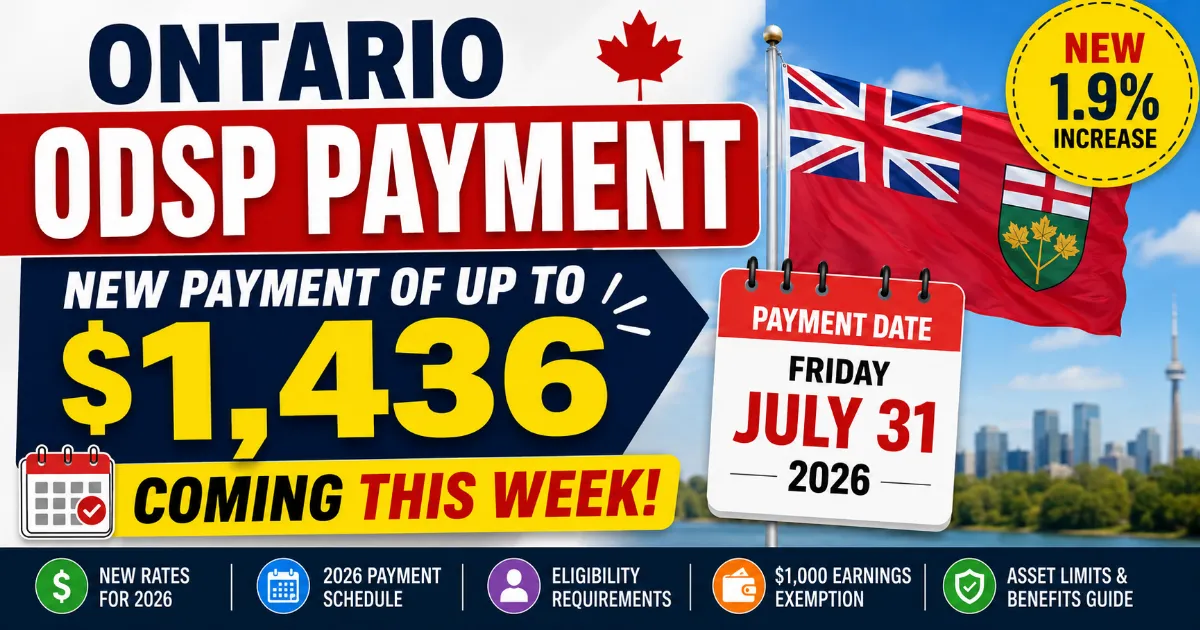
A new Ontario Disability Support Program payment is arriving on Friday, July 31, 2026, and this deposit is different from the previous one. It is the first monthly payment issued after Ontario’s latest annual inflation adjustment took effect on July 1, 2026.
For many recipients, the updated rates mean a slightly higher monthly payment without having to submit a new application or contact an ODSP office. If you already receive ODSP income support, the increase is applied automatically.
The latest adjustment may look small at first glance, but it continues a trend that started several years ago when Ontario began increasing core ODSP rates each year to reflect inflation. While some benefits have increased again this year, not every allowance under the program has changed.
In this guide, you will find the updated July 2026 payment amounts, the latest benefit rates, which parts of ODSP increased, and what recipients should know before the July 31 payment arrives.
31st July 2026 ODSP Payment Brings Updated Monthly Rates
The Ontario government has confirmed that the next ODSP payment date is Friday, July 31, 2026. This payment reflects the 1.9 percent annual inflation adjustment that became effective on July 1.
For a single person receiving the maximum amount available for both basic needs and shelter, the monthly payment can now reach up to $1,436. Previously, the maximum monthly amount was $1,408, so eligible recipients could see an increase of up to $28 per month.
The increase is automatic for current recipients. There is no need to complete additional paperwork or request the adjustment through a caseworker.
Quick Overview of the July 2026 ODSP Update
| Category | Updated Information |
|---|---|
| Next payment date | 31 July 2026 |
| Annual rate increase | 1.9% |
| Maximum payment for a single recipient | Up to $1,436 per month |
| Previous maximum | $1,408 per month |
| Maximum monthly increase | Up to $28 |
| Application required | No |
| Effective date of new rates | July 1, 2026 |
Why the July 2026 Payment Is Important
Ontario has continued linking core ODSP payments to inflation, allowing benefit rates to receive yearly adjustments instead of remaining unchanged for long periods.
Since these annual increases began in September 2022, the maximum monthly support for a single recipient has grown significantly. Before the first increase, the maximum monthly amount was $1,169. With the latest adjustment, that figure has reached up to $1,436.
Although this year’s increase is smaller than some previous adjustments, it still helps benefits keep pace with rising living expenses.
Understanding How ODSP Calculates Monthly Payments
Monthly ODSP income support is generally made up of two main parts.
The Basic Needs amount helps cover everyday living expenses such as food, clothing, and personal items.
The Shelter amount helps with housing costs such as rent, mortgage payments, utilities, or similar expenses. However, the shelter portion is based on eligible housing costs and cannot exceed the maximum amount allowed for your household.
Because of this, not every recipient receives the full shelter amount. If your actual housing expenses are lower than the maximum shelter limit, your payment for that portion may also be lower.
New ODSP Maximum Payment Rates for July 2026
The updated benefit rates apply to different family situations. The actual payment you receive may vary depending on your living arrangements, verified shelter expenses, income, and other eligibility factors.
| Family Situation | Maximum Monthly ODSP Payment |
|---|---|
| Single recipient | Up to $1,436 |
| Couple where one person qualifies for ODSP | Up to $2,148 |
| Couple where both partners qualify for ODSP | Up to $2,416 |
| Single parent with one child under 18 | Up to $1,927 |
| Single parent with two children under 18 | Up to $2,006 |
Breakdown of the New Rates for Single Recipients
For a single recipient receiving the maximum benefit:
| Payment Component | Previous Rate | New Rate |
|---|---|---|
| Basic Needs | $809 | $825 |
| Maximum Shelter | $599 | $611 |
| Total Maximum Monthly Payment | $1,408 | $1,436 |
The shelter amount shown above represents the highest amount available. If your eligible housing costs are below the maximum limit, your shelter payment will reflect your actual approved expenses instead.
Which ODSP Benefits Increased in July 2026?
The annual inflation adjustment applies mainly to the program’s core income support amounts. These include the basic monthly payment and several housing related amounts.
The following table shows which parts of ODSP received an increase this year.
| Benefit or Allowance | July 2026 Update |
|---|---|
| Basic Needs | Increased |
| Maximum Shelter | Increased |
| Board and Lodging Amounts | Increased |
| Long Term Care and Specialized Residence Amounts | Increased |
| Maximum Amount for Double Disability Couples | Increased |
| Assistance for Children with Severe Disabilities | Increased |
Which ODSP Benefits Stayed the Same?
Not every benefit under the program received an inflation adjustment this year. Several flat rate supports continue at their existing amounts.
These include:
| Benefit or Allowance | July 2026 Status |
|---|---|
| Special Diet Allowance | No change |
| Pregnancy and Breastfeeding Nutritional Allowance | No change |
| Special Boarder Allowance | No change |
| Personal Needs Allowance | No change |
| Remote Communities Allowance | No change |
| Work Related Expenses Allowance | No change |
Recipients who receive one or more of these allowances may notice that their total monthly payment does not increase by the full 1.9 percent.
What This Means for ODSP Recipients
One point many people overlook is that the published maximum payment is not automatically paid to every recipient. Your actual monthly amount depends on factors such as your household size, approved shelter costs, income, and any deductions that apply to your case.
If your rent recently increased, moved to a new address, or your family situation has changed, it is a good idea to make sure your information has already been updated with ODSP. Keeping your file current can help ensure your payment reflects the correct entitlement under the latest rates.
Another practical step is to review your MyBenefits account after the July 31 payment is issued. It allows you to confirm the payment amount, check for any notices, and quickly identify if any information on your file needs attention.
2026 ODSP Payment Schedule
Ontario generally issues ODSP payments on the last business day of each month. If the final day falls on a weekend or a public holiday, payments are normally sent on the previous business day.
Here is the current payment calendar for 2026.
| Month | Payment Date |
|---|---|
| January | January 30, 2026 |
| February | February 27, 2026 |
| March | March 31, 2026 |
| April | April 30, 2026 |
| May | May 29, 2026 |
| June | June 30, 2026 |
| July | July 31, 2026 |
| August | August 31, 2026 |
| September | September 29, 2026 |
| October | October 30, 2026 |
| November | November 30, 2026 |
| December | To be announced |
The September payment is scheduled for September 29 because September 30 is observed as the National Day for Truth and Reconciliation.
If you receive your benefits through direct deposit, the money usually appears in your bank account on the payment date. However, the exact posting time depends on your financial institution.
Can You Work While Receiving ODSP?
A common misunderstanding is that starting a job automatically reduces your ODSP payment. That is not how the program works.
Ontario allows recipients to earn a certain amount from employment before any reduction applies.
Current Earnings Exemption Rules
| Employment Income | Impact on ODSP |
|---|---|
| First $1,000 of monthly net earnings | No reduction to ODSP payment |
| Earnings above $1,000 | 75% deducted from ODSP calculation |
| Work Related Benefit | Eligible recipients may receive an additional $100 per month |
For example, if someone earns $1,000 in net employment income during the month, their regular ODSP payment is generally not reduced under the earnings exemption rules. Eligible workers may also qualify for the additional work related benefit.
Students attending high school or approved post secondary education also have different earnings rules, with many employment earnings remaining exempt.
Practical Tip
One mistake some recipients make is assuming that they should avoid part time work because they think every dollar earned will reduce their benefits.
In reality, understanding the earnings exemption can help you plan your finances better. If you start a new job, always report your income on time and keep copies of your pay statements. Late reporting can create payment adjustments later.
ODSP vs Ontario Works in 2026
Although both programs provide financial assistance, they serve different groups of people and follow different benefit rules.
One noticeable difference is that ODSP rates continue to receive annual inflation adjustments, while Ontario Works rates have remained unchanged for several years.
| Feature | ODSP | Ontario Works |
|---|---|---|
| Maximum monthly payment for a single adult | Up to $1,436 | Up to $733 |
| Monthly earnings exemption | First $1,000 exempt | First $200 exempt |
| Asset limit for a single person | $40,000 | $10,000 |
| Annual inflation adjustment | Yes | No |
| Disability required | Yes | No |
The difference between the two programs has become more noticeable because ODSP has received multiple inflation based increases since 2022, while Ontario Works has not received the same yearly adjustments.
How ODSP Rates Have Changed Since 2022
Ontario first introduced a significant increase in September 2022 before moving to annual inflation adjustments each July.
Since then, the maximum monthly amount for a single recipient has continued to grow.
| Effective Date | Increase | Maximum for Single Recipient |
|---|---|---|
| September 2022 | 5.0% | $1,228 |
| July 2023 | 6.5% | $1,308 |
| July 2024 | About 4.5% | $1,368 |
| July 2025 | 2.8% | $1,408 |
| July 2026 | 1.9% | $1,436 |
Overall, the maximum support available for a single recipient has increased by more than 22 percent since September 2022.
While the latest increase is smaller than previous years, it reflects lower inflation compared with earlier periods.
Canada Disability Benefit Can Be Paid Alongside ODSP
Another important update for eligible recipients involves the Canada Disability Benefit (CDB).
Ontario has confirmed that this federal benefit does not reduce ODSP payments. Eligible individuals may receive both benefits if they meet the requirements.
The July 2026 adjustment also increased the maximum Canada Disability Benefit payment to $204.20 per month through federal indexation.
This means an eligible single recipient receiving the maximum amounts from both programs could receive combined monthly support of up to $1,640.20, depending on their personal circumstances.
Basic Eligibility for the Canada Disability Benefit
To qualify, applicants generally need to:
- Be between 18 and 64 years old
- Hold an approved Disability Tax Credit certificate
- Meet the program’s eligibility requirements
- Complete any required application through Service Canada
ODSP Asset Limits for 2026
Besides income, ODSP also considers the value of certain assets when determining eligibility.
Here are the current limits.
| Household | Maximum Asset Limit |
|---|---|
| Single person | $40,000 |
| Couple | $50,000 |
| Additional allowance | Available for dependent children |
Some important assets are normally excluded from these limits.
These may include:
- Your primary home
- One vehicle
- Registered Disability Savings Plan (RDSP) assets
- Eligible prepaid funeral arrangements
Practical Observation
Receiving a large inheritance, insurance payment, or legal settlement can sometimes affect ODSP eligibility if the money is not handled correctly.
If you know a significant lump sum payment is coming, it is worth getting professional legal or financial advice before accepting the funds. In many situations, proper planning may help preserve your eligibility under existing ODSP rules.
Who Can Qualify for ODSP?
The Ontario Disability Support Program is designed for Ontario residents who have a qualifying disability and meet the program’s financial requirements.
In most cases, applicants must meet the following conditions:
- Be 18 years of age or older
- Live in Ontario
- Meet the program’s financial eligibility rules
- Have a physical or mental disability expected to last at least one year
- Show that the disability significantly affects daily living, employment, or participation in the community
Eligibility is assessed in two stages. The first review looks at your financial situation, while the second focuses on medical eligibility through Ontario’s disability assessment process.
Some individuals, including certain CPP Disability recipients and applicants with qualifying documentation from recognized provincial programs, may have a simplified application process under specific rules.
How the ODSP Application Process Works
Applying for ODSP is not always completed in a single step. The process usually involves several stages.
Step 1: Financial Eligibility Review
Your local ODSP office reviews your income, assets, family situation, and other financial information.
If everything required has been submitted, the initial financial review may be completed within 15 business days.
Step 2: Disability Assessment
After passing the financial review, eligible applicants receive a Disability Determination Package.
Applicants normally have 90 calendar days to complete and return the required medical forms.
Step 3: Provincial Decision
Once the completed package is received, the Disability Adjudication Unit generally issues a decision within 90 business days, although processing times can vary depending on individual circumstances.
Practical Advice
One issue that often delays applications is incomplete medical documentation.
Before submitting your package, check that every required section has been completed by your healthcare provider and that all supporting records are included. Missing information can lead to additional requests and longer processing times.
What If Your ODSP Payment Does Not Arrive?
Most payments are deposited on the scheduled payment date, but delays can occasionally happen because of banking schedules or administrative reasons.
If your payment is missing, do not panic immediately.
A few practical steps can help you identify the issue.
1. Check Your Bank Account Again
Some financial institutions process direct deposits later than others. Waiting until the end of the business day is often worthwhile.
2. Sign In to MyBenefits
Your MyBenefits account can show whether your payment has already been issued and whether there are any notices or changes on your file.
3. Review Recent Changes
Payment delays sometimes happen after:
- A change in banking information
- Missing income reporting
- Outstanding verification requests
- Changes to your household or address
- Administrative reviews
4. Contact Your Caseworker
If several business days have passed and your payment is still missing, contact your ODSP caseworker for an update.
What This Update Means for Recipients
The July 31, 2026 payment is more than just another monthly deposit. It is the first payment issued under Ontario’s latest inflation adjusted benefit rates.
While the increase may not be enough to fully offset higher living costs, it continues the province’s practice of reviewing core ODSP rates each year instead of leaving them unchanged for long periods.
If you currently receive ODSP, this is also a good time to review your file and make sure everything is up to date.
A few simple actions can help prevent future payment issues:
- Keep your address and banking information current.
- Report employment income within the required timelines.
- File your annual income tax return, even if you have little or no taxable income.
- Check your MyBenefits account regularly for important notices.
Taking these small steps can help ensure there are no unnecessary interruptions to your benefits.
FAQ
Yes. Existing ODSP recipients do not need to submit a separate application for the July 2026 increase. Updated rates are applied automatically if you remain eligible.
The published maximum applies only to recipients who qualify for the full benefit. Your actual payment depends on factors such as your housing costs, family size, income, and any applicable deductions.
Yes. ODSP allows recipients to earn employment income. The first $1,000 of eligible monthly net earnings is generally exempt before benefit reductions begin, subject to program rules.
No. Ontario has confirmed that eligible recipients can receive the Canada Disability Benefit without it being counted as income for ODSP purposes.
First check your bank account and MyBenefits account. If the payment is still missing after several business days, contact your ODSP caseworker for assistance.
Fact Check: This article is based on information published by the Government of Ontario for the Ontario Disability Support Program, official ODSP income support directives, and the announced July 1, 2026 inflation indexed benefit rates, including the confirmed July 31, 2026 payment schedule.
Disclaimer: This article is provided for general informational purposes only and should not be considered legal, financial, or immigration advice. Benefit amounts and eligibility depend on individual circumstances. Always verify the latest information through official Government of Ontario and Service Canada resources before making financial or benefit related decisions.