
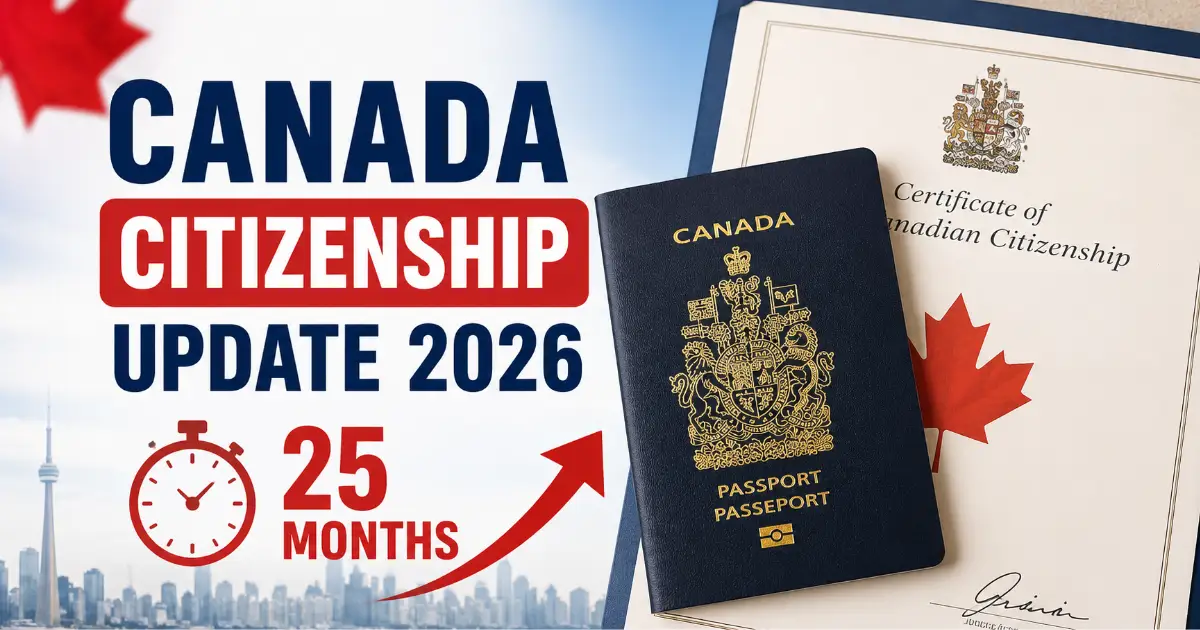
A 25-month processing estimate is now attached to Canadian citizenship certificate applications, putting proof of citizenship among the longer waits faced by some applicants in 2026.
According to the latest Immigration, Refugees and Citizenship Canada (IRCC) data available on August 10, 2026, the estimated processing time for a citizenship certificate has reached 25 months. The increase comes as the department deals with a rapidly growing inventory of applications from people seeking official confirmation of Canadian citizenship through descent.
The size of the pending inventory has also crossed a significant point. IRCC reported 121,800 active applications as of August 10. That is about 22,300 more files than the previous month, representing an increase of roughly 22 percent.
For applicants with Canadian family connections, the update is a reminder that gathering the right evidence and submitting a complete application can matter even more when the queue is expanding.
How Quickly Has the Processing Time Increased?
The current estimate is considerably higher than it was earlier in 2026.
The following figures show how the published estimate changed:
| Period | Estimated processing time |
|---|---|
| January 2026 | 10 months |
| May 2026 | 12 months |
| July 2026 | 19 months |
| August 10, 2026 | 25 months |
The change from January to August is particularly noticeable. The estimate has increased from 10 months to 25 months in roughly seven months.
The jump has also accelerated during the summer. The estimate was 19 months in July before reaching 25 months in August.
That does not mean every individual application will necessarily take exactly 25 months. Processing estimates are based on the department’s workload and operating capacity, so the actual experience can vary depending on the application and the circumstances of the file.
Why Are So Many Citizenship Certificate Applications in the Queue?
One major factor behind the growing inventory is the change to Canada’s citizenship-by-descent rules. A legislative amendment that took effect on December 15, 2025 removed the previous first-generation limit for citizenship by descent for people born before that date.
Under the amended rules described in the source information, people born before December 15, 2025 can establish a claim to Canadian citizenship through an unbroken connection to a Canadian ancestor, even where the family connection extends beyond the previous first generation.
This created a broader group of people who may need formal proof of their Canadian citizenship.
For someone who already has a Canadian parent or another qualifying Canadian connection, the legal question and the documentation process are not necessarily the same thing. A citizenship certificate is used as formal evidence of Canadian citizenship, which can then be important when applying for other Canadian documents.
A June Review Also Added Pressure to Processing Operations
The increase in processing times was not linked only to the number of new applications.
IRCC also carried out an administrative review in June 2026 involving documentation connected with previously issued citizenship certificates in the United States. During that review, the department temporarily paused finalization of new citizenship-by-descent claims. The review was completed on June 30, 2026, after which standard processing resumed.
When a department is already handling a growing inventory, even a temporary operational pause can add pressure to the overall workload. This helps explain why the processing estimate moved sharply upward during the same period that the number of applications was increasing.
What Does 121,800 Pending Applications Mean?
The inventory figure gives applicants a useful picture of the current situation.
With 121,800 active files reported on August 10, a newly submitted application is entering an already substantial queue. IRCC’s processing estimates take factors such as the existing inventory, available processing capacity and expected future applications into account.
That means the published 25-month estimate should be viewed as a planning indicator rather than a guaranteed completion date for every applicant. The important point is that the department is currently dealing with a much larger inventory than it was earlier in the year.
The Numbers at a Glance
| Latest figure | Details |
|---|---|
| Current estimated processing time | 25 months |
| Active applications | 121,800 |
| Increase from July | About 22,300 applications |
| Monthly inventory increase | About 22% |
| Latest data date | August 10, 2026 |
| June administrative review | Completed June 30, 2026 |
Who Could Be Affected by the Longer Wait?
The longer processing timeline can affect people around the world who are trying to establish or formally document Canadian citizenship through family ancestry.
The United States is particularly relevant because of the long history of movement between Canada and the U.S. Canadian communities also developed across parts of New England during the 19th and early 20th centuries.
For a person who qualifies for Canadian citizenship by descent, a citizenship certificate can provide official proof of status. That proof can then be used when seeking documents such as a Canadian passport.
Canadian citizenship also carries the right to live and work in Canada.
However, having a Canadian ancestor does not automatically mean that every applicant will qualify under the current rules. Citizenship cases can depend on the person’s date of birth, family history and the evidence available to establish the required connection.
What Should Applicants Prepare Before Applying?
The current processing time makes preparation especially useful.
Applicants should first concentrate on building a clear documentary record connecting themselves to the Canadian ancestor through each generation.
Depending on the family history, useful records can include:
- Birth certificates
- Marriage certificates
- Historical civil records
- Baptismal records
- Other official documents that help establish family relationships
The goal is not simply to collect as many documents as possible. The records need to support the relevant family connection and provide a consistent documentary trail.
A Practical Tip for Applicants
One common mistake in ancestry-based applications is starting with the application form before checking whether the family documents actually connect each generation.
A better approach is to map the family line first.
For example, an applicant can work backwards from themselves and identify each parent, grandparent and earlier generation involved in the claim. The applicant can then check whether official records exist for each relationship.
This can reveal missing documents before the application is submitted rather than after the file has already entered a long processing queue.
Should You Wait Before Submitting?
There is no advantage in delaying an application simply because the current processing estimate is long, provided the applicant has a genuine claim and is ready to submit the required evidence.
At the same time, applicants should not rush to file an incomplete application merely to enter the queue.
The more practical approach is to prepare the supporting records carefully, check the current IRCC requirements and submit when the application is ready.
Because processing estimates can change as inventory and department capacity change, applicants should also check the official IRCC information rather than relying on an older processing-time figure found elsewhere online.
How Can Applicants Follow Their Application?
After submitting an application, applicants can use the official government channels available for their application to follow its status and receive updates.
The processing estimate itself is not a personal promise about when a particular certificate will be issued. Individual files can move at different speeds depending on factors such as completeness and the work required to assess the evidence.
Applicants should therefore keep copies of their submitted documents and regularly check their official account or other IRCC communication channels for requests or updates.
What This Update Means for People With Canadian Ancestry
The biggest takeaway from the August 10 update is the combination of higher demand and a much larger inventory.
The processing estimate has moved from 10 months in January to 25 months in August, while the active inventory has reached 121,800 applications.
For people who are considering a citizenship-by-descent application, this makes preparation more important than ever. A clear family-document trail can help applicants avoid preventable problems, while checking the latest official requirements can help ensure they are using the correct process.
At the same time, applicants should remember that a processing-time estimate is not the same as an individual case decision. It can change as IRCC’s workload and processing capacity change.
Final Takeaway
The Canadian citizenship certificate queue has changed significantly during 2026. The estimated processing time reached 25 months on August 10, while the active inventory climbed to 121,800 applications.
For people pursuing proof of Canadian citizenship through descent, the best practical step is to understand the current eligibility rules and organize the family documents before submitting an application.
Because immigration and citizenship rules can change, applicants should use the latest information published by the Government of Canada when making decisions about their individual case.
Fact Check: This article is based on the processing-time and application-inventory figures reported by IRCC.com on August 10, 2026, including the reported 25-month processing estimate and 121,800 active applications. The information has been reviewed against the source article for accuracy and presented here in original language for informational purposes. Read the original IRCC.com report Readers should also verify current citizenship rules, eligibility requirements and processing times through official Government of Canada sources before making any application-related decision.
Disclaimer: This article is provided for general informational purposes only and does not constitute legal or immigration advice. Applicants should verify current requirements and processing information through official Government of Canada sources before taking action.