
Many people who are applying for a Canadian citizenship certificate are now feeling confused. Some applicants already sent their files. Some are still collecting old family records. Some are using genealogy websites to trace their Canadian parent or grandparent.
The main question is simple. What proof will IRCC accept now?
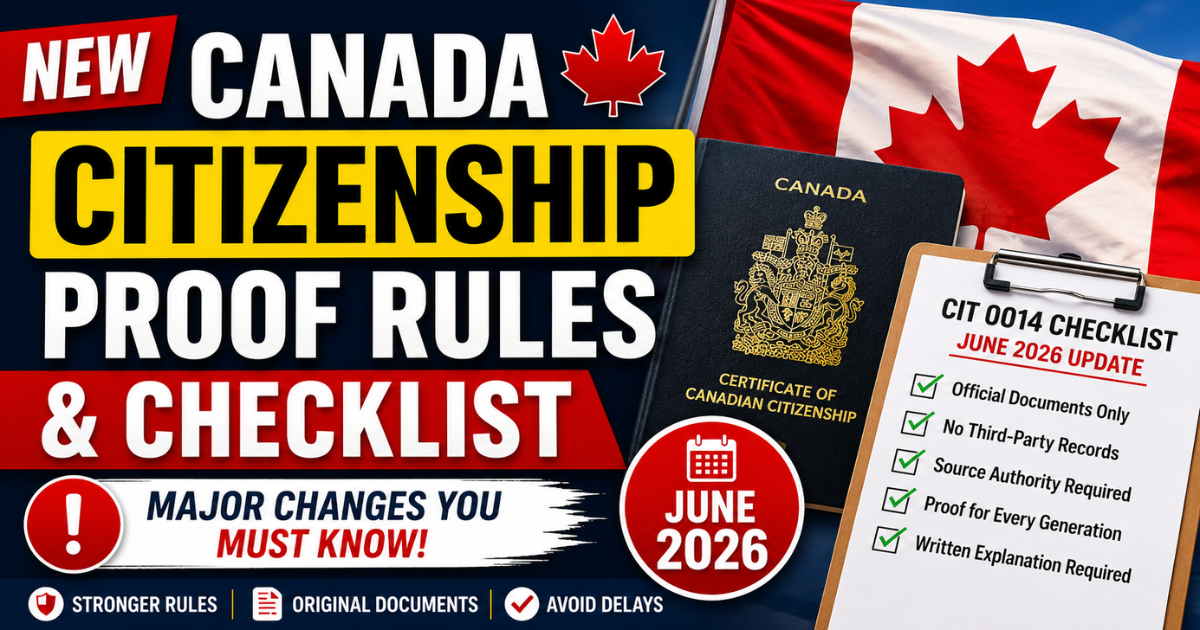
In June 2026, Immigration, Refugees and Citizenship Canada updated the CIT 0014 Document Checklist for citizenship certificate applications. This update is important for people applying for proof of Canadian citizenship, mainly through Canadian ancestry or citizenship by descent.
The biggest change is that IRCC now says an application cannot be supported only by third party records. This means applicants need stronger documents from official source authorities, such as civil registries, vital statistics offices, or other original record keeping bodies.
What Changed In The June 2026 CIT 0014 Checklist
IRCC updated the CIT 0014 checklist in June 2026. The new checklist gives clearer rules about what type of documents can support a citizenship certificate application.
- The updated form now makes three important points very clear.
- Your documents must be authentic, reliable, and verifiable.
- You must provide documents for every generation in your family line.
- Your application cannot depend only on third party records.
This is a major point for applicants who were using records from genealogy websites as their main proof. These platforms may help you find family records, but IRCC now expects you to request official records from the authority that created or keeps the record.
Why This Update Matters For Applicants
Earlier, many people used family history websites to find old records. In some cases, these records helped them build a family chain from a Canadian parent, grandparent, or older ancestor.
The issue is that a genealogy platform is not the original authority. It may show a scanned record or index, but IRCC wants stronger proof where possible.
For example, if a genealogy website shows that a birth record exists, IRCC expects the applicant to request the proper birth certificate or certified record from the official office.
This change can affect pending applications too, mainly if the file depends heavily on third party records.
What IRCC Means By Third Party Records
Third party records usually mean records collected, copied, indexed, or displayed by a platform that did not create the original record.
This can include genealogy website records, online family tree records, user uploaded family data, or record indexes from private platforms.
These records can still be useful for research. But they should not be the only proof in a citizenship certificate application.
A safer use is this.
Use genealogy websites to find where a record exists.
Then contact the original authority.
Request the official record or certified copy.
Add that official document to the IRCC application.
Documents IRCC Now Wants To See
For citizenship by descent cases, IRCC wants documents that prove both parentage and Canadian citizenship for each generation.
This means you may need proof for yourself, your parent, your grandparent, and any other ancestor in the chain.
Common documents may include:
- Birth certificate from a province or territory in Canada
- Foreign birth certificate showing parent and child link
- Canadian citizenship certificate
- Canadian naturalization certificate
- Certificate of Registration of Birth Abroad
- Certificate of Retention of Canadian Citizenship
- Old British naturalization certificate issued in Canada
- Proof of British subject status before the required date
- Proof of landed immigrant status in Canada before the required date
- Other strong evidence from an official source
- The exact documents depend on your case and your family history.
Scenario 3 Applicants Should Be Extra Careful
Scenario 3 is very important in the updated CIT 0014 checklist.
This scenario usually applies to people born outside Canada to a Canadian parent and who never had a citizenship certificate before.
For these applicants, IRCC needs proof of parentage and citizenship for every generation in the family line.
If you are using your parent, grandparent, or older ancestor to prove Canadian citizenship, your file should clearly show the link from one generation to the next.
For example:
- Your birth certificate should show your parent.
- Your parent birth certificate should show their parent.
- Your grandparent record should show their Canadian citizenship or Canadian birth.
- If any link is weak or missing, the file may face delay or review.
What To Do If A Birth Certificate Is Missing
Old family records are not always easy to find. Some people may not have a birth certificate for a parent or grandparent. Some records may be lost, damaged, or never properly registered.
IRCC has given guidance for this type of situation.
If a birth certificate is missing, you should try to provide other official documents that show the parent and child link.
These may include:
- Hospital birth record
- Record from a doctor or midwife
- Certified baptism record
- Census record
- Boat manifest
- Other official record from the time
The key point is that these records should come from the original authority where possible.
Why A Written Explanation Is Important
If you cannot get the original document, do not leave the gap unexplained.
IRCC expects applicants to explain why the document is not available. You should also show proof that you tried to get it.
This can include:
- Emails sent to the records office
- Letters from civil registry offices
- Search request receipts
- A letter saying no record was found
- Written reply from an official authority
This type of proof shows that you made a real effort. It also helps the officer understand why you are using alternative documents.
What Is A Letter Of No Record
A letter of no record is a document from an official records office. It says that the office searched for a record but could not find it.
This can be very useful when an old birth record, marriage record, or other family record is missing.
For example, if your grandparent was born in a province but the birth certificate cannot be found, you can ask the provincial vital statistics office to search its records. If nothing is found, the office may issue a letter confirming that.
You can then submit this letter with other proof, such as census records, baptism records, or other official documents.
IRCC Pause On Some Citizenship By Descent Applications
In June 2026, IRCC also confirmed that it paused the finalization of some citizenship by descent applications while it reviews certain files.
This came after some people who had already received citizenship certificates were asked to return them for review.
For affected people, this can feel stressful. But IRCC has said the review is being done to make sure applications are assessed fairly and lawfully.
People who already moved to Canada after receiving a certificate may still be able to work while the review continues. But affected people may face limits on using a Canadian passport during the review period.
Anyone who receives a letter from IRCC should read it carefully and respond with strong supporting documents.
What This Means For Pending Applicants
Many people are waiting for their citizenship certificate applications to be processed. For them, the updated checklist is a signal to review their file now.
If your application mainly used genealogy website printouts, you should try to add stronger official records.
Do not wait for IRCC to ask if you already know that your proof is weak.
A stronger file may include:
- Certified birth certificates
- Official civil registry records
- Vital statistics records
- Citizenship certificates
- Naturalization records
- Letters of no record
- Written explanation for missing documents
- Alternative official records
This does not mean every old document problem will lead to refusal. IRCC says it will consider all documents and information submitted. But a clear file is always safer than an unclear one.
Step By Step Checklist For Applicants
Step 1: Make Your Family Chain Clear
Write down every person in your citizenship chain.
Start with yourself.
Then add your parent.
Then add your grandparent or older ancestor if needed.
Make sure each generation connects clearly to the next one.
Step 2: Collect Official Birth Records
Try to get birth certificates from the official authority.
For Canadian records, this may be the provincial or territorial vital statistics office.
For foreign records, contact the civil registry or official record office in that country.
Step 3: Prove Canadian Citizenship In The Chain
You need to show where Canadian citizenship comes from.
This may be through a Canadian birth certificate, citizenship certificate, naturalization certificate, or another accepted record.
Step 4: Use Genealogy Websites Only For Research
You can use websites like Ancestry or FamilySearch to find clues.
But do not depend only on them.
If a record appears there, try to get the official copy from the original source.
Step 5: Handle Missing Records Properly
If a record is missing, request a search from the authority.
If the authority cannot find it, ask for written confirmation.
Then submit that letter with other proof.
Step 6: Add A Clear Written Explanation
Explain what document is missing.
Explain why it is missing.
Explain what steps you took to get it.
Keep the explanation simple and honest.
Step 7: Keep Proof Of Your Efforts
Save emails, letters, receipts, and official replies.
These small records can support your file.
Step 8: Get Help If The Case Is Complicated
If you received a surrender letter or your family chain is complex, speak with a licensed immigration lawyer or a Regulated Canadian Immigration Consultant.
This is better than guessing and sending weak documents.
Common Mistakes To Avoid
Relying Only On Genealogy Website Records
This is now a big risk. Genealogy records may help, but they should not be the only proof.
Not Proving Every Generation
IRCC needs to see how each person connects to the next person in the family chain.
Sending Unclear Copies
Blurry, cut, or unreadable copies can create problems. Send clear colour copies where required.
Ignoring Missing Records
If a document is missing, explain it. Do not leave the officer to guess.
Not Keeping Proof Of Search Efforts
If you tried to get a record, keep proof. Emails and official replies can help your case.
Using Unofficial Family Trees As Main Proof
A family tree made by a user is not the same as an official record. Use it only as a guide.
Who Will Be Affected Most
This update may affect people who are applying for proof of Canadian citizenship through descent.
It may also affect applicants with old family records, missing birth certificates, or long family chains.
People who already submitted applications with weak documentation may also need to review their file.
The biggest risk is for files that depend mainly on third party records, without certified records from original authorities.
Practical Example
Suppose someone was born outside Canada. Their father was also born outside Canada. Their grandmother was born in Canada.
In this type of case, the applicant must prove:
Their own birth and parentage
Their father birth and parentage
Their grandmother Canadian birth or citizenship
The link must be clear at every step.
If the applicant only submits a genealogy website page showing the grandmother birth, that may not be enough. A safer file would include the official Canadian birth certificate from the province or territory where the grandmother was born.
What Applicants Should Do Now
If you have not applied yet, build your file using official records first.
If you already applied, check what documents you submitted.
If your file depends only on third party records, consider adding official documents before a decision is made.
If records are missing, get a letter of no record and submit alternative proof.
If you received a review or surrender letter, do not ignore it. Respond before the deadline and get professional help if needed.
FAQ
You can use these platforms for research, but your application should not depend only on these records. IRCC now says the application cannot be supported solely by third party records.
The best proof is usually an official document from the original authority. This may include a birth certificate, citizenship certificate, naturalization certificate, or civil registry record.
You should try to get a letter of no record from the official authority. You can also submit other official documents, such as baptism records, census records, hospital records, or boat manifests, along with a written explanation.
IRCC has not clearly said how the new checklist will apply to every pending file. But applicants with pending files should review their documents and add stronger proof if needed.
Recent IRCC actions show that some already issued certificates were sent for review. If you receive a letter from IRCC, respond carefully and provide strong documents.
For a simple file with clear official records, you may not need one. But if your case has missing documents, old records, a surrender letter, or a long family chain, professional help can be useful.
Fact Check
This article is based on the June 2026 update to IRCC Document Checklist CIT 0014, IRCC guidance for citizenship certificate applications, and recent public reporting about the temporary pause in some citizenship by descent finalizations.
The key confirmed point is that IRCC now says a citizenship certificate application cannot be supported solely by third party records. IRCC also expects documents to be authentic, reliable, verifiable, and issued by the original authority where possible.
Applicants should always check the latest IRCC page before submitting documents because forms and rules can change.
Final Thoughts
The June 2026 CIT 0014 update makes one thing very clear. IRCC wants stronger proof for citizenship certificate applications.
Genealogy websites can help you find records, but they should not be your main proof. The safer path is to collect certified documents from original authorities and explain any missing records with proper proof.
For anyone applying through Canadian ancestry, this is the right time to review the file carefully and make the document chain as strong as possible.