
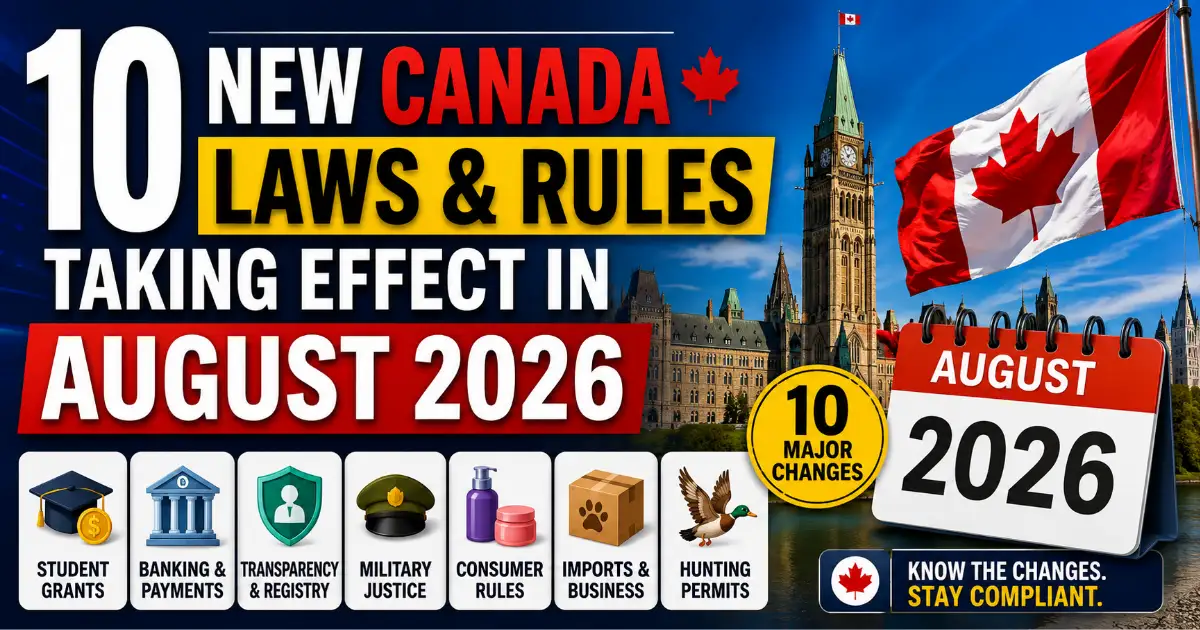
Last month mostly focused on immigration and policy announcements. August 2026 looks very different.
This month brings 10 major federal changes across several sectors at the same time. Students will continue receiving higher financial aid, banks are moving closer to real time payments, new transparency rules are coming into force, and businesses in industries like cosmetics and imports must meet fresh compliance requirements.
Not every update will affect every Canadian, but some could directly impact your education, finances, business operations, or legal responsibilities. That is why understanding which rules apply to your situation is important.
In this guide, we have explained each federal change in simple language, including what is changing, when it takes effect, who it affects, and what you should know going forward.
Quick Overview of August 2026 Federal Changes
| Effective Date | New Rule | Main People Affected |
|---|---|---|
| August 1 | Student grants and loan amounts continue | Students and families |
| August 1 | New eligibility rules for private for profit colleges | Students |
| August 1 | Cosmetic ingredient labelling expands | Cosmetic companies and consumers |
| August 1 | Tobacco warning rotation begins | Manufacturers and retailers |
| August 1 | Reserve Force education reimbursement increases | Primary Reserve members |
| August 1 | Digital migratory bird hunting permits available | Hunters |
| August 4 | Foreign Influence Transparency Registry launches | Organizations and individuals with foreign arrangements |
| August 17 | Certain military criminal offences move to civilian courts | Canadian Armed Forces |
| August 22 | New certification for pet food imported from Mexico | Importers |
| August 24 | Real Time Rail payment rules become effective | Banks and payment providers |
1. Canada Student Grants Stay Higher for the 2026 to 2027 Academic Year
Students receiving federal financial assistance will continue getting the higher grant amounts throughout the 2026 to 2027 loan year.
These enhanced grant levels remain available from August 1, 2026, until July 31, 2027, helping hundreds of thousands of students manage education costs.
Maximum federal student support
| Benefit | Maximum Amount |
|---|---|
| Full time student grant | Up to $525 per month of study |
| Typical eight month grant | Up to $4,200 |
| Part time student grant | Up to $2,520 per year |
| Students with disabilities | Up to $2,800 annually |
| Full time students with dependants | Up to $280 per dependant each month |
| Part time students with dependants | Up to $2,688 annually |
| Maximum federal student loan | $300 per week |
Around 720,000 students are expected to benefit from these funding levels.
Grant eligibility still depends on household income and family size.
2026 to 2027 Income Limits
| Family Size | Full Grant Income | Grant Ends At |
|---|---|---|
| 1 | $38,474 | $69,987 |
| 2 | $54,412 | $98,017 |
| 3 | $66,641 | $117,317 |
| 4 | $76,952 | $129,769 |
| 5 | $86,033 | $141,180 |
| 6 | $94,245 | $151,937 |
| 7 or more | $101,797 | $161,321 |
Families below the first income level generally qualify for the maximum grant, while support gradually decreases as income approaches the upper limit.
Quebec, Nunavut, and the Northwest Territories continue operating separate student assistance systems.
Practical Take
If you are planning to study during the upcoming academic year, complete your student aid application early. Many students delay submitting documents, which can slow grant approval even when they qualify.
2. New Rules for Students at Private For Profit Colleges
Another important change begins on August 1, 2026.
Most students attending private for profit postsecondary institutions will no longer qualify for the Canada Student Grant for Full Time Students.
The grant will generally remain available for students studying at:
- Public colleges and universities
- Private not for profit institutions
There is a temporary exception during the 2026 to 2027 loan year for selected priority programs, including:
- Nursing
- Dental hygiene
- Early childhood education
- Paramedic training
Outside British Columbia and Manitoba, these programs usually must be at least two years long and lead to a recognized credential.
The federal government has also increased the Canada Student Loan program borrowing limit from $34 billion to $40 billion, allowing lending to continue as demand grows.
Students attending private for profit institutions outside Canada also lose access to federal student aid beginning August 1, although some existing students may remain protected until July 31, 2029 under transition rules.
3. Canada Launches the Foreign Influence Transparency Registry
A completely new federal registry becomes operational on August 4, 2026.
The Foreign Influence Transparency and Accountability Act introduces a public registration system for certain arrangements involving foreign principals and political influence activities in Canada.
Anton Boegman officially starts serving as the first commissioner on the same day.
Registration is generally required when all three conditions apply:
- An arrangement exists with a foreign principal.
- The purpose is to influence a political or government process in Canada.
- The activity includes actions such as contacting officials, sharing information, or providing funding or services.
The law applies across federal, provincial, territorial, and municipal governments.
Registration Deadlines
| Situation | Deadline |
|---|---|
| New arrangements | Within 14 days |
| Existing arrangements before August 4 | October 3, 2026 |
Organizations that fail to comply could face administrative penalties ranging from $250 to $1 million, along with possible investigations or criminal enforcement in serious cases.
4. Certain Military Criminal Cases Will Move to Civilian Courts
Beginning August 17, 2026, major amendments to the National Defence Act change how certain Criminal Code sexual offences are handled.
Instead of proceeding through the military justice system, these cases will now fall under civilian authorities.
Under the updated framework:
- Civilian police investigate eligible offences.
- Civilian prosecutors manage prosecutions.
- Civilian courts hear the cases.
- Military courts no longer have jurisdiction over these specific Criminal Code offences committed in Canada.
Military personnel can still take immediate action when necessary to prevent harm, preserve evidence, or make an arrest before transferring responsibility to civilian authorities.
5. Canada Introduces the Legal Framework for Instant Payments
On August 24, new Real Time Rail regulations and Canadian Payments Association By law No. 10 become effective.
These rules establish the legal and operational framework for Canada’s future instant payment system.
The regulations cover:
- Clearing payments
- Settlement procedures
- Security standards
- Operational requirements
- Risk management responsibilities
Does This Mean Instant Transfers Start Immediately?
No.
August 24 only marks the legal implementation of the framework.
Banks are not required to offer instant payments to customers on that day. Consumer access is currently expected later during the fourth quarter of 2026.
What This Means for You
Most Canadians will not notice any immediate change in their banking apps this month. The biggest impact right now is on financial institutions preparing their systems for future instant payment services.
6. Cosmetic Products Must List More Fragrance Allergens
Health Canada is expanding fragrance ingredient disclosure requirements beginning August 1, 2026.
Previously, companies had to disclose 24 fragrance allergens above certain concentration levels.
That list now increases to 81 allergens for new cosmetic products entering the Canadian market.
Disclosure applies when allergen concentrations exceed:
- 0.001 percent for leave on products
- 0.01 percent for rinse off products
Products already available before August 1 receive additional time and generally have until August 1, 2028 to meet the new labelling requirements.
7. New Tobacco Health Warning Rotation Starts
Canada is introducing a new cycle of federally required tobacco health warnings on August 1.
Updated warning messages and quitting information will appear on cigarette packages and, where required, directly on individual cigarettes.
Manufacturers must follow the latest packaging requirements immediately.
Retailers have until October 31, 2026, to complete their transition.
8. New Import Certification for Pet Food From Mexico
Importers bringing pet food into Canada from Mexico will need updated certification beginning August 22, 2026.
The revised requirements apply to products such as:
- Dry pet food
- Canned pet food
- Pet treats
- Jerky products
- Various pet chews
Until August 22, businesses may continue using either the previous or updated certificates.
After the transition period ends, only the revised certification will be accepted.
Certain products, including plant based pet food, pet supplements, and rawhide only chews, are not affected.
9. Primary Reserve Members Receive Higher Education Support
Members of Canada’s Primary Reserve become eligible for larger education reimbursements for academic years starting on or after August 1, 2026.
The updated program now covers:
- 75 percent of eligible education costs
- Up to $7,500 each academic year
- Up to $30,000 during a member’s Primary Reserve service
Eligible expenses include tuition, books, laboratory fees, examinations, enrollment charges, and other mandatory educational costs.
10. Bird Hunting Permits Move Further Online
Environment and Climate Change Canada has introduced its updated online permit platform for migratory game bird hunting.
Starting August 1, hunters can obtain the 2026 permit through the new Regulatory Services Platform.
The digital system allows users to:
- Purchase permits online any time
- Download or print permits
- Store permits electronically
- Buy multiple permits in one transaction
- View previous purchases through an online account
Physical permits remain available for now, although they are expected to be phased out in future hunting seasons.
What These August 2026 Changes Mean for Canadians
Unlike many months that focus on only one major policy area, August 2026 introduces changes affecting education, banking, public administration, defence, product labelling, imports, and environmental services.
Students should review their financial aid eligibility before starting the new academic year. Businesses involved in imports, cosmetics, or regulated industries should confirm they meet the latest federal requirements before the applicable deadlines.
For most individuals, these updates may not require immediate action, but understanding which rules apply to your situation can help avoid unnecessary delays or compliance issues later.
Fact Check: This article is based on official federal announcements, Canada Gazette publications, Government of Canada regulations, and departmental guidance available as of August 1, 2026.
Disclaimer: This article is provided for general informational purposes only. It should not be considered legal, immigration, financial, or professional advice. Always verify the latest information through the relevant Government of Canada department before making decisions.