
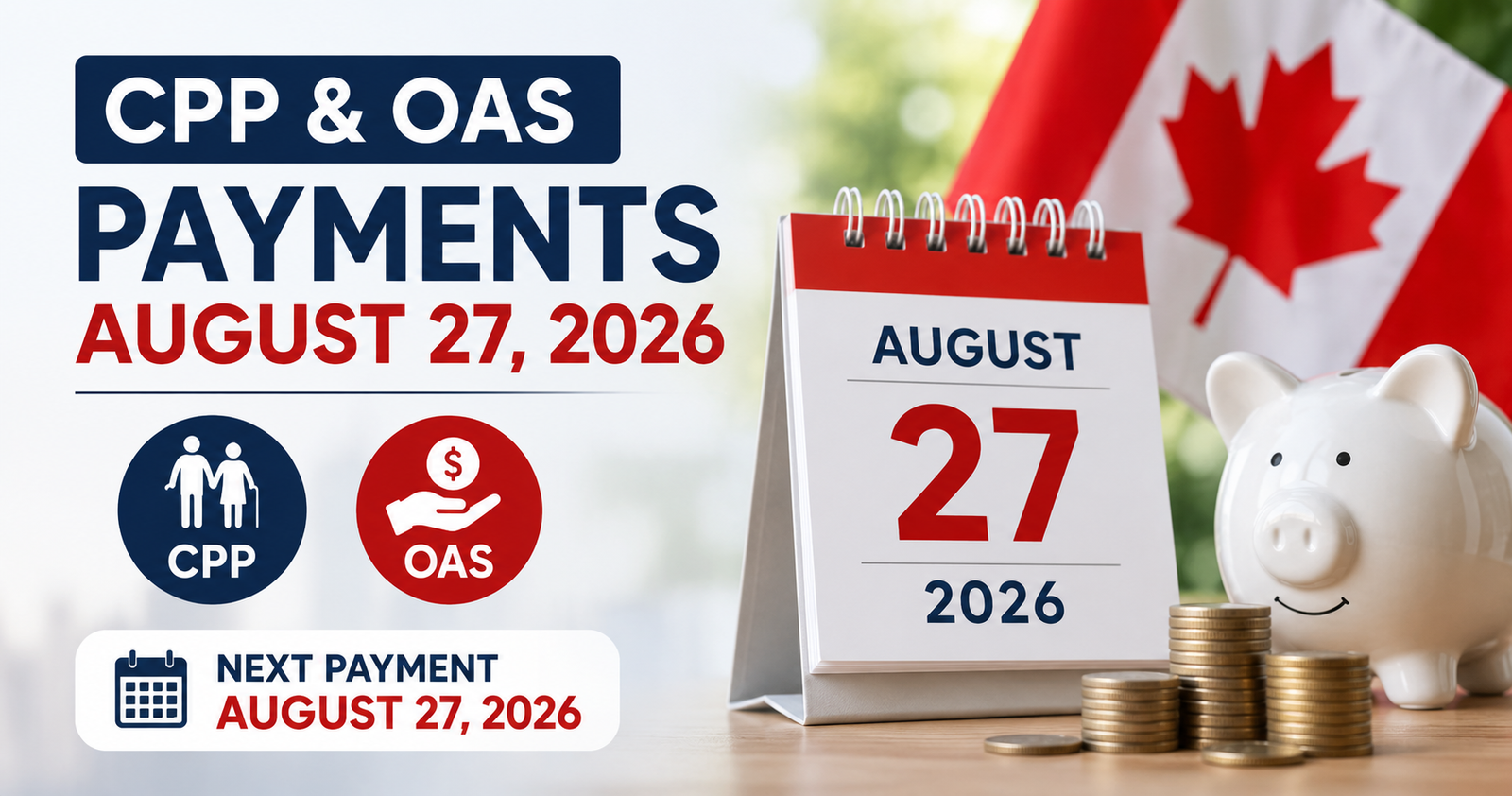
August 27, 2026, is the next CPP and OAS payment date for Canadian seniors. The deposit will use the current July-to-September OAS rates, while CPP continues at its 2026 annual level. For people searching for CPP payment dates in 2026 or the August OAS payment amount, the key point is that the date is fixed but the amount is personal.
A recipient’s payment can change with age, contribution history, years lived in Canada, marital status and income. The figures below are official maximums, not a promise of what every account will receive. Here is how to read the August payment correctly and what to check if the deposit looks different from July.
August 27 CPP and OAS payment at a glance
The Government of Canada’s 2026 benefits calendar lists Thursday, August 27, for both Canada Pension Plan and Old Age Security payments. OAS-linked benefits, including the Guaranteed Income Supplement, Allowance and Allowance for the Survivor, follow the same payment date. Although the benefits are scheduled together, CPP and OAS are calculated under different rules and may appear as separate entries in a recipient’s bank account.
| Benefit | August 2026 amount or status | What determines the actual payment |
| OAS, age 65 to 74 | Up to $751.97 | Residence history, age and income |
| OAS, age 75 and older | Up to $827.17 | Includes the automatic 10% age-75 increase; income rules still apply |
| GIS, single, widowed or divorced | Up to $1,123.17 | Previous-year income and continuing OAS eligibility |
| CPP retirement pension at age 65 | Up to $1,507.65 for a new pension starting in January 2026 | Contributions, pensionable earnings and starting age |
| Average new CPP retirement pension at age 65 | $877.01, based on April 2026 data | Published average, not an individual entitlement |
The $751.97 and $827.17 OAS figures apply to the July-to-September 2026 quarter. The maximum CPP retirement figure applies to a new pension beginning at age 65 in January 2026, while $877.01 is the published average for new age-65 beneficiaries in April. This distinction matters because many readers compare their deposit with the maximum and assume an error, even though most CPP recipients do not qualify for the ceiling.
Why two seniors can receive very different amounts on the same date
CPP is mainly contribution-based, while OAS is mainly tied to age, Canadian residence and income. A person may qualify for CPP after making at least one valid contribution, but a long record of high contributions is needed to approach the maximum pension. OAS does not require an employment history, yet the full pension generally requires 40 years of Canadian residence after age 18, and higher income can reduce the payment.
This is why an August deposit should be compared with the recipient’s own July payment and benefit statement, not with a headline maximum. A smaller payment is not automatically a mistake, and a change may come from an income reassessment, tax withholding, a new age category or updated banking information. In practice, the quickest first check is the payment record in My Service Canada Account, where the gross benefit and deductions can be reviewed separately.
OAS amounts for August 2026
For the current quarter, the official OAS payment table sets the monthly maximum at $751.97 for recipients aged 65 to 74 and $827.17 for people aged 75 or older. The higher age-75 rate comes from a permanent 10% increase, which is added automatically in the month after a recipient’s 75th birthday. Someone turning 75 in August should therefore check the September payment rather than expect the increase on their birthday.
The published maximum also assumes entitlement to a full OAS pension. A person living in Canada generally needs at least 10 years of residence after age 18 to qualify, while 40 years is normally required for the full amount. When someone has between 10 and 39 qualifying years, the partial pension is usually calculated as qualifying years divided by 40, and the recovery tax may then reduce it further if income is high.
The OAS income limit is not the same as the clawback starting point
The OAS recovery tax for payments from July 2026 through June 2027 is based on 2025 net world income. It starts when that income exceeds $93,454, not when it reaches the much higher full-recovery limits. Under the official recovery-tax rules, 15% of the income above $93,454 is recovered through reduced OAS payments.
For example, a 2025 net world income of $100,000 is $6,546 above the threshold. Fifteen per cent of that difference is $981.90, which is roughly $81.83 per month when spread across 12 payments, although the actual deduction is determined by the CRA. This is a useful check for a senior whose July or August OAS suddenly became lower even though the public maximum went up.
| OAS recovery period | Income year used | Recovery begins above | Full recovery at age 65–74 | Full recovery at age 75+ |
| July 2026 to June 2027 | 2025 | $93,454 | $152,062 | $157,923 |
| July 2027 to June 2028 | 2026 | $95,323 | $155,109 estimated | $161,088 estimated |
The 2026 upper limits for the future July 2027-to-June 2028 recovery period are still identified by the government as estimates at this stage. The $95,323 starting threshold is the figure to watch when planning 2026 taxable income, especially before a large RRSP withdrawal or capital gain. For a personal calculation, the tax return and CRA determination should take priority over a general online example.
GIS, Allowance and Survivor amounts paid with OAS
The Guaranteed Income Supplement is a tax-free monthly benefit for qualifying low-income OAS recipients living in Canada. Its amount is recalculated using the previous year’s income and, for couples, their combined income and benefit situation. The current GIS and OAS rate table applies from July through September 2026.
| Situation | Income must be below | Maximum monthly payment |
| Single, widowed or divorced | $22,800 | $1,123.17 |
| Spouse or partner receives full OAS | $30,096 combined | $676.09 |
| Spouse or partner receives the Allowance | $42,144 combined | $676.09 |
| Spouse or partner receives neither OAS nor Allowance | $54,624 combined | $1,123.17 |
| Allowance for an eligible person aged 60–64 | $42,144 combined | $1,428.06 |
| Allowance for the Survivor, age 60–64 | $30,696 | $1,702.34 |
A single person qualifying for both the full OAS rate of $751.97 and maximum GIS of $1,123.17 could receive a combined $1,875.14 for the month. That total is only an illustration because residence, income and eligibility can change the result. GIS, the Allowance and the Allowance for the Survivor are not taxable, while regular OAS and CPP benefits are taxable income.
One practical issue appears every summer: GIS is reviewed in July using the latest tax information. A late or missing 2025 tax return can interrupt income-tested benefits, even when the person was eligible in the previous year. Anyone whose GIS disappeared in July should file the outstanding return promptly, review notices in My Service Canada Account and contact Service Canada if the payment is not restored.
CPP payments stay at the 2026 annual rate
CPP does not receive a new quarterly increase in August. CPP benefits in pay rose by 2.0% for 2026, based on the annual Consumer Price Index calculation, and that adjustment has applied since January. OAS works differently because its rates are reviewed four times a year, so an OAS change in July does not mean CPP should change at the same time.
The Government of Canada’s CPP amount table lists $1,507.65 as the maximum retirement pension at age 65 for a new benefit beginning in January 2026. The latest published average for a new age-65 retirement pension is $877.01, which is a more realistic comparison for many recipients. A person’s actual CPP depends on when the pension starts, how much was earned, how long contributions were made and whether low-earning periods can be excluded under CPP rules.
Maximum CPP benefit amounts published for 2026
| CPP pension or benefit | Maximum amount |
| Retirement pension at age 65 | $1,507.65 per month |
| Post-retirement benefit at age 65 | $54.69 per month |
| Disability benefit | $1,741.20 per month |
| Post-retirement disability benefit | $610.46 per month |
| Survivor’s pension, under age 65 | $803.54 per month |
| Survivor’s pension, age 65 or older | $904.59 per month |
| Combined survivor’s and retirement pension at age 65 | $1,531.56 per month |
| Combined survivor’s pension and disability benefit | $1,756.14 per month |
| Children’s benefit, under 18 or a full-time student | $307.81 per month |
| Children’s benefit, part-time student | $153.91 per month |
| Death benefit | $2,500 one-time payment* |
*An additional $2,500 death benefit may be payable where the contributor died before collecting a CPP retirement or disability pension and did not leave an eligible survivor. The government notes that maximums for new benefits reflect the continuing CPP enhancement and can move slightly as that enhancement develops. Recipients should use their personal CPP estimate or payment record rather than adding several table maximums together, because combined-benefit limits can apply.
Starting age can make a large difference
The standard age for starting CPP is 65, but it can begin as early as 60 or as late as 70. Starting before 65 reduces the pension by 0.6% for each early month, up to 36% at age 60, while delaying after 65 adds 0.7% per month, up to 42% at age 70. OAS can also be delayed after 65, but its increase is 0.6% per month and reaches a maximum of 36% at age 70.
The larger future payment is not the only factor in a start-date decision. Cash-flow needs, health, life expectancy, taxes and GIS eligibility can change which option makes sense for a household. A common mistake is to defer OAS without realizing that GIS cannot be paid while OAS itself is being deferred, so a low-income senior should check the combined effect before changing the start date.
What working Canadians contribute to CPP in 2026
For workers and employers, the first CPP contribution rate remains 5.95% each on pensionable earnings between the $3,500 basic exemption and the 2026 Year’s Maximum Pensionable Earnings of $74,600. The maximum first-level contribution is $4,230.45 for the employee and the same amount for the employer. These contributions help build future benefits; they do not determine the amount of the August payment for someone already receiving CPP.
CPP2 applies to pensionable earnings between $74,600 and the additional ceiling of $85,000. The employee and employer rate on this band is 4%, with a maximum contribution of $416 each in 2026. A self-employed person pays both shares, bringing the combined maximum first-level and CPP2 contribution to $9,292.90 for the year.
Another OAS increase is confirmed for October
The government has confirmed a 1.4% OAS-program adjustment for October to December 2026, following the 1.2% increase that took effect in July. The first payment under the October quarter is scheduled for October 28. CPP will not receive the same quarterly change because its next regular cost-of-living adjustment is handled through the annual CPP process.
Applying 1.4% to the current maximums produces an estimated OAS rate of about $762.50 for ages 65 to 74 and about $838.75 for recipients aged 75 or older. Estimated maximums for GIS, the Allowance and the Allowance for the Survivor would also rise, but recipients should wait for the official October rate table before treating a calculated figure as final. For budgeting, the safest approach is to use the current confirmed payment and consider the October amount an estimate until Service Canada publishes the new dollar values.
What to check before and after August 27
Payment problems are often linked to account changes, outdated addresses or a benefit review rather than the national payment schedule. My Service Canada Account allows CPP and OAS recipients to review payment information, benefit details and tax documents. Checking the account before calling can show whether the payment was issued, reduced or placed under review.
- Confirm the date: August 27 is the official issue date for CPP, OAS and related OAS-program benefits.
- Review the payment record: In MSCA, open the CPP “View my payments” area or the OAS payments section and compare the gross amount and deductions with July.
- Check banking information: A direct-deposit update can take up to 30 days, so avoid closing the old account until the new destination is confirmed.
- Allow time for mailed payments: OAS and CPP cheques are mailed during the final three business days of the month and will not necessarily arrive on the direct-deposit date.
- Contact Service Canada when needed: If the payment remains unexplained or missing, call 1-800-277-9914; TTY users can call 1-800-255-4786.
Never send banking details in response to an unsolicited text, email or social-media message claiming to release a pension payment. Service Canada account updates should be completed through the official Canada.ca portal or a verified Service Canada contact channel. This simple check is especially useful around widely publicized payment dates, when benefit-themed scams often look more believable.
Remaining CPP and OAS payment dates in 2026
| Payment date | OAS rate period |
| August 27, 2026 | July–September rate |
| September 25, 2026 | July–September rate |
| October 28, 2026 | October–December rate begins |
| November 26, 2026 | October–December rate |
| December 22, 2026 | October–December rate |
The December payment arrives earlier than the usual late-month pattern, which can make the gap before January’s payment feel longer. Seniors who budget bill payments around pension deposits may want to mark both dates in advance. The complete schedule can be checked at any time on the official Government of Canada benefits calendar.
Frequently asked questions
Yes. The official federal calendar schedules both programs for August 27, along with GIS and the OAS Allowances. The benefits may still appear as separate transactions because each program calculates and records payments independently.
No. August 27 is the regular monthly CPP and OAS payment date, not a new bonus announced for all seniors. OAS recipients are receiving the quarterly rate that began in July, while CPP continues under its annual 2026 adjustment.
No. Those are maximum figures for specific situations, and most people will receive a different amount. CPP depends heavily on contribution and earnings history, while OAS can be affected by residence, income, age and whether the recipient qualifies for a full or partial pension.
The July review also brought updated income information into the 2026–2027 benefit cycle. A recovery-tax deduction, a partial OAS pension, voluntary tax withholding or a GIS reassessment can outweigh the quarterly rate increase. Compare the gross amount and deductions in MSCA before assuming the published rate was applied incorrectly.
OAS-program benefit rates are set to rise by 1.4% for the October-to-December quarter. The current OAS maximums would become approximately $762.50 for ages 65 to 74 and $838.75 for age 75 and older, subject to the official dollar table. CPP does not receive a matching October increase because CPP adjustments are annual rather than quarterly.
Fact Check: This information is based on Government of Canada payment dates, CPP monthly amounts, OAS rate tables and OAS recovery-tax guidance available on August 25, 2026.
Disclaimer: This article is for general information only and is not financial, tax, legal or benefits advice; verify your personal entitlement through Canada.ca or Service Canada.