
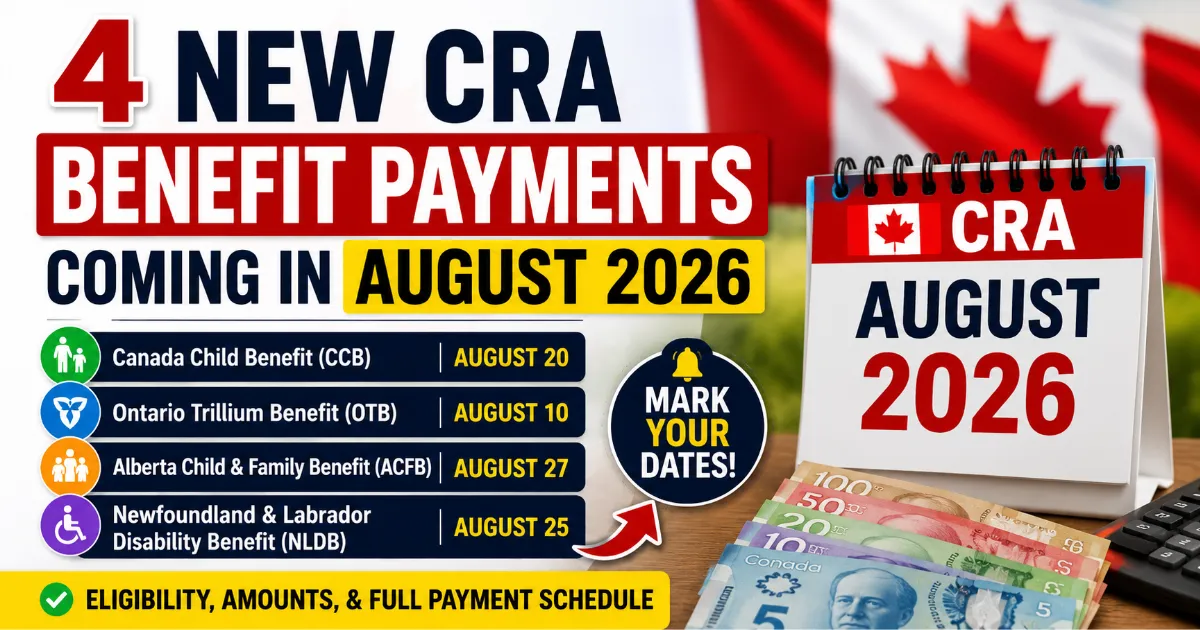
Imagine a family in Ontario waiting for their monthly government benefits while preparing for back to school expenses. At the same time, a parent in Alberta is expecting a quarterly payment, and an eligible resident in Newfoundland and Labrador is checking for disability support. August 2026 is an important month because four CRA benefit payments are scheduled across different dates, providing financial help to eligible Canadians.
The Canada Revenue Agency (CRA) will issue payments under several benefit programs during August 2026, including the Canada Child Benefit (CCB), Ontario Trillium Benefit (OTB), Newfoundland and Labrador Disability Benefit (NLDB), and the Alberta Child and Family Benefit (ACFB). These payments are based on your 2025 income tax return, which means your benefit amount may be different from what you received earlier this year if your income or family situation has changed.
In this guide, you’ll find the complete CRA benefit payment schedule for August 2026, updated payment amounts, eligibility rules, income limits, and practical tips to help you understand which benefits you may qualify for. Whether you are looking for the CRA payment dates, Canada Child Benefit August 2026, or other provincial benefit payments, this article explains everything in one place using the latest official information.
CRA Benefit Payment Dates for August 2026
The CRA has scheduled four separate benefit payments during August. Each benefit follows its own payment calendar, so not everyone will receive money on the same date.
| CRA Benefit | Payment Date |
|---|---|
| Ontario Trillium Benefit | August 10, 2026 |
| Canada Child Benefit | August 20, 2026 |
| Newfoundland and Labrador Disability Benefit | August 25, 2026 |
| Alberta Child and Family Benefit | August 27, 2026 |
Depending on where you live and which programs you qualify for, it is possible to receive more than one CRA payment during the month.
Why Your August Payment May Be Different
One question many Canadians ask every summer is why their benefit amount suddenly changes.
The answer is simple. Every July, the CRA starts a new benefit year and recalculates most income tested benefits using the latest tax return on file. For August 2026, payments are based on your 2025 income tax return instead of your 2024 return.
This means your benefit could increase if your household income went down during 2025. On the other hand, families with higher income may receive a lower payment because these programs are designed to provide more support to lower and middle income households.
Another reason for changes is the annual inflation adjustment. Benefit rates for the 2026 to 2027 benefit year were increased after the confirmed 2 percent indexation, allowing eligible Canadians to receive slightly higher maximum payments than last year.
Practical Tip: If your August payment looks different from what you expected, check your latest Notice of Assessment and compare it with your 2025 tax return. In many cases, the updated family income is the main reason behind the change.
Canada Child Benefit Payment in August 2026
The Canada Child Benefit (CCB) remains one of the largest monthly financial support programs available to Canadian families raising children.
This tax free benefit helps parents cover everyday expenses such as groceries, school supplies, clothing, childcare, and other costs involved in raising children under the age of 18.
The next Canada Child Benefit payment is scheduled for August 20, 2026.
Since this is the second payment of the new benefit year, every amount is calculated using your family’s 2025 adjusted family net income.
Updated Canada Child Benefit Amounts for 2026 to 2027
The maximum benefit depends on the age of your child.
| Child’s Age | Maximum Annual Benefit | Maximum Monthly Benefit |
|---|---|---|
| Under 6 years | $8,157 | $679.75 |
| Age 6 to 17 | $6,883 | $573.58 |
Compared to the previous benefit year, eligible families can receive higher support because of the annual increase.
Children under six can receive up to $160 more each year, while children between six and seventeen may receive up to $135 more annually.
The actual amount your family receives will depend on your adjusted family net income and the number of eligible children living in your household.
How Family Income Affects Your CCB Payment
Not every family receives the maximum payment.
Families with a 2025 adjusted family net income below $38,237 can generally receive the full Canada Child Benefit for each eligible child.
Once income rises above this amount, the benefit gradually begins to decrease. The reduction depends on several factors, including:
- Your adjusted family net income
- Number of eligible children
- Age of each child
- Family circumstances
A second reduction calculation applies after family income exceeds $82,847, resulting in lower monthly payments for higher income households.
Because every family situation is different, two households with similar income may still receive different CCB amounts.
Extra Support Through the Child Disability Benefit
Some families qualify for additional monthly assistance through the Child Disability Benefit (CDB).
This payment is available for children who qualify for the Disability Tax Credit (DTC) and is paid in addition to the regular Canada Child Benefit.
For the 2026 to 2027 benefit year, eligible families can receive:
| Benefit | Maximum Amount |
|---|---|
| Child Disability Benefit | $3,480 per year |
| Approximate Monthly Amount | $290 |
The exact amount depends on household income, but eligible families can receive this benefit alongside their regular monthly CCB payment.
Who Can Receive the Canada Child Benefit?
To qualify for the Canada Child Benefit, you must meet the CRA’s eligibility requirements.
Generally, you must:
- Live with the child and be mainly responsible for their care.
- Be a Canadian citizen, permanent resident, protected person, eligible person under the Indian Act, or an eligible temporary resident who meets the CRA residency requirements.
- File your annual income tax return every year, even if you had no income.
- Ensure both spouses or common law partners also file their tax returns if applicable.
Parents who share custody usually receive 50 percent of the benefit based on each parent’s individual entitlement.
What This Means for Families
One common mistake families make is assuming their benefit continues automatically forever. While the program itself continues if you remain eligible, the CRA still needs your latest tax information each year to calculate the correct payment.
If you recently welcomed a child, changed your marital status, moved to a new address, or your custody arrangement changed, updating your information with the CRA as soon as possible can help prevent payment delays or future overpayments.
For many households, the Canada Child Benefit remains the largest monthly government payment they receive, so keeping your records current is just as important as filing your tax return on time.
Ontario Trillium Benefit Payment for August 2026
While the Canada Child Benefit supports families across the country, Ontario residents may also receive another important provincial payment during August.
The Ontario Trillium Benefit (OTB) is scheduled to be deposited on August 10, 2026. This tax free payment combines several Ontario tax credits into one monthly benefit and is designed to help eligible residents manage expenses such as housing, energy costs, and sales tax.
Unlike the CCB, eligibility for the OTB depends on the specific provincial credits you qualify for through your 2025 income tax return.
What Is Included in the Ontario Trillium Benefit?
Many Ontario residents think the Ontario Trillium Benefit is a single government program. In reality, it combines three different provincial tax credits into one monthly payment. This makes the process easier because eligible residents receive one deposit instead of separate payments.
The next Ontario Trillium Benefit (OTB) payment is scheduled for August 10, 2026. Like other CRA benefits, the amount is calculated using information from your 2025 income tax return.
Depending on your situation, you may qualify for one, two, or even all three credits that make up the Ontario Trillium Benefit.
1. Ontario Energy and Property Tax Credit (OEPTC)
The Ontario Energy and Property Tax Credit helps residents who paid eligible housing related expenses during 2025.
This includes people who:
- Paid rent for their main home in Ontario
- Paid property taxes as homeowners
- Lived in a long term care home
- Lived on a reserve and paid eligible housing costs
For the 2026 to 2027 benefit year, the maximum annual amounts are:
| Eligible Resident | Maximum Annual Amount |
|---|---|
| Adults aged 18 to 64 | $1,307 |
| Seniors aged 65 or older | $1,488 |
| Residents of reserves or public long term care homes | Up to $290 |
| Students living in designated residences during 2025 | Up to $25 |
The actual payment depends on your income and the eligible expenses you reported on your tax return.
2. Ontario Sales Tax Credit (OSTC)
The Ontario Sales Tax Credit is designed to offset part of the provincial sales tax paid by lower and moderate income households.
Unlike the property tax credit, you do not need to calculate this benefit separately. The CRA determines your eligibility automatically after reviewing your tax return.
For the current benefit year, eligible individuals can receive up to:
| Eligible Person | Maximum Annual Credit |
|---|---|
| Individual | $378 |
| Spouse or common law partner | $378 |
| Each eligible child under 19 | $378 |
For larger families, these credits can significantly increase the overall Ontario Trillium Benefit.
3. Northern Ontario Energy Credit (NOEC)
Residents living in Northern Ontario may also qualify for additional support through the Northern Ontario Energy Credit.
This program helps eligible households manage higher energy costs that are common in northern communities.
Maximum annual amounts include:
| Household Type | Maximum Annual Amount |
|---|---|
| Single individual | $189 |
| Families | $290 |
Eligibility depends on where you lived during 2025 and the information provided on your income tax return.
Who Can Receive the Ontario Trillium Benefit?
Each credit has its own eligibility rules, but filing your 2025 income tax return is the first and most important requirement.
In general, you may qualify if:
- You were an Ontario resident.
- You filed your 2025 income tax return.
- You qualify for at least one OTB credit.
- You meet the age or family requirements for the credit you are claiming.
For the Ontario Sales Tax Credit, you generally must be at least 19 years old, have a spouse or common law partner, or be a parent living with your child.
To receive the Ontario Energy and Property Tax Credit or the Northern Ontario Energy Credit, you must also complete Form ON BEN when filing your Ontario tax return.
Practical Observation: Every year, many eligible people miss out on part of their Ontario Trillium Benefit because they forget to complete Form ON BEN. Even if you qualify based on your income, missing this form can prevent the CRA from calculating the energy and property tax credits.
Will Everyone Receive Monthly OTB Payments?
Not always.
If your total Ontario Trillium Benefit entitlement is $500 or less for the benefit year, the CRA generally issues the entire amount as a single payment in July instead of monthly deposits.
Households receiving more than $500 usually continue receiving monthly payments throughout the benefit year.
What This Means for Ontario Residents
The Ontario Trillium Benefit can provide valuable support beyond federal benefits like the Canada Child Benefit. If you are eligible for multiple OTB credits, your monthly payment can help cover regular household costs such as rent, property taxes, electricity, or other essential living expenses.
If you recently moved, changed your marital status, or corrected information on your 2025 tax return, it is worth checking your CRA My Account before the August payment date. Small updates to your tax information can sometimes change your monthly entitlement.
Alberta Child and Family Benefit Payment in August 2026
Families living in Alberta have another important payment arriving later in the month.
The Alberta Child and Family Benefit (ACFB) will be paid on August 27, 2026. Unlike the Canada Child Benefit, this program is issued four times each year and is administered by the CRA on behalf of the Government of Alberta.
August is especially important because it is the first quarterly payment based on the updated 2026 to 2027 benefit year calculations.
Alberta Child and Family Benefit Payment in August 2026
Families living in Alberta have another important payment scheduled before the end of August.
The Alberta Child and Family Benefit (ACFB) will be issued on August 27, 2026. Unlike the Canada Child Benefit, this program is paid every three months and is managed by the Canada Revenue Agency on behalf of the Government of Alberta. The August payment is also the first quarterly deposit based on the updated 2026 to 2027 benefit rates that use information from your 2025 income tax return.
One advantage of the ACFB is that eligible families can receive support through two different payment components. If you meet the conditions for both, they are combined into a single quarterly payment.
Alberta Child and Family Benefit Maximum Amounts for 2026 to 2027
The maximum benefit depends on how many children are included in your household.
| Number of Children | Base Component | Working Component | Maximum Annual Benefit |
|---|---|---|---|
| 1 Child | $1,529 | $782 | $2,311 |
| 2 Children | $2,293 | $1,494 | $3,787 |
| 3 Children | $3,057 | $1,920 | $4,977 |
| 4 or More Children | $3,821 | $2,061 | $5,882 |
These figures represent the highest annual benefit available before income reductions are applied.
Understanding the Two ACFB Components
Unlike some other provincial programs, the Alberta Child and Family Benefit is divided into two separate parts.
Base Component
This portion is mainly designed for lower income families with children.
The base amount begins to reduce once your adjusted family net income exceeds $28,116.
Working Component
Families with employment income may also qualify for the working component.
To receive this part of the benefit:
- Employment income must be above $2,760
- The benefit begins to reduce once family income exceeds $47,115
Since these two components are calculated separately, many working families receive support from both.
Who Can Receive the Alberta Child and Family Benefit?
To qualify, you generally must:
- Be a resident of Alberta.
- Have one or more children under 18 years of age.
- File your annual income tax return.
- Meet the program’s income requirements.
One helpful feature of this program is that there is no separate application for most families.
If you already qualify for the Canada Child Benefit, the CRA automatically reviews your eligibility for the Alberta Child and Family Benefit using the information from your tax return.
Does Receiving Other Alberta Benefits Affect the ACFB?
Many parents worry that receiving provincial assistance could reduce their Alberta Child and Family Benefit.
For most eligible families, that is not the case.
Programs such as:
- Alberta Income Support
- Assured Income for the Severely Handicapped (AISH)
- Alberta Child Care Subsidy
do not reduce or replace your Alberta Child and Family Benefit.
This allows eligible households to receive support from multiple provincial programs if they qualify.
Practical Take: If your family welcomed a new child during 2025 or your employment income changed significantly, check your CRA My Account before the August payment. Small changes in family income or household information can affect the quarterly amount more than many parents expect.
Newfoundland and Labrador Disability Benefit Payment
Residents of Newfoundland and Labrador who qualify for the Disability Tax Credit may also receive another monthly payment during August.
The Newfoundland and Labrador Disability Benefit (NLDB) is scheduled for August 25, 2026. This provincial benefit is administered by the CRA and provides additional financial assistance to eligible adults living with disabilities.
Unlike many disability programs that require a separate monthly application, this benefit is generally assessed automatically once the required eligibility conditions have been met.
How Much Can You Receive?
For the current benefit year, eligible individuals can receive:
| Benefit | Maximum Amount |
|---|---|
| Monthly Payment | Up to $400 |
| Annual Value | Up to $4,800 |
Individuals whose adjusted family net income is below $29,402 may qualify for the full monthly benefit.
Partial payments remain available for households with income above this level, depending on family circumstances.
Couples where both spouses qualify for the Disability Tax Credit may continue receiving support until combined household income reaches the higher program threshold.
Who Is Eligible for the NLDB?
To qualify, you generally must:
- Be between 18 and 64 years of age.
- Live in Newfoundland and Labrador.
- Have an approved Disability Tax Credit (DTC) certificate.
- File your 2025 federal income tax return.
No separate provincial application is usually required once your Disability Tax Credit has been approved and your tax return has been processed.
An Important Benefit for Eligible Couples
One feature that many people are not aware of is that eligible couples may each receive the disability benefit if both partners qualify for the Disability Tax Credit.
In those situations, the total household benefit can reach $800 per month, providing significantly more support for families managing disability related expenses.
Practical Observation: If you recently applied for the Disability Tax Credit, remember that approval can take time. Many people assume they will receive the NLDB immediately after submitting Form T2201, but payments generally begin only after the CRA has approved the DTC and updated your account.
CRA Benefits That Are Not Scheduled for August
Although August includes four CRA administered benefit payments, some popular federal programs will not issue deposits this month.
Knowing this can help avoid unnecessary concern if you were expecting another payment.
Canada Groceries and Essentials Benefit
The Canada Groceries and Essentials Benefit (CGEB) follows a quarterly payment schedule.
The next payment is scheduled for October 5, 2026, rather than August.
Advanced Canada Workers Benefit
Eligible workers receiving advance payments under the Advanced Canada Workers Benefit (ACWB) will also need to wait until October 9, 2026 for the next scheduled payment.
CPP and OAS
Many Canadians also receive Canada Pension Plan (CPP) or Old Age Security (OAS) payments during August.
These payments are scheduled for August 27, 2026, but they are administered by Service Canada, not the Canada Revenue Agency.
Remaining CRA Benefit Payment Dates for 2026
If you receive more than one government benefit, keeping track of upcoming payment dates can make monthly budgeting much easier. The CRA follows a fixed payment calendar for most benefit programs, so knowing the schedule in advance helps you avoid unnecessary worry if a deposit has not arrived yet.
Here are the remaining CRA administered payment dates for the rest of 2026.
| Benefit Program | August | September | October | November | December |
|---|---|---|---|---|---|
| Canada Child Benefit (CCB) | Aug. 20 | Sept. 18 | Oct. 20 | Nov. 20 | Dec. 11 |
| Ontario Trillium Benefit (OTB) | Aug. 10 | Sept. 10 | Oct. 9 | Nov. 10 | Dec. 10 |
| Alberta Child and Family Benefit (ACFB) | Aug. 27 | — | — | Nov. 27 | — |
| Newfoundland and Labrador Disability Benefit (NLDB) | Aug. 25 | Sept. 25 | Oct. 23 | Nov. 25 | Dec. 24 |
| Canada Groceries and Essentials Benefit (CGEB) | — | — | Oct. 5 | — | — |
| Advanced Canada Workers Benefit (ACWB) | — | — | Oct. 9 | — | — |
Payment dates are based on the official Government of Canada benefits calendar. If you receive payments by direct deposit, the money is usually available on the scheduled date. Cheque payments can take several additional business days to arrive.
How to Make Sure You Receive Your CRA Benefits on Time
Most CRA benefit delays happen because of missing tax information or outdated personal details. The good news is that these issues can often be avoided with a few simple steps.
1. File Your 2025 Income Tax Return
This is the most important requirement for almost every CRA benefit.
Even if you had little or no income during 2025, filing your tax return allows the CRA to calculate your eligibility and continue your payments without interruption.
Many Canadians believe they do not need to file because they earned nothing during the year. In reality, skipping your tax return can stop several benefit payments.
2. Keep Your Personal Information Updated
Your payment amount depends on your current family situation.
Report changes to the CRA if you have:
- Changed your address
- Got married or separated
- Had a new baby
- Started or ended a shared custody arrangement
- Experienced another major family change
Updating this information quickly helps reduce the risk of incorrect payments.
3. Register for Direct Deposit
Direct deposit is still the fastest and safest way to receive CRA payments.
Instead of waiting for a cheque in the mail, eligible payments are deposited directly into your bank account on the payment date.
4. Check CRA My Account Regularly
Your CRA My Account can show:
- Upcoming payment dates
- Expected payment amounts
- Recent payment history
- Benefit notices
- Requests for additional information
Checking your account before each payment date can help you identify problems early.
Practical Tip: Around July and August each year, many payment amounts change because the CRA starts a new benefit year. If your August deposit looks different from earlier payments, compare your latest Notice of Assessment with your 2025 tax return before assuming there is a mistake.
What Should You Do If Your Payment Does Not Arrive?
Missing a payment can be stressful, especially if you depend on government benefits for everyday expenses.
Before contacting the CRA, consider these steps:
Check Your CRA My Account
Confirm that:
- Your payment has been issued.
- Your banking information is correct.
- No review or adjustment has been applied.
Wait for Cheque Delivery
If you receive payments by mail, allow five to ten business days after the official payment date before reporting a missing payment.
Contact the CRA
If the payment still has not arrived after the recommended waiting period, contact the CRA to ask about the status of your benefit.
Having your Social Insurance Number and personal information ready can make the process quicker.
What These August Payments Mean for Canadian Families
August is one of the busier months in the CRA payment calendar because several important programs are issued within just a few weeks.
For many households, these benefits help cover everyday costs such as:
- Rent or housing expenses
- Groceries
- Children’s school supplies
- Utility bills
- Transportation
- Disability related expenses
Another important point to remember is that these payments are based on your 2025 tax return, not your current income. If your financial situation changes during 2026, the impact will generally be reflected when the CRA recalculates benefits for the next benefit year.
From practical experience, one of the most common mistakes people make is assuming that government benefits renew automatically every year. While many programs continue without a new application, they still depend on your annual tax return and accurate personal information. Taking a few minutes to keep your records up to date can help prevent payment interruptions later.
FAQ
Yes. Each benefit has its own eligibility rules. If you qualify for multiple programs, you may receive several CRA deposits during the same month.
Most CRA benefits for the 2026 to 2027 benefit year are calculated using your 2025 income tax return. A change in family income, marital status, or annual indexation can affect the amount you receive.
No. Payments such as the Canada Child Benefit, Ontario Trillium Benefit, Alberta Child and Family Benefit, and Newfoundland and Labrador Disability Benefit are generally tax free and do not need to be reported as taxable income.
Late filing can delay your benefit calculations. Once the CRA processes your return and confirms your eligibility, any missed payments that you qualify for are generally issued retroactively.
You can sign in to CRA My Account to view your upcoming payment dates, benefit amounts, payment history, and any changes made after your latest tax assessment.
Final Words
August 2026 includes four important CRA administered benefit payments, giving financial support to families, low income households, and eligible people living with disabilities across Canada.
The key payment dates to remember are August 10, August 20, August 25, and August 27. Since these benefits are based on your 2025 tax return, it is a good idea to review your CRA My Account before each payment date to confirm that your personal information and banking details are up to date.
Whether you receive one benefit or several, staying informed about payment schedules and eligibility rules can help you avoid delays and better manage your monthly finances.
Fact Check: Payment dates, benefit amounts, eligibility rules, and income thresholds mentioned in this article are based on official information published by the Canada Revenue Agency and the Government of Canada for the 2026 to 2027 benefit year. Readers should refer to the latest official announcements for any future updates.
Disclaimer: This article is provided for general informational purposes only. It should not be considered financial, tax, legal, or immigration advice. Benefit eligibility and payment amounts depend on individual circumstances and official CRA assessments.