
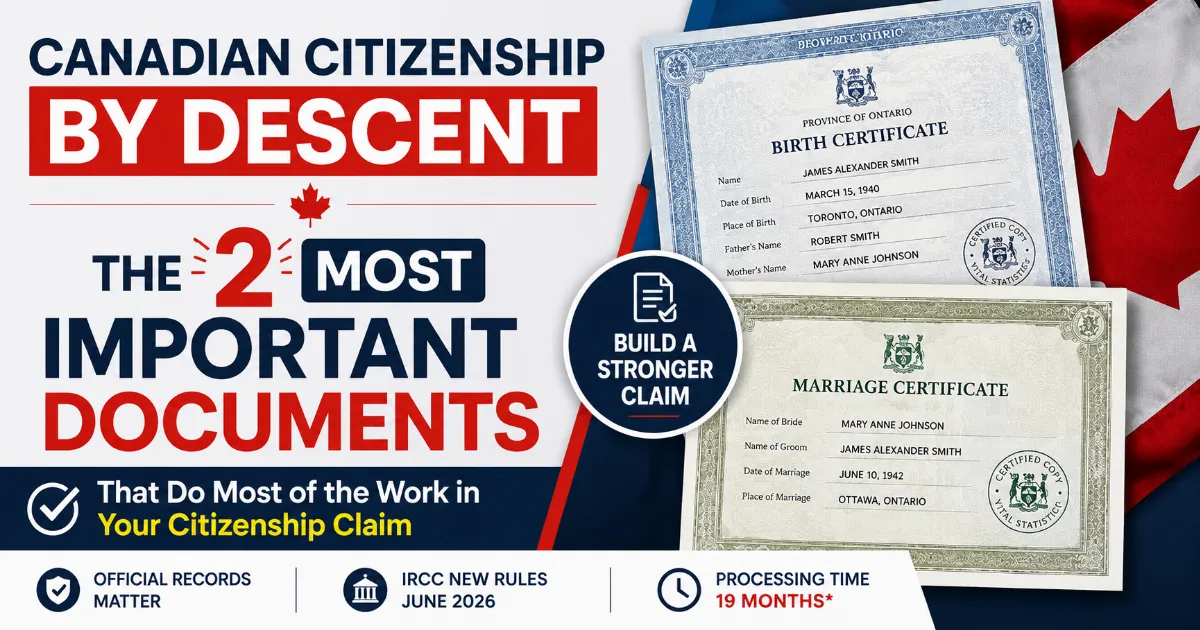
Finding old family records is often the hardest part of a Canadian citizenship by descent application. Many applicants spend weeks searching through family papers before realizing that only a few documents truly help build a strong citizenship claim.
If your application is based on a Canadian parent, grandparent, or another eligible ancestor, two records usually become the foundation of the entire process. These documents help prove your family connection while also making it easier to locate the remaining records needed for your application.
Why Your Family Document Trail Matters
Canadian citizenship by descent is based on proving an uninterrupted family relationship from a Canadian citizen to you. Every generation must be connected with official records.
Instead of proving only one person’s identity, you must show that every parent child relationship in your family line can be verified with reliable government accepted documents.
Missing even one important record can slow down your application or lead to requests for additional evidence.
The Two Most Valuable Documents
Although Immigration, Refugees and Citizenship Canada (IRCC) requests several supporting records, these two documents usually provide the strongest evidence.
| Document | Why It Matters |
|---|---|
| Birth Certificate or Certified Baptism Record | Confirms birth details, identifies parents, and often proves Canadian citizenship for Canadian born ancestors. |
| Marriage Certificate | Connects family members when surnames change and confirms legal name changes across generations. |
These documents often unlock additional records because they contain names, dates, locations, and family information needed for the next stage of your research.
IRCC Introduced Stricter Document Rules
In June 2026, IRCC updated its document requirements for citizenship by descent applications.
Applicants now need records issued directly by the government office or archive responsible for creating and maintaining them. This includes civil registries, provincial vital statistics offices, and official archives.
Documents downloaded from genealogy websites may still help you locate records, but they are no longer accepted as primary evidence on their own.
This change means applicants should begin requesting official certified copies as early as possible because older records can sometimes take months to obtain.
Why Birth Certificates Are So Important
For many applications, a birth certificate becomes the starting point of the entire citizenship chain.
When an ancestor was born in Canada, the birth certificate generally serves two important purposes.
First, it identifies the child’s parents.
Second, because Canada grants citizenship to most people born in the country, it also helps establish Canadian citizenship for that ancestor. The main exceptions involve children born to certain foreign diplomats.
Long form birth certificates are usually the better choice because they contain additional family information, including parents’ names. Short form certificates may leave out details that IRCC needs to review.
What If No Birth Certificate Exists?
Older family records are not always available.
If a civil birth registration was never created, IRCC may accept other official records issued by the original authority, including:
- Certified baptism records
- Hospital birth records
- Physician or midwife records
- Census records
- Passenger or ship manifests
These alternatives are considered only when they come from the original record keeping authority.
Special Rules for Quebec Records
Applicants using Quebec records need to pay extra attention.
IRCC accepts Quebec birth and marriage certificates issued after January 1, 1994.
If an older certificate was printed before that date, applicants usually need either:
- A certified reproduction from Bibliothèque et Archives nationales du Québec (BAnQ), or
- A newly issued certificate from the Directeur de l’état civil (DEC).
The important date is when the certificate was issued, not when the birth or marriage actually occurred.
Why Marriage Certificates Matter Just As Much
Marriage certificates often solve identity questions that appear during citizenship applications.
One of the most common situations involves surname changes after marriage.
For example, a woman may appear under her birth surname on one document but under her married surname on her child’s birth certificate. Without the marriage certificate, those records may appear to belong to different people.
Marriage certificates also help when families changed the spelling of their surname after immigration. Older records sometimes include both spellings, making it much easier to connect generations accurately.
Another benefit is that many marriage records include the names of both parents, allowing applicants to continue researching earlier generations.
Some Marriage Certificates Are Required for Eligibility
Certain historical citizenship cases depend directly on a marriage certificate.
For example, women who married a Canadian born or Canadian naturalized British man before January 1, 1947, or before April 1, 1949, in Newfoundland and Labrador, may fall under special IRCC citizenship rules.
In these situations, the marriage certificate becomes a primary document instead of simply supporting evidence.
These applications are generally processed using paper applications.
What Happens If a Record Cannot Be Found?
Older records sometimes no longer exist or cannot be located.
Under IRCC’s updated rules, simply explaining that a document is missing is no longer enough.
Applicants should also provide proof that they attempted to obtain the record.
Useful supporting evidence may include:
- Letters from archives
- Search results from provincial record offices
- Official no record certificates
- Email correspondence with government record holders
Showing documented search efforts has become much more important under the updated requirements introduced in June 2026.
A Simple Example
Imagine someone living in the United States whose grandmother was born in Ontario.
The grandmother’s Ontario birth certificate confirms her Canadian birth and identifies her parents.
Her marriage certificate shows her legal surname after marriage.
The father’s birth certificate then identifies her under that married surname.
Finally, the applicant’s own birth certificate connects them to their father.
Together, these records create a complete family chain that supports a citizenship by descent application.
Practical Tip Before You Begin
One pattern I have noticed while following citizenship by descent applications is that most delays happen before the application is even submitted. Applicants often spend too much time searching randomly instead of starting with the closest available official document.
A better approach is to collect one certified record at a time. Every new document usually provides another name, date, location, or family detail that makes the next search much easier.
If your family history involves multiple provinces, surname changes, or very old records, requesting official copies early can save several months later.
Current Processing Time
According to IRCC’s update published on July 7, 2026, the estimated processing time for a proof of citizenship application is 19 months.
This is a significant increase compared with the approximately nine month processing estimate published in November 2025.
IRCC updates processing times regularly, so applicants should check the latest estimate before submitting their application.
Between January and May 2026, IRCC issued nearly 29,000 proof of citizenship certificates, while more than 82,000 applications remained in processing.
What This Means for Applicants
The latest document rules place much greater importance on obtaining records directly from official government sources.
If you believe you may qualify for Canadian citizenship through a parent, grandparent, or another eligible ancestor, gathering official birth and marriage records should be your first priority. These documents often become the backbone of a successful application and make every later step much easier.
Fact Check: This article is based on official Immigration, Refugees and Citizenship Canada (IRCC) citizenship by descent documentation requirements, including document standard updates issued in June 2026 and processing time information published on July 7, 2026.
Disclaimer: This article is provided for general informational purposes only and should not be considered legal or immigration advice. Always verify the latest requirements through official IRCC sources before submitting your application.