
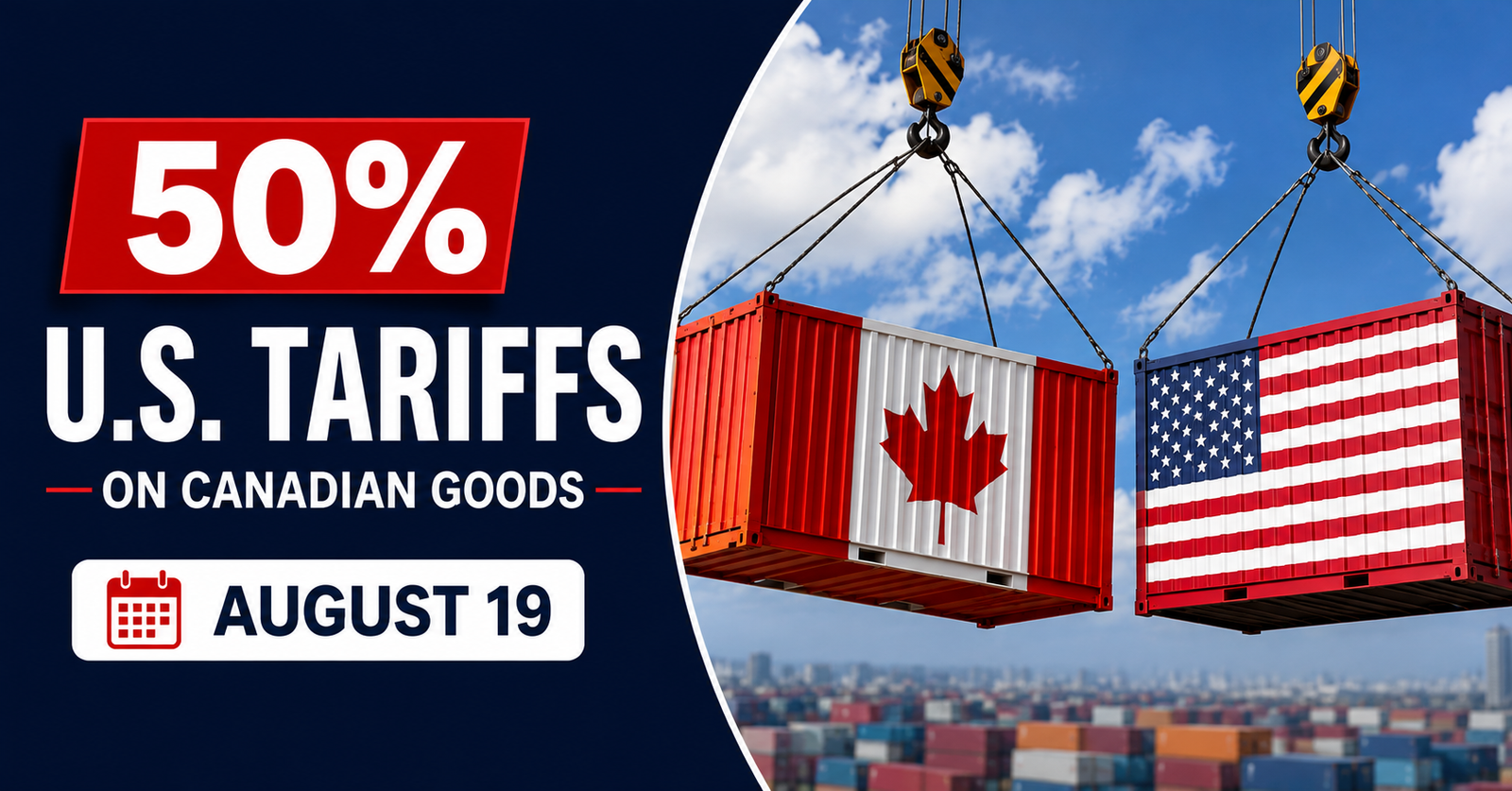
A new round of 50% U.S. tariffs on Canadian goods is scheduled to begin on August 19, 2026, and the scope is much broader than cars, dairy and alcohol. The measures cover hundreds of product categories, including clothing, furniture, electronics, cosmetics, building materials, sporting goods and agricultural products.
The tariffs could affect almost US$20 billion in Canadian imports, according to the U.S. Trade Representative. However, there is an important detail that Canadian consumers and businesses should understand: the 50% duty is collected from U.S. importers, not directly from Canadian exporters or Canadian households.
At the same time, Canada and the United States are still negotiating. As of August 13, a Canadian government source said the talks were progressing and that Washington also wanted an agreement before the August 19 deadline. That means the final outcome could still change before the tariffs take effect.
What is changing on August 19?
The United States announced three separate proclamations on July 20, 2026, using Section 338 of the Tariff Act of 1930. Each proclamation establishes an additional 50% tariff on specified Canadian imports, with the measures scheduled to begin at 12:01 a.m. Eastern Time on August 19, 2026.
The measures are significant because they are not limited to products that fail to qualify under the Canada-U.S.-Mexico trade agreement. The White House says the Section 338 tariffs apply to covered goods even when those goods would otherwise qualify for treatment under the United States-Mexico-Canada Agreement (USMCA).
The U.S. Trade Representative estimates that the new tariffs could cover nearly US$20 billion of Canadian imports. That represents about 5.2% of the US$383 billion in goods the United States imported from Canada during 2025.
Key details at a glance
| Detail | What it means |
|---|---|
| Tariff rate | 50% additional tariff |
| Start date | August 19, 2026 |
| Start time | 12:01 a.m. Eastern Time |
| Legal authority | Section 338 of the Tariff Act of 1930 |
| Canadian imports potentially covered | Nearly US$20 billion annually |
| Estimated share of 2025 U.S. imports from Canada | About 5.2% |
| USMCA treatment | Covered goods are not exempt simply because they qualify under USMCA |
The most important practical point is that USMCA eligibility does not automatically protect a product from these new Section 338 duties. Canadian exporters that have relied on USMCA treatment should therefore check the specific tariff classification of their products rather than assuming their goods remain duty-free.
Which Canadian products could face the new 50% tariff?
The affected list is extensive. The three proclamations together cover more than 500 Harmonized Tariff Schedule subheadings, touching a wide range of Canadian industries.
Some of the major product groups include:
| Product category | Examples of goods covered |
| Dairy | Milk, cream, whey, caseinates, lactose and cheese ingredients |
| Alcohol | Beer, wine, whisky, rum, vodka, gin, liqueurs, cider and spirits |
| Electronics | Telephones, monitors, displays, circuit boards, antennas and broadcasting equipment |
| Building materials | Cement, plywood, fibreboard, doors, windows, flooring and veneer sheets |
| Furniture | Office furniture, metal seating, wooden furniture, lighting fixtures and lamps |
| Plastics and packaging | Plastic floor coverings, films, bags, boxes, bottles and packaging containers |
| Clothing and textiles | T-shirts, sweaters, jackets, trousers, coats, gloves, headgear and nonwoven fabrics |
| Sporting goods | Hockey sticks, fishing rods, golf equipment, ice skates and exercise equipment |
| Toys | Toys and video game consoles |
| Cosmetics | Essential oils, perfumes, makeup, skin preparations and hair products |
| Agriculture | Honey, live plants, flowers, seeds, bulbs, seaweed and vegetable extracts |
| Wood and paper | Wood charcoal, sawn timber, pulp, wallpaper, envelopes, paper towels and cardboard |
| Leather and luggage | Hides, suitcases, handbags, leather gloves and other leather products |
| Machinery | Hand tools, saws, wrenches, cranes, boilers and food-processing machinery |
| Chemicals | Salt, inks, paints, lubricant additives and petroleum-derived chemicals |
| Jewellery | Gold and silver jewellery, diamonds, imitation jewellery and coins |
| Art and collectibles | Paintings, prints, sculptures, stamps and antiques over 100 years old |
| Vessels and motorcycles | Electric motorcycles, floating docks and certain vessels |
The breadth of the list is what makes this announcement different from a tariff affecting only one or two Canadian industries. A Canadian business selling apparel, furniture, cosmetics or certain manufactured goods into the U.S. market may need to examine the new rules even if it has not previously been directly affected by the major sector-specific tariffs.
Are Canadian cars included in the new 50% tariff?
This is one area where headlines can be misleading.
The proclamation associated with motor vehicles covers a broad range of tariff classifications, but the source article’s broad product list does not mean that passenger cars will suddenly receive another 50% Section 338 tariff. Passenger automobiles are already subject to separate Section 232 tariff measures, and the White House specifically excludes products already covered by Section 232 from the new Section 338 duties.
The distinction matters because businesses often look at a headline such as “50% tariffs on Canadian motor vehicles” and assume every Canadian-made vehicle will receive another 50% charge. That is not how the new measures are structured. The exact tariff classification and the existing duty applicable to the product determine what happens at the border.
Which Canadian products are excluded?
The new 50% tariff does not cover every Canadian export to the United States.
The White House specifically excludes energy products, potash, fish and critical minerals, along with certain aerospace products covered by the WTO Agreement on Trade in Civil Aircraft. Products that already fall under separate Section 232 tariffs are also excluded from these additional Section 338 duties.
That means certain major Canadian exports, including products already covered by separate tariff arrangements for steel, aluminium, copper, automobiles, designated wood products, semiconductor articles and patented pharmaceutical articles, are not simply hit with another Section 338 charge on top of the existing measure.
| Generally excluded from the new Section 338 tariff | Reason |
| Energy products | Specifically excluded |
| Potash | Specifically excluded |
| Fish | Specifically excluded |
| Critical minerals | Specifically excluded |
| Certain aerospace products | Covered by the WTO Agreement on Trade in Civil Aircraft |
| Goods already covered by Section 232 | Subject to separate tariff treatment |
For exporters, this is where checking the specific Harmonized Tariff Schedule classification becomes more useful than relying on broad product names. Two products that sound similar in everyday language can fall under different tariff classifications and therefore receive different treatment.
Who actually pays the 50% tariff?
This is probably the most important point for Canadian consumers to understand.
The tariff is collected by the U.S. government from U.S.-based importers when the covered Canadian goods enter the United States. A Canadian exporter does not simply receive a bill from the U.S. government for 50% of the shipment’s value.
That does not mean Canadian businesses are unaffected. A U.S. importer facing a significantly higher landed cost may respond by accepting lower profits, asking the Canadian supplier to reduce its price, increasing the price charged to customers, or using another supplier outside Canada. In many real-world cases, the financial impact is shared across several parts of the supply chain.
For example, if an American company regularly purchases a Canadian product because it is competitively priced, an additional 50% tariff could make that product considerably less attractive. The U.S. buyer may then ask the Canadian supplier for a discount or look for an alternative source in another country.
So while the tariff itself is not a direct tax on Canadian consumers, Canadian businesses can still feel the consequences through weaker U.S. demand, reduced orders, lower margins or changes in investment and employment.
Why is the United States imposing these tariffs?
The White House says the measures are intended to respond to what the U.S. administration describes as discriminatory treatment of American commerce in three major areas: motor vehicles, alcoholic beverages and dairy products.
On vehicles, the White House says Canada has applied a 25% tariff to certain U.S. motor vehicles that do not qualify for USMCA duty-free treatment and has also applied a 25% charge to non-Canadian and non-Mexican content in qualifying vehicles, subject to company-specific tariff-rate quotas. The administration says U.S. vehicle exports to Canada declined by about 22%, or US$5.6 billion, between April 2025 and March 2026 compared with the previous year.
Alcohol is another major point of dispute. The White House says all but two Canadian provinces and territories halted the purchase, distribution or retailing of American alcoholic beverages without applying equivalent restrictions to other countries. It says U.S. alcoholic beverage imports into Canada fell by approximately 81%, or US$582 million, between March 2025 and February 2026 compared with the previous period.
The third issue is Canada’s dairy supply-management system. The White House argues that Canada’s tariff-rate quotas give more favourable treatment to some European Union cheese imports than to comparable U.S. dairy products. These arguments form the stated basis for the Section 338 action, although the Canadian government has continued to challenge the broader U.S. tariff approach.
What could the tariffs mean for Canada’s economy?
The direct tariff covers a relatively small share of Canada’s total exports to the United States, but the economic effects could extend beyond the companies that ship the affected products.
Global Affairs Canada estimates that the new Section 338 measures could create particular pressure in sectors such as plastics, electrical machinery, wood products, furniture and paper manufacturing. The department has described the overall GDP effect as potentially modest while warning of more concentrated effects in exposed industries.
TD Economics has estimated that if the tariffs remain in place, they could reduce Canadian GDP growth by around 0.3 to 0.6 percentage points over the following year, with the lower end considered more likely. Other economic projections cited in the source material put the potential reduction at roughly 0.2 to 0.3 percentage points in both 2026 and 2027.
The bigger concern for some Canadian exporters is not simply the tariff payment itself. It is the possibility that U.S. buyers begin replacing Canadian suppliers with companies from other countries. Once a buyer changes suppliers, Canadian companies may have difficulty recovering that business even if tariffs are later reduced.
The earlier vehicle trade figures illustrate how quickly sourcing patterns can change. The U.S. proclamation noted that Canadian imports of Mexican vehicles increased by approximately 23.6%, while imports from Japan, Korea and Germany rose by roughly 10% to 13.5% after Canada’s measures affecting U.S. vehicles.
That is why exporters should be looking beyond August 19 itself. The practical question is not only “Will I pay 50%?” but also “Will my U.S. customer still find it commercially worthwhile to buy from me?”
Which Canadian businesses may feel the most pressure?
Businesses that depend heavily on U.S. customers are naturally more exposed, particularly manufacturers and exporters in industries appearing on the Section 338 list.
Manufacturing, agriculture, building materials and small- and medium-sized exporters could face greater challenges if U.S. buyers reduce Canadian orders. British Columbia, Ontario and Quebec are among the provinces identified as particularly exposed because of their strong integration with U.S. supply chains.
This does not mean every company in those provinces will be affected equally. A business selling a product outside the tariff list, or one whose U.S. customer can absorb the additional cost, may see a very different result from a company competing directly against cheaper suppliers from another country.
For Canadian businesses, a sensible first step is therefore to identify the exact tariff classification of every product exported to the United States, determine whether it appears in the relevant Annex II schedule, and then calculate the potential landed cost for the U.S. customer.
Canada and U.S. are still negotiating
The August 19 date should not be treated as an entirely settled outcome.
Canadian and U.S. officials have continued intensive negotiations in an effort to prevent or modify the new tariffs. On August 13, a Canadian government source told Reuters that discussions were progressing well and that the U.S. side also wanted to reach an agreement before the deadline.
Canadian Trade Minister Dominic LeBlanc has met U.S. Trade Representative Jamieson Greer several times, while Canada’s Chief Trade Negotiator Janice Charette and other senior officials continue discussions with their American counterparts. Reuters reported that the August 13 meeting was LeBlanc’s fourth with Greer in three weeks.
Global Affairs Canada said on August 6 that Canada was seeking relief from existing sectoral tariffs as well as the new Section 338 tariffs and was continuing work toward a modernized CUSMA.
Canada has also indicated that retaliation remains an option if negotiations fail. However, Prime Minister Mark Carney has avoided announcing specific new countermeasures while talks continue. The Canadian government has also been discussing issues involving alcohol distribution, dairy quotas and auto tariffs as part of the negotiations.
That leaves several possible outcomes before August 19: the countries could reach an agreement, the tariff could be modified or delayed, or the 50% duties could begin as scheduled and lead to another round of trade retaliation.
What should Canadian businesses do before August 19?
If your business exports to the United States, this is a situation where broad assumptions can be costly. The fact that your product is “made in Canada” or that it previously qualified for USMCA treatment does not, by itself, tell you whether the new 50% Section 338 tariff applies.
Start by checking the product’s exact HTS classification against the applicable U.S. tariff schedule. Then confirm whether another tariff regime already applies and whether the product falls within one of the exclusions. If the classification or treatment is unclear, a licensed customs broker or qualified trade-compliance professional can help determine the applicable duty before the goods enter the U.S. market.
Businesses should also speak with their U.S. customers now rather than waiting until August 19. Understanding whether the importer plans to absorb the additional cost, renegotiate pricing or switch suppliers can provide a much clearer picture of the commercial risk than simply calculating the 50% figure.
What does this mean for Canadians?
For most Canadian households, the new U.S. tariff does not automatically mean that a Canadian product sitting on a Canadian store shelf will become 50% more expensive on August 19. The new duty is imposed when covered Canadian goods enter the U.S., and the immediate payment is made by the U.S. importer.
The Canadian impact is more likely to appear indirectly through businesses, employment, investment, exchange-rate movements and supply chains. The situation becomes more direct for Canadian consumers if Canada responds with new tariffs on American goods, because those measures could increase the price of affected U.S. products sold in Canada.
For newcomers and families watching the Canadian economy, the useful takeaway is to separate the headline from the actual mechanism. A “50% tariff on Canadian goods” sounds like a 50% tax being charged to Canadians, but that is not how this particular measure works. Its bigger Canadian risk is the effect on exporters and the broader economy if U.S. buyers reduce demand for Canadian products.
What happens next?
The next few days are likely to be important because the August 19 deadline is approaching quickly and negotiations remain active.
If Canada and the United States reach an agreement, the tariff package could be changed, delayed or otherwise adjusted. If no agreement is reached, the new Section 338 duties are currently scheduled to begin at 12:01 a.m. Eastern Time on August 19.
Canadian businesses with U.S. exposure should therefore continue checking official announcements rather than making long-term decisions based only on the current tariff schedule. The rules could change as negotiations develop, and the exact tariff treatment still depends on the product classification and applicable exemptions.
Frequently Asked Questions
The United States has announced additional 50% tariffs under Section 338 of the Tariff Act of 1930 on more than 500 tariff classifications covering a wide range of Canadian products. The measures are scheduled to take effect on August 19, 2026.
No. The measures apply only to specified product classifications. Energy, potash, fish, critical minerals, certain aerospace products and goods already covered by Section 232 tariffs are among the exclusions identified by the White House.
No, not directly. The tariff is collected from U.S. importers when covered Canadian goods enter the United States. Canadian consumers could still experience indirect effects through business conditions, supply chains, currency movements or any Canadian retaliatory tariffs.
Yes. As of August 13, Canada and the United States were still negotiating, and a Canadian government source said both sides wanted to reach an agreement before the deadline. Until an official change is announced, however, the currently published tariffs remain scheduled for August 19.
Fact Check: This article is based primarily on the White House's three Section 338 presidential proclamations and fact sheet dated July 20, 2026, Global Affairs Canada's trade updates dated August 6, 2026, and verified reporting on the Canada-U.S. negotiations published August 13, 2026.
Disclaimer: This article is for general informational purposes only and does not constitute legal, financial, customs or trade-compliance advice. Businesses involved in cross-border trade should verify the latest official tariff schedule and consult a qualified customs broker or trade professional before making decisions.