
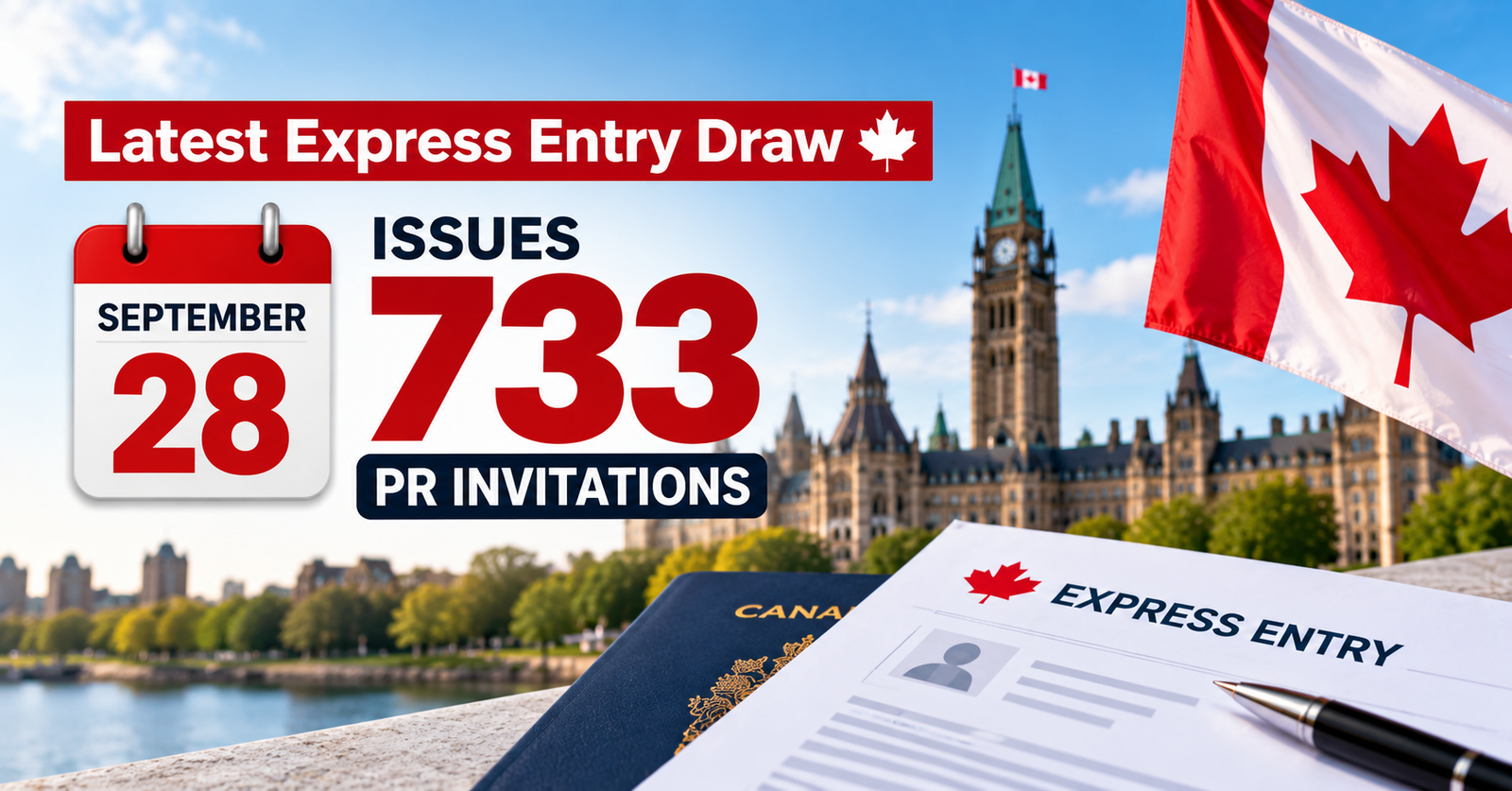
Canada’s latest Express Entry draw on September 28, 2026 invited 733 provincial nominees for permanent residence with a CRS cutoff of 725. Here are the full details and what applicants should know.
733 candidates received an opportunity to move forward with Canadian permanent residence in the latest Express Entry draw, but the number that deserves just as much attention is 725.
Immigration, Refugees and Citizenship Canada (IRCC) held a Provincial Nominee Program (PNP) Express Entry draw on September 28, 2026, inviting 733 candidates with provincial nominations. The minimum Comprehensive Ranking System (CRS) score was 725, which was 9 points lower than the previous PNP draw held on September 14.
For applicants following the latest Express Entry news, this round also provides a useful reminder: a PNP nomination can dramatically change a candidate’s CRS position because it adds 600 points to an Express Entry profile.
September 28 Express Entry Draw: Key Results
The September 28 round was specifically for candidates eligible under the Provincial Nominee Program. Unlike a Canadian Experience Class or category-based draw, this selection was limited to candidates who had a qualifying provincial nomination connected to their Express Entry profile.
Here are the main details:
| Draw Detail | September 28, 2026 Result |
|---|---|
| Draw category | Provincial Nominee Program |
| Invitations issued | 733 |
| Minimum CRS score | 725 |
| Draw date | September 28, 2026 |
| Tie-breaking date | September 17, 2026 |
| Tie-breaking time | 01:36:17 UTC |
| Express Entry round | #445 |
The 733 invitations represent a noticeable increase from the 576 invitations issued in the September 14 PNP draw. At the same time, the CRS cutoff moved from 734 down to 725, giving this latest round a different profile from the earlier September selection.
For readers following Express Entry updates on CIKH.ca, the September sequence is particularly useful because it shows why applicants should compare draws by category instead of looking at the CRS number alone.
Why Did the CRS Cutoff Fall to 725?
At first glance, a CRS score of 725 can look extremely high. However, PNP draws operate differently from most other Express Entry rounds because a provincial nomination adds 600 CRS points to an eligible candidate’s profile.
That means a candidate who reached the 725 cutoff could have had a base CRS score of 125 before receiving the nomination. The 725 figure therefore should not be compared directly with the CRS cutoffs seen in CEC, French-language, healthcare, or other category-based draws.
The September 28 result is also 9 points below the September 14 PNP cutoff of 734. That change can happen when the number of invitations changes and when the group of eligible provincial nominees in the Express Entry pool changes between rounds.
733 Invitations: A Larger PNP Round Than September 14
The latest draw issued 733 invitations, compared with 576 in the September 14 PNP round.
That works out to an increase of about 27% in the number of invitations between the two PNP draws. The September 28 round was also the largest PNP draw since June 22, when IRCC issued 955 invitations with a CRS cutoff of 730.
Looking at these numbers together gives applicants a more useful picture than focusing on the 725 score by itself. IRCC can change both the number of candidates invited and the category being targeted, which means one draw does not establish a permanent CRS threshold for future rounds.
The Tie-Breaking Rule Matters for Candidates at 725 CRS
There is another detail that candidates with exactly 725 CRS points should pay attention to.
IRCC used a tie-breaking timestamp of September 17, 2026, at 01:36:17 UTC for this draw. Candidates with CRS scores above 725 did not need to rely on this timestamp, but applicants who had exactly 725 points needed to have submitted their Express Entry profile before the specified time to be selected in this round.
This is why keeping an Express Entry profile active and accurate matters. If several candidates have the same CRS score at the cutoff, the profile submission timestamp can determine who receives the invitation.
What the Latest Express Entry Pool Shows
The Express Entry pool snapshot from September 27, one day before the draw, contained 229,904 candidates.
The largest broad CRS group was the 451–500 range, with 73,131 candidates. There were also 21,070 candidates in the 501–600 range and 728 candidates in the 601–1200 range.
| CRS Score Range | Candidates in Pool |
|---|---|
| 601–1200 | 728 |
| 501–600 | 21,070 |
| 451–500 | 73,131 |
| 401–450 | 62,611 |
| 351–400 | 47,298 |
| 301–350 | 17,359 |
| 0–300 | 7,707 |
| Total | 229,904 |
These figures are a snapshot rather than a permanent measure of Express Entry competition. The pool changes continuously as new candidates enter, profiles expire, candidates receive invitations, and existing applicants update their profiles.
One practical point here is that the total number of people in the pool does not tell you your individual chances by itself. Your category, CRS score, provincial nomination status, language results, work experience, and eligibility for targeted draws can matter much more than the headline pool size.
How the September 28 Draw Fits Into 2026 Express Entry Activity
The September 28 round was the 57th Express Entry draw of 2026. By this draw, approximately 129,715 invitations had been issued across all Express Entry categories during the year.
September itself has already included several different types of selection rounds. IRCC began the month with a Canadian Experience Class draw, followed by physician, healthcare and social services, PNP, another CEC round, senior-manager selection, and now another PNP round.
This variety is important because it shows why there is no single CRS number that applies to everyone in the Express Entry pool. A candidate with a score that is not competitive in one type of draw could still qualify for another category if they meet its specific requirements.
For a broader look at recent activity, CIKH.ca’s coverage of the September 14 PNP draw provides useful context because that round issued 576 invitations at a 734 CRS cutoff. The earlier September 2026 CEC draw also shows how different the scoring environment can be when IRCC targets Canadian Experience Class candidates.
Why Provincial Nomination Remains Important
A provincial nomination can have a major effect on an Express Entry profile because of the additional 600 CRS points.
The basic sequence generally looks like this:
- Create an eligible Express Entry profile.
- Enter the Express Entry pool.
- Become eligible for an Express Entry-linked provincial stream.
- Receive a provincial nomination.
- Accept the nomination and receive the additional CRS points.
- Become eligible for a PNP Express Entry invitation round.
- Receive an Invitation to Apply for permanent residence.
- Submit a complete application within the required deadline.
The important part is that receiving a provincial nomination does not itself mean permanent residence has been approved. The nomination helps a candidate qualify for the federal invitation stage, while IRCC still reviews the permanent residence application after it is submitted.
What Should Candidates Do After Receiving an ITA?
If you received an invitation in the September 28 draw, the next stage requires careful document preparation.
Candidates have 60 calendar days to submit a complete permanent residence application after receiving an Invitation to Apply. Missing the deadline can cause the invitation to expire, and the profile is removed from the Express Entry pool rather than simply being placed back into the queue.
This is where preparation can make a real difference. Employment letters, language test results, police certificates, education documents, medical examination requirements, and other supporting records may take time to organize.
If you completed your education outside Canada and are relying on that education for eligibility or CRS points, you may also need a valid Educational Credential Assessment, depending on your circumstances.
What Happens If Your CRS Score Was Below 725?
A CRS score below 725 does not automatically mean your Express Entry plans are over.
The September 28 round was a PNP-specific draw, so candidates without a provincial nomination were not competing in the same selection group. Future Express Entry rounds can target completely different candidates, including the Canadian Experience Class or specific occupation and language categories.
This is why it can be risky to judge your entire immigration plan from one PNP draw. If your score is below the latest PNP cutoff, it may be more useful to review whether you can improve your CRS score, qualify for a provincial program, strengthen your language results, gain additional eligible work experience, or qualify for another Express Entry category.
CIKH.ca’s previous coverage of Express Entry PNP draws in 2026 can also help applicants compare how invitation numbers and CRS thresholds have moved across earlier rounds rather than relying on a single result.
A Practical Tip for Future Express Entry Applicants
One mistake applicants often make is waiting for an invitation before getting their documents organized.
That can create unnecessary pressure once an ITA arrives. If you are already eligible for Express Entry, it is sensible to keep your employment records, education documents, language results, police certificates and other potentially required paperwork organized and current.
Applicants who are considering a PNP pathway should also watch individual provincial programs rather than assuming every province has the same requirements. Occupation priorities, intake windows, eligibility rules and nomination availability can change during the year.
What If You Received the Invitation at 725 CRS?
If your CRS score was exactly 725, the tie-breaking rule becomes especially important.
For this September 28 draw, the applicable timestamp was September 17, 2026, at 01:36:17 UTC. A candidate at exactly 725 CRS needed to have submitted their Express Entry profile before that timestamp to be selected in this round.
Candidates above 725 did not need to meet that particular tie-breaking timestamp. The rule is used only when candidates have the same score at the cutoff.
Express Entry Draw vs PNP Draw: Why the Difference Matters
It is easy to see a CRS score of 725 and assume that someone needs 725 CRS points to receive any Express Entry invitation.
That would be misleading.
The 725 score belongs specifically to a PNP draw. Since provincial nominees receive 600 additional CRS points, their final scores are naturally much higher than those commonly seen in CEC or other category-based rounds.
For example, CIKH.ca’s September 2026 coverage of the CEC draw reported a much lower CRS threshold because that round targeted a different group of candidates. Comparing those numbers directly would not give an accurate picture of the competitiveness of either category.
What This Latest Draw Means for Candidates
The September 28 result gives applicants three useful pieces of information.
First, IRCC continues to use PNP-specific Express Entry rounds as part of its 2026 invitation strategy. Second, the number of invitations can change significantly from one PNP draw to another, which can influence the cutoff. Third, the 600-point provincial nomination bonus remains central to understanding why PNP CRS scores sit far above many other Express Entry categories.
For candidates still in the pool, the most useful approach is to focus on the factors they can actually control: maintaining an accurate profile, improving eligible CRS factors where possible, researching suitable provincial programs, and keeping documents ready.
Frequently Asked Questions
IRCC issued 733 Invitations to Apply for permanent residence in the September 28, 2026 Provincial Nominee Program Express Entry draw.
The minimum CRS score was 725. Candidates with exactly 725 points were subject to the draw’s tie-breaking rule.
The tie-breaking timestamp was September 17, 2026, at 01:36:17 UTC. Candidates with exactly 725 CRS points needed to have submitted their profiles before that timestamp to receive an invitation in this round.
Provincial nominees who accept an Express Entry-aligned nomination receive 600 additional CRS points. As a result, their final CRS scores are much higher than those commonly seen in CEC and many category-based draws.
You should begin preparing your permanent residence application immediately. Express Entry candidates who receive an ITA generally have 60 calendar days to submit a complete application, so gathering documents early can help prevent last-minute problems.
No. A nomination can lead to an Express Entry invitation, but receiving an ITA and submitting an application does not guarantee permanent residence. IRCC still assesses the complete application and supporting documents before making a final decision.
Fact Check: The September 28, 2026 Express Entry draw was a Provincial Nominee Program round that issued 733 invitations with a minimum CRS score of 725; the draw details and pool figures are based on IRCC’s published Express Entry information and cross-checked against the September 28 draw reporting.
Disclaimer: This article is for general informational purposes only and is not legal or immigration advice. Express Entry rules, provincial nomination requirements, fees and processing information can change, so applicants should verify the latest information through official IRCC and provincial government sources before making immigration decisions