
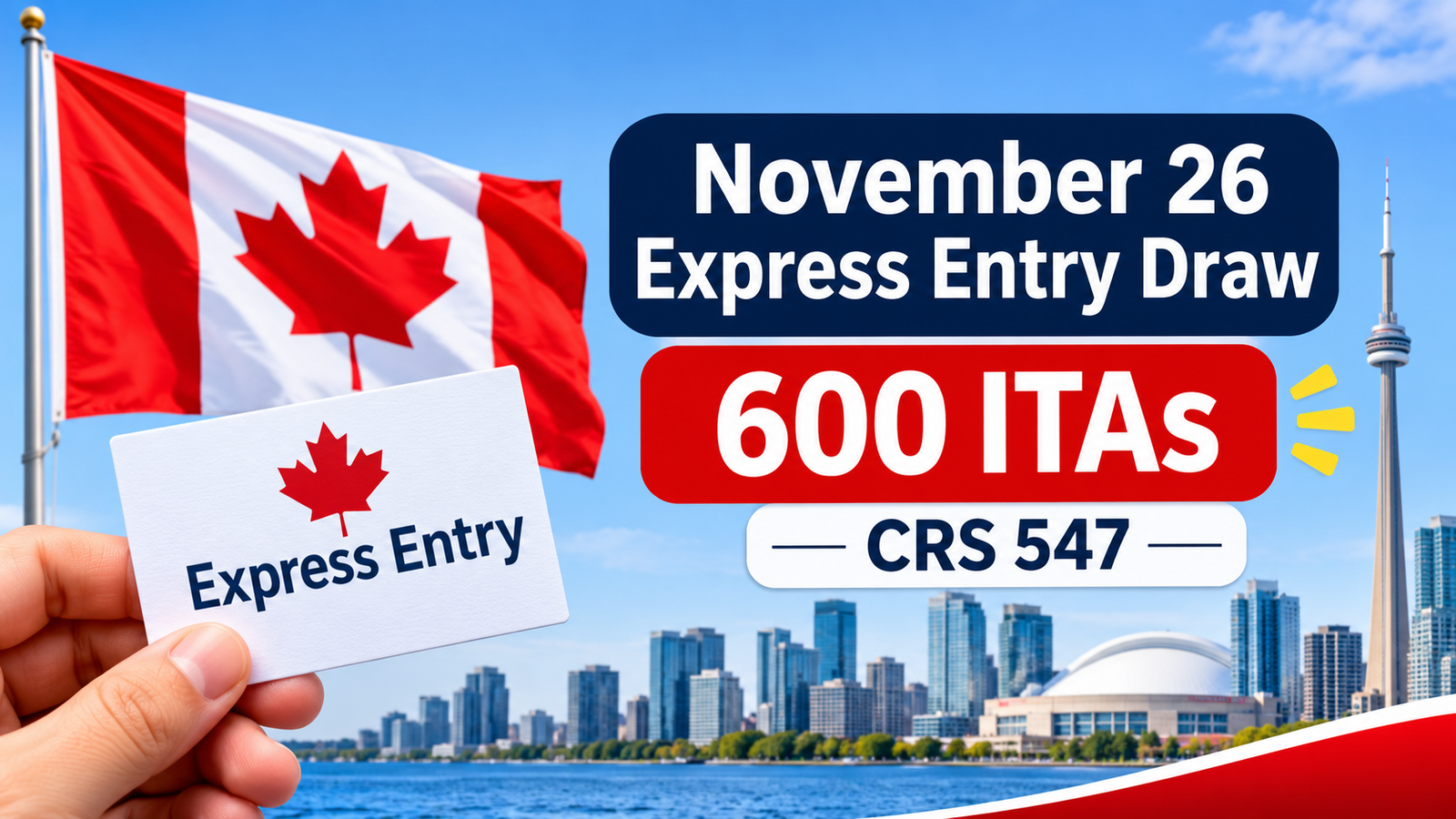
Canada has conducted another category-based Express Entry draw, this time focusing on candidates working in science, technology, engineering and mathematics (STEM) occupations. On November 26, 2026, Immigration, Refugees and Citizenship Canada (IRCC) issued 600 Invitations to Apply (ITAs) for permanent residence, with the minimum Comprehensive Ranking System (CRS) score set at 547.
The latest selection is particularly relevant for skilled professionals whose work experience falls within Canada’s eligible STEM occupations. However, having a job in the technology or engineering sector alone does not guarantee an invitation. Candidates must also meet the specific work experience requirements, qualify under an eligible Express Entry program and have a competitive CRS score.
November 26 Express Entry Draw: Complete Results
The latest invitation round was conducted under the STEM occupations category, Version 3 of the 2026 selection criteria. It was the 456th Express Entry draw conducted by IRCC.
Here are the important details candidates should know:
| Draw Information | Official Results |
|---|---|
| Draw date | November 26, 2026 |
| Draw number | 456 |
| Selection category | STEM occupations |
| Category version | 2026-Version 3 |
| Invitations issued | 600 |
| Minimum CRS score | 547 |
| Required rank | 600 or above |
| Draw time | 12:52:00 UTC |
| Tie-breaking date | December 2, 2025 |
| Tie-breaking time | 16:52:51 UTC |
| Programs covered | FSWP, CEC and FSTP |
The most important figure is the CRS cutoff of 547. Candidates needed at least this score to be considered, along with meeting the STEM category requirements.
The tie-breaking rule also matters for applicants who had exactly 547 CRS points. Their Express Entry profiles needed to have been submitted before the specified December 2, 2025, timestamp to qualify at the cutoff.
Why Did IRCC Conduct Another STEM Express Entry Draw?
Canada uses category-based Express Entry selections to attract skilled workers who can contribute to specific economic and labour market priorities. Instead of selecting candidates exclusively according to their overall CRS rankings, IRCC can invite eligible applicants from particular occupational or language categories.
STEM occupations cover several professional fields, including engineering, technology and certain technical occupations. These professionals can contribute to infrastructure development, technological innovation, cybersecurity and other areas of the Canadian economy.
The November 26 selection provided another opportunity for eligible professionals to move closer to Canadian permanent residence. However, the 600 invitations also show that not every candidate in the STEM category should expect to receive an invitation simply because they meet the occupational requirements.
IRCC ranks eligible candidates using their CRS scores and determines how many invitations will be issued in each round. The minimum score can therefore change depending on the number of available invitations and the profiles competing in that category.
Who Qualifies for the STEM Express Entry Category?
This is one of the most important questions for candidates interested in the November 26 draw.
Not every person working in science, technology or engineering automatically qualifies for STEM-based Express Entry selection. IRCC uses specific National Occupational Classification (NOC) codes to determine which occupations are included in the category.
Under the STEM category requirements, candidates generally need to demonstrate at least 12 months of qualifying full-time work experience, or an equivalent amount of part-time experience, within the previous three years.
The experience must meet the following conditions:
- It must be in one eligible occupation listed under the STEM category.
- It can be Canadian or foreign work experience.
- The qualifying experience must total at least 12 months.
- The experience does not need to be continuous.
- Candidates must also meet the requirements of an eligible Express Entry immigration program.
For example, a software professional may have several years of experience, but the job title alone does not determine eligibility. IRCC examines the actual occupation, its NOC classification and whether the applicant’s employment duties match the relevant occupational description.
This is where applicants sometimes make mistakes. They assume that working for a technology company automatically makes them eligible for a STEM draw, even when their actual position does not fall within the designated occupation list.
Before relying on a STEM invitation opportunity, candidates should carefully compare their employment duties with the official NOC description.
Which Express Entry Programs Were Included in the November 26 Draw?
The November 26 STEM selection covered candidates eligible under three federal immigration programs managed through Express Entry.
1. Federal Skilled Worker Program (FSWP)
This program is designed for skilled workers with qualifying foreign or Canadian work experience who meet the applicable education, language and other eligibility requirements.
Candidates applying through this pathway generally need to satisfy the program’s selection criteria, including the minimum requirements and applicable selection factors.
2. Canadian Experience Class (CEC)
The Canadian Experience Class is an important pathway for skilled workers who have gained qualifying Canadian work experience.
Candidates must meet the program’s Canadian work experience and language requirements. The applicable language level depends on the occupation’s TEER category.
3. Federal Skilled Trades Program (FSTP)
This program targets qualified workers with experience in eligible skilled trades. Applicants must meet the relevant work experience, language and other program requirements.
Being eligible for one of these programs does not automatically guarantee an invitation. Candidates must also satisfy the STEM category requirements and rank high enough to receive an ITA in the particular round.
CRS Score of 547: What Does It Mean for STEM Candidates?
A CRS cutoff of 547 means that 547 was the lowest score among candidates invited in this particular round.
It is important to understand that the cutoff applies only to the November 26 STEM selection. Candidates from other Express Entry categories cannot use this score as a direct indication of their chances.
For instance, someone with 550 CRS points but without the required STEM work experience would not qualify for this category-based selection simply because their score was above 547.
On the other hand, a candidate with qualifying STEM experience and a CRS score of 547 could receive an invitation if their profile also satisfied the tie-breaking requirement.
Applicants with scores below 547 should not assume that their immigration opportunities are over. They may qualify for other category-based or program-specific draws, depending on their personal circumstances and eligibility.
The practical lesson is that candidates should evaluate two separate things: their CRS score and their eligibility for the selection category. Both matter when IRCC conducts a category-based draw.
Recent Express Entry Draws: November 23 to November 26, 2026
The latest selection becomes more interesting when viewed alongside the invitation rounds conducted over the previous few days.
IRCC held three different Express Entry draws between November 23 and November 26, targeting provincial nominees, French-speaking candidates and STEM professionals.
Here is a comparison:
| Draw Date | Category | Invitations | CRS Cutoff |
|---|---|---|---|
| November 26, 2026 | STEM occupations | 600 | 547 |
| November 25, 2026 | French-language proficiency | 6,000 | 401 |
| November 23, 2026 | Provincial Nominee Program | 1,999 | 673 |
These three rounds demonstrate how IRCC can use different selection categories to invite candidates with different professional and personal backgrounds.
The November 25 French-language round had the largest invitation allocation, while the November 26 STEM round focused on candidates with qualifying occupational experience. The November 23 PNP round, meanwhile, selected candidates with provincial nominations.
The CRS cutoffs are not directly comparable because each category has separate eligibility requirements. A candidate should always compare their score with the relevant category rather than assuming that the lowest cutoff across all draws applies to them.
Tie-Breaking Rule for the November 26 Express Entry Draw
Candidates sometimes focus entirely on their CRS scores and overlook the tie-breaking rule. However, this rule can make a difference when multiple applicants have the same score at the bottom of an invitation round.
For the November 26 STEM draw, IRCC used the following timestamp:
December 2, 2025, at 16:52:51 UTC.
This means candidates with exactly 547 CRS points needed to have submitted their Express Entry profiles before the specified date and time to qualify under the tie-breaking rule.
Consider two candidates who both have 547 points and meet the STEM eligibility requirements. If one submitted their profile before the tie-breaking timestamp and the other submitted it afterward, the first candidate would receive priority under the rule.
Candidates with scores above 547 do not need to satisfy this particular cutoff tie-break condition, provided they meet all the other requirements of the draw.
This is another reason why applicants should keep their Express Entry profiles accurate and avoid unnecessary delays when entering the pool.
What Should Invited STEM Candidates Do Next?
Receiving an ITA is a major achievement, particularly for applicants who have spent years improving their qualifications and gaining professional experience. However, an invitation is not the same as permanent residence approval.
After receiving an ITA, candidates generally have 60 days to submit their complete permanent residence application. They should use this time carefully because IRCC will assess the information and supporting documents before making a final decision.
Here are some important steps to follow.
1. Check Your Express Entry Invitation
Sign in to your IRCC account and review the invitation details. Confirm the immigration program, personal information and deadline before starting the application.
2. Verify Your STEM Work Experience
Make sure your employment documents support the occupation and work experience claimed in your Express Entry profile. Job titles alone are not sufficient if the actual duties do not match the applicable NOC description.
3. Collect Employment Reference Letters
Your employment letters should contain relevant information such as job title, duties, employment dates, hours worked and salary where required. Make sure the documents accurately reflect your actual employment.
4. Prepare Educational Documents
Keep your educational certificates, transcripts and applicable Educational Credential Assessment documents ready. Check that the qualifications claimed in your profile can be supported with appropriate evidence.
5. Arrange Police Certificates
Review the police certificate requirements for yourself and accompanying family members. Obtaining certificates from different countries can take time, so start early.
6. Complete Medical Requirements
Follow the medical examination instructions applicable to your permanent residence application. Make sure you understand the current IRCC process rather than relying on outdated information.
7. Review Everything Before Submission
Compare your permanent residence application with the information in your Express Entry profile. Employment history, education, language results and personal details should be accurate and consistent.
One important practical point is that candidates should not claim work experience simply because their job title appears similar to an eligible STEM occupation. IRCC can examine the actual duties performed, and unsupported claims can create serious problems during application assessment.
What Can Candidates Do If They Missed the November 26 Draw?
Candidates who did not receive an invitation should not immediately assume that they have no remaining opportunity through Express Entry.
The Canadian immigration system includes multiple selection categories, and applicants may qualify for more than one depending on their background.
For example, a candidate with a CRS score below 547 might still be competitive in another category-based round or a Canadian Experience Class selection, provided they meet the relevant eligibility requirements.
There are also several ways to strengthen an Express Entry profile.
- Improve language results: Better English or French test scores can increase CRS points.
- Gain additional work experience: Additional qualifying experience may improve a candidate’s overall profile.
- Explore provincial nomination: Eligible candidates can investigate provincial immigration pathways that connect with Express Entry.
- Review educational qualifications: Additional eligible education credentials may improve the CRS score.
- Keep the profile updated: Changes in employment, education, language results and family circumstances should be reflected accurately.
For candidates exploring provincial immigration opportunities, our guide on Canada’s Expression of Interest programs explains how provincial selection systems can provide another route towards permanent residence.
Candidates should also understand the latest CRS scoring changes before making decisions about their profiles. You can read more in our coverage of Canada’s Express Entry changes effective November 2026.
The best strategy is to focus on eligibility first and CRS improvement second. A high score is useful, but it cannot replace the specific requirements of a category-based invitation round.
What Does the November 26 Draw Mean for Canada’s STEM Professionals?
The latest draw is another indication that IRCC continues to use category-based selection to target skilled workers in occupations considered important to Canada’s economic priorities.
For STEM professionals, this creates an opportunity to compete through an occupational selection category rather than relying entirely on general Express Entry invitations.
However, the 600 invitations issued on November 26 should not be interpreted as a guarantee of another STEM draw with the same cutoff or invitation volume. IRCC determines the size and timing of future rounds according to its immigration priorities and the eligible candidates available in the pool.
Candidates working in technology, engineering and related fields should therefore make sure their NOC classification is correct, their work experience is properly documented and their Express Entry profiles reflect their current circumstances.
For those who are not eligible for STEM selection, other Express Entry categories and provincial immigration programs may still provide suitable opportunities.
Frequently Asked Questions About the November 26 Express Entry Draw
IRCC issued 600 Invitations to Apply for Canadian permanent residence through a STEM occupations category-based Express Entry draw. The minimum CRS score was 547.
The minimum CRS score was 547. Candidates also needed to meet the STEM occupational requirements and qualify under an eligible Express Entry program.
Candidates generally need at least 12 months of qualifying full-time work experience, or an equivalent amount of part-time experience, within the previous three years in one eligible STEM occupation. The experience can be gained in Canada or abroad.
The tie-breaking timestamp was December 2, 2025, at 16:52:51 UTC. Candidates with exactly 547 CRS points needed to have submitted their profiles before that timestamp to qualify under the tie-breaking rule.
Yes. Candidates who do not qualify for the STEM category may still receive invitations through other selection rounds, including general, Canadian Experience Class, French-language proficiency and other applicable category-based draws, depending on their eligibility.
Final Thoughts
The November 26, 2026 Express Entry draw gave 600 STEM professionals an opportunity to apply for Canadian permanent residence, with a minimum CRS cutoff of 547. The selection is particularly relevant for skilled workers in eligible science, technology, engineering and mathematics occupations who meet the required work experience conditions.
For candidates who received an invitation, the next priority should be preparing an accurate and complete permanent residence application within the 60-day deadline. Those who were not selected should review their eligibility, improve their CRS scores where possible and explore other immigration pathways.
Canada’s Express Entry system offers several routes to permanent residence, but each category has its own requirements. Understanding those differences and keeping your profile updated can help you make more informed immigration decisions.
Fact Check: The draw number, date, 600 invitations, CRS cutoff of 547, STEM category version and tie-breaking timestamp are based on the November 26, 2026 Express Entry round results published by Immigration, Refugees and Citizenship Canada (IRCC). STEM category eligibility and application requirements are based on official Government of Canada immigration guidance.
Disclaimer: This article is intended for general informational purposes only and does not constitute legal or immigration advice. Immigration rules, CRS calculations and selection criteria may change. Always verify the latest requirements through official IRCC announcements or consult an authorized Canadian immigration professional.