

Immigration, Refugees and Citizenship Canada (IRCC) has announced new guidelines for international students who plan to transfer schools for the winter or spring 2025 semesters. Under these updated rules, students changing schools in Canada for the 2025 winter/spring terms can begin their studies at the new Designated Learning Institution (DLI) before receiving a new study permit, as long as they meet certain requirements. To start their studies at a new DLI before the approval of their new study permit, students must: *DLIs are educational institutions in Canada authorized by the government to enroll international students. All of these conditions must be met for students to begin studying at their new DLI before receiving their updated study permit. Previously, international students were required to obtain a new study permit before transferring to a different DLI. This meant they could no longer change institutions directly through their online account and had to apply for a study permit extension. Implications of Transferring Schools on PGWP Eligibility Depending on the timing of their study permit application and their new level of study, students may need to fulfill additional field of study requirements to qualify for a Post-Graduation Work Permit (PGWP). Applied for a new study permit before November 1, 2024: Level of study Field of study requirements University bachelor’s, master’s or doctoral programs N/A University programs not listed above N/A College program or non-university program N/A Applied for a new study permit after November 1, 2024: Level of study Field of study requirements University bachelor’s, master’s or doctoral programs N/A University programs not listed above Must graduate from an eligible field of study College program or other non-university program Must graduate from an eligible field of study International students applying for a Post-Graduation Work Permit (PGWP) in Canada must meet new language eligibility criteria to qualify for an open work permit (OWP) after graduation. To prove language proficiency, students must take an IRCC-approved English or French language test. University program students must demonstrate language proficiency equivalent to Canadian Language Benchmark (CLB) level 7 (for English) or Niveaux de compétence linguistique canadiens (NCLC) level 7 (for French). College and non-university program students must show language proficiency at a CLB or NCLC level 5. This new language requirement is essential for international students seeking to work in Canada post-graduation. Standard procedure for transferring between schools Students transferring to a new school after the winter/spring semester must meet specific requirements to begin their studies before receiving a new study permit. To start studying at their new Designated Learning Institution (DLI) before their new study permit is issued, students must fulfill all of the following conditions: These conditions are essential for students to begin studying at a new DLI without waiting for their updated study permit.

Canada recognized as one of the safest travel destinations for 2025
A new report highlights Canada as the third safest destination for travelers in 2025, placing it just behind Iceland (#1) and Australia (#2). The annual travel safety rankings, compiled by Berkshire Hathaway Travel Protection (BHTP), a leading North American travel insurance provider, showcase Canada’s strong performance in key safety metrics. Outperforming Other Popular Destinations Canada secured its position above renowned countries like Switzerland (#5), New Zealand (#6), the United Kingdom (#13), and Sweden (#15). The rankings were based on feedback from American travelers regarding various safety aspects, including crime rates, terrorism, health risks, and the inclusivity of safety measures for groups like travelers of color and the LGBTQIA+ community. BHTP also incorporated data from sources such as the Global Peace Index, Numbeo, and GeoSure Global scores of major cities, using these inputs to calculate a weighted score that reflects overall safety. Excelling in Safety Sub-Categories Canada ranked in the top three for several safety sub-categories, highlighting its overall commitment to creating a safe environment for visitors. Notable rankings include: A Consistent Top Performer BHTP’s 2025 rankings also introduced a “Hall of Fame” for countries that consistently rank highly in safety. Canada claimed the third spot in the Hall of Fame, following Switzerland (#1) and Australia (#2). Since the rankings began in 2018, Canada has regularly been recognized as one of the world’s safest destinations. Wildlife and Road Safety Considerations While Canada excels in safety metrics, the report advises travelers to take precautions when exploring its vast wilderness. Wildlife encounters are a common concern, particularly on highways like the Trans-Canada. Travelers may encounter bears, moose, elk, caribou, wolves, and deer in various regions, so caution is recommended, especially while driving. Canada’s Travel Requirements For those planning a visit, Canada requires most travelers to obtain a visitor visa or an electronic travel authorization (eTA) before arrival. Exceptions include American citizens, U.S. green card holders, and residents of France’s St. Pierre and Miquelon, who need only valid travel documents, such as a passport. It’s also important to note that admissibility is a factor for entry. Past criminal activity or other factors may affect whether a traveler is permitted into the country. A Legacy of Safety While Canada ranked first in BHTP’s 2024 report, its third-place position for 2025 reinforces its reputation as a consistently safe and welcoming destination. The report states, “Canada, Northern Europe, Australia, and New Zealand are widely regarded as safe spaces for travelers year after year.” Planning your next trip? Canada remains a top choice for travelers seeking a secure and inclusive experience.

The Trudeau government is looking at changes to asylum policies
The Trudeau government is considering allocating hundreds of millions of dollars to enhance security at the Canada-U.S. border in response to concerns raised by Donald Trump. This move aims to prevent his threat of imposing 25% tariffs. Sources told Radio-Canada that the total amount could exceed $1 billion. Although the plan is still in the works, various options will be presented to the federal cabinet soon. At a press conference outside Ottawa on Monday, Treasury Board President Anita Anand confirmed that efforts to secure the border are ongoing. She highlighted that the government is investing “hundreds of millions of dollars” to ensure better security. The Hill Times reported on Monday that the proposed border security plan could reach $1 billion. Recently, Public Safety Minister Dominic LeBlanc announced plans to increase the number of officers at the border and invest in additional equipment, including drones and helicopters, to strengthen patrols. Trump, in a Sunday NBC interview, reiterated his threat to impose a 25% tariff on goods from Canada and Mexico unless they take stronger action to stop the flow of drugs and migrants across their borders. He emphasized his belief in the power of tariffs, saying, “I think tariffs are the most beautiful word… It’s going to make us rich.” Radio-Canada also reported last week that the RCMP is preparing to purchase 17 new drones, with an option for at least 14 more. Two sources familiar with the situation told Radio-Canada that the government plans to announce the new border security measures before Christmas, just weeks before Trump’s inauguration on January 20. Two changes to immigration policy The Trudeau government is reportedly planning to use the border funding as an opportunity to adjust its immigration policies. The aim is twofold: to ease tensions with U.S. customs officials and to prepare for a potential increase in migrant crossings from the U.S. if Trump moves forward with his plan to deport millions of undocumented immigrants. One potential change under consideration is closing a loophole in the Safe Third Country Agreement between Canada and the U.S. Currently, individuals who cross illegally into Canada from the U.S. and remain undetected for 14 days are allowed to make asylum claims. The Trudeau government is considering granting itself the authority to return these individuals to their home countries without allowing them to seek asylum. However, these migrants would still have a chance to avoid deportation by applying for a “pre-removal risk assessment” if they fear torture or cruel treatment in their country of origin. The Bloc Québécois has already called for the closure of this loophole. Taking action against ‘flagpoling’ Additionally, Ottawa is looking to clamp down on the practice of ‘flagpoling,’ a method used by holders of student or work visas to quickly and easily renew their permits. Flagpoling involves leaving Canada at a land border crossing without entering the U.S. and then asking Canadian customs officials to renew the visa upon re-entry. This method bypasses the more time-consuming online or paper application process. However, it has been a source of frustration for U.S. customs officials, who must manage the increased border traffic. To ease the burden on American border officials, the Trudeau government is considering creating service points in major Canadian cities where visa holders can renew their permits in person, without having to leave the country. It remains unclear which of the government’s proposals will require changes to the law. It is also uncertain whether the border security plan will be introduced as a standalone bill or included in the upcoming fall economic statement, set to be presented next Monday.

Canada is introducing new immigration pathways in 2025
In 2025, Canada plans to launch new pathways to permanent residence, creating fresh opportunities for eligible foreign nationals to achieve their immigration goals. Let’s explore the pathways set to roll out in 2025: Pathway Whom it is for Enhanced Caregiver Pilot Programs (2) Home care professionals, including home child care providers and home support workers Rural Community Immigration Pilot Individuals addressing labor shortages in specific small rural communities across Canada Francophone Community Immigration Pilot French-speaking individuals addressing labor shortages in specific small communities outside of Quebec Manitoba’s West Central Immigration Initiative pilot Workers looking to settle in communities within Manitoba’s rural west-central region New Pathways Enhanced Caregiver Pilot Programs Recognizing the growing demand for caregivers across the country, the IRCC announced two improved caregiver pilot programs on June 2, 2024. These new initiatives are designed to replace the previous, successful pilot programs—the Home Child Care Provider Pilot and the Home Support Worker Pilot—that concluded in June 2024. Unlike the earlier pilots, the new programs offer home care workers permanent residency (PR) upon their arrival in Canada. Additionally, these workers will have the flexibility to work for organizations that provide temporary or part-time care to individuals who are semi-independent or recovering from illness or injury. Eligibility and requirements include: Further details on the official launch of these pilots and additional eligibility criteria will be shared in the coming months. Rural Immigration Community Program Building on the success of the Rural and Northern Immigration Pilot (RNIP), the IRCC has introduced a new Rural Community Immigration Pilot. This initiative aims to offer pathways to permanent residency (PR) for newcomers who: Although originally planned for a fall 2024 launch, the program is expected to begin in 2025. Eligibility requirements for this pilot have not yet been released. Francophone Community Immigration Pilot The Francophone Community Immigration Pilot is a key component of Canada’s Francophone Immigration Policy, which seeks to strengthen and grow francophone minority communities. This pilot focuses on increasing the number of French-speaking newcomers settling in francophone minority areas outside of Quebec. Its goal is to promote the economic growth of these communities while also boosting their demographic presence. Details and eligibility: Launched alongside the Rural Community Immigration Pilot, this initiative will also collaborate with select communities to attract and retain skilled foreign workers in rural and francophone minority regions. The eligibility criteria for this program have not yet been released. Manitoba’s West Central Immigration Initiative pilot On November 15, Manitoba introduced a three-year pilot program to address labor market shortages in its rural west-central region. The initiative will involve collaboration between the province, seven rural municipalities, and the Gambler First Nation to meet specific workforce demands. The Manitoba Minister of Labour and Immigration stated that this pilot is designed to respond to the local need for skilled workers. It builds on existing regional immigration efforts in areas such as Winkler-Stanley, Morden, and the Parkland region. Details and eligibility: The province anticipates needing between 240 and 300 workers over the next three years to address labor market gaps. No official launch date or eligibility requirements have been provided yet.

Newcomer entry wages are rising faster than Canadian wage growth
In a report released on December 9, 2024, Statistics Canada revealed that newcomer entry wages have grown significantly, even as real wages for Canadians have declined. The report focused on the real median entry wages of immigrants one year after arriving in Canada, comparing data from 2021 and 2022. Over this period, newcomer wages increased by 6.7%, climbing from $40,200 in 2021 to $42,900 in 2022. Meanwhile, real median wages for Canadians dropped by 1.6%. These numbers account for inflation, meaning the growth reflects actual increases in purchasing power. How did median wages differ across various immigration pathways? The overall median wage for newcomers one year after admission rose between 2021 and 2022 when considering all economic immigration pathways together. However, differences emerged when examining specific pathways: Segment Median wage in 2021 Median wage in 2022 Business Programs $27,600 $24,500 Canadian Experience Class $68,300 $56,400 Caregiver $35,200 $35,400 Federal Skilled Worker + Federal Skilled Trades $52,000 $56,400 Provincial/territorial Nominee $47,600 $47,700 The decline in the median wage for CEC immigrants is linked to the significant rise in CEC admissions, which jumped from 25,000 in 2020 to 130,000 in 2021. As CEC Express Entry draws became less competitive, candidates with lower Comprehensive Ranking System (CRS) scores received invitations to apply (ITAs). Since CRS scores heavily consider education and work experience, lower-scoring candidates tend to earn less than those with higher scores. Why are median wages important? The article highlights that newcomers’ median wages can serve as a strong indicator of their future economic success. For most workers, annual earnings tend to grow over time, meaning a higher entry-level wage can result in significantly greater lifetime earnings. Canada’s economic immigration programs are designed to bring in skilled workers who are likely to secure meaningful employment and contribute to the economy by: Higher median wages among newcomers signal increased economic prosperity, reflecting the success of these immigration programs in achieving their goals. How do newcomers’ earnings evolve? Immigrants in Canada typically see their earnings grow over time. For example, those admitted in 2016 saw their median employment earnings rise from $58,400 in 2017 to $76,800 in 2021, as noted in IRCC’s latest annual Express Entry report. While median earnings vary across different admission years, the overall trend shows consistent wage growth for newcomers each year after arrival. The article by Statistics Canada also highlights a decrease in the wage gap between men and women over time. In 2022, the gap was notably smaller than in previous years, dropping from 36.7% in 2012 to 24.4% in 2022. What factors are linked to higher earnings among newcomers? A 2020 study by Statistics Canada identified several factors that are linked to higher earnings among newcomers: Among these, prior Canadian work experience was the most significant predictor of higher earnings. Additionally, arriving at a younger age had a noticeable impact on earnings, both 5–6 years and 10–11 years after landing. How can foreign nationals gain Canadian work experience before arriving in Canada? Foreign nationals can gain Canadian work experience before arriving by participating in several programs, such as: Additionally, various Provincial Nominee Programs (PNPs) assist nominees in obtaining work permits, and the Atlantic Immigration Program (AIP) offers a two-year work permit to its nominees.

Canada Scholarships for International Students in 2025
Canada is a popular destination for international students, known for its welcoming atmosphere and world-class education. To make higher education more affordable, Canada offers various scholarships to help students from all over the world. Despite recent limits on the number of international students allowed to receive study permits, Canada continues to provide opportunities for academically talented individuals. With the increasing cost of education, scholarships play a vital role in easing financial challenges while allowing students to attend prestigious institutions. This article explores the scholarships available for international students in Canada for the 2025 academic year, including how to apply, what these scholarships cover, and how they can benefit your education and future career. Understanding Scholarships in Canada Canada offers strong financial support for international students, complementing its high-quality education system. Scholarships are available at all levels of study, whether you are pursuing an undergraduate, graduate, or doctoral degree. These scholarships come from various sources, such as government programs, universities, private organizations, and even individual donors. They can be divided into merit-based, need-based, country-specific, and field-specific scholarships. Here’s a breakdown of what you need to know about scholarships in Canada: The Value of Scholarships Scholarships are not just financial support—they recognize hard work, leadership skills, and academic potential. For international students, scholarships can majorly impact their decision to study in Canada. Here are some reasons why scholarships are important: Government-Funded Scholarships Global Affairs Canada ScholarshipsThe Study in Canada Scholarships (SiCS) offer short-term exchange programs for students from countries in Sub-Saharan Africa, Asia, and Latin America. These scholarships cover tuition, living expenses, and sometimes travel, with up to $500 for administrative costs. The eligibility depends on your home country and the program you choose. Vanier Canada Graduate ScholarshipsThe Vanier CGS is one of Canada’s most prestigious scholarships, aimed at doctoral students with strong academic records and leadership potential. The scholarship gives $50,000 per year for three years, providing major support for Ph.D. students. Banting Postdoctoral FellowshipsThis fellowship is mostly for Canadian citizens but is also open to international students doing postdoctoral research in Canada. It offers $70,000 per year for two years. Provincial and Territorial Scholarships Ontario Trillium ScholarshipsThese scholarships are for doctoral students who wish to study in Ontario. They offer $40,000 per year to attract the best talent. Quebec Merit Scholarships for Foreign StudentsOffered by the Government of Quebec, these scholarships support students at various levels, from master’s to postdoctoral research. University-Specific Scholarships University of Toronto University of British Columbia (UBC) University of Waterloo University of Calgary York University McGill University University of Winnipeg Private and External Scholarships Pierre Elliott Trudeau Foundation ScholarshipsThese scholarships are for international doctoral students in social sciences and humanities. They offer up to $60,000 per year for three years, plus travel allowances. Anne Vallee Ecological FundThis fund supports international students conducting animal research at the doctoral level in Quebec or British Columbia. How to Apply for Scholarships Steps to Apply Tips for Winning Scholarships Challenges and Opportunities Challenges Opportunities The Future of Scholarships in Canada In the future, we can expect scholarships in Canada to focus more on: In conclusion, scholarships in Canada offer valuable support for international students. They provide financial help and open doors to a diverse, multicultural academic experience. By researching opportunities, following application steps, and preparing carefully, you can make your dream of studying in Canada a reality.
How to Get Ready for the Canadian Citizenship Test
The citizenship test is a crucial step in your journey to becoming a Canadian citizen. This test assesses your understanding of Canada’s history, geography, economy, government, laws, and national symbols. In this guide, we’ll cover: How is the Canadian citizenship test administered? The Canadian citizenship test can be taken in either English or French and lasts 45 minutes. Most applicants complete the test online. However, if you face challenges such as accessibility issues, lack of internet access, or wearing a face covering, you can request to take the test in an alternative format, such as in person or via Microsoft Teams. The test consists of 20 questions, which include multiple-choice and true-or-false formats. To pass, you need to answer at least 15 out of 20 questions correctly. If you do not pass on your first attempt, you have two more chances within 30 days. Should you fail all three attempts, you will be required to attend a hearing with a citizenship official. According to data released through an Access to Information and Privacy (ATIP) request, the citizenship test had a pass rate of 92% between January 1, 2022, and June 14, 2024. On average, most participants completed the test in just 12 minutes. Who qualifies to take the Canadian citizenship test? To take the Canadian citizenship test, you must first meet all the requirements for Canadian citizenship. These include: For temporary residents or protected persons, each day spent in Canada counts as a half-day toward the physical presence requirement, up to a maximum of 365 days. Eligibility for the test also depends on your age. If you are between 18 and 54 years old on the date you sign your application, you are required to take the citizenship test. Those under 18 or over 54 are exempt but may still be asked to attend an interview in certain situations. Once your application for citizenship is submitted, Immigration, Refugees, and Citizenship Canada (IRCC) will review it for completeness and send you an acknowledgment of receipt (AOR) by letter or email. Approximately a week after receiving your acknowledgment of receipt (AOR), you should receive an invitation to schedule your citizenship test. If you provided an email address with your application, the invitation will typically be sent to you via email. How can I get ready for the Canadian citizenship test? To prepare for the Canadian citizenship test, start by studying the official guide, Discover Canada: The Rights and Responsibilities of Citizenship. This guide is available in various formats: The time required to study depends on your learning style, prior knowledge, and study habits. Once familiar with the content, practice with sample questions available online. Although the Government of Canada doesn’t offer official practice tests, platforms like Citizenship Counts and the Richmond Public Library provide tests that simulate the actual format, helping you build confidence and understanding of the material. What happens on the day of the citizenship test? Before for the Test Choose a date and time for your test within the 30-day window in your invitation. During this period, you have up to three attempts to pass the online test. Ensure you have the following ready: During the Test After the test Once you’ve submitted your online test, your results will be generated automatically. Your official test results will be reviewed and confirmed over the next few months, with instructions on the next steps provided. If you pass, you will be contacted with details on the following steps, which may include: Whether an interview is required depends on your case and is determined by IRCC. You will sing the Canadian national anthem at the citizenship ceremony and take the Oath of Citizenship. Once you take the Oath, you will officially become a Canadian citizen.

Report reveals Canadian jobs with expected pay hikes in 2025
Randstad Canada has released its 2025 salary guide, offering valuable insights into salary trends and highlighting the professions likely to see the most significant pay increases. The report covers over 1,000 industries across Canada and provides detailed salary data for entry-level, mid-level, and senior-level roles nationwide. If you’re aiming to thrive in the Canadian job market, here are some key professions and sectors featured in the report: *Entry-level roles are defined as having 1–3 years of experience, mid-level roles require 4–7 years, and senior-level positions demand 8–12 years of experience.*All salaries have been rounded to the nearest thousand. Human resources The human resources sector is poised for strong growth in 2025, driven by the rising demand for diversity and inclusion management roles. According to Randstad, salaries in this field are projected to rise by 12%, with senior-level positions potentially increasing from $110,000 to $123,200. Role Entry Mid-Level Senior human resources manager 91-123k 106-144k 123-165k human resources coordinator 52-68k 58-77k 66-87k talent acquisition director 94-130k 119-165k 148-204k A degree in human resources is preferred, but candidates with backgrounds in commerce, business administration, arts, or social sciences are also commonly considered. Obtaining certification can be beneficial for those looking to advance their careers. The Certified Human Resources Professional (CHRP) is Canada’s leading certification for HR professionals. To earn this designation, candidates must have a degree, relevant work experience, and pass a certification exam. Finance Finance professionals are also set to see salary growth, as highlighted in the report. One example is compensation analysts, whose salaries for mid-level positions are expected to rise by 7%. Role 1 year of experience 3 years of experience 5 years of experience accountant 75-86k 80-93k 86k – 101k financial analyst 82-93k 89-107k 97–115k controller 97-136k 125-177k 151-207k A bachelor’s degree in accounting, economics, or business administration can be beneficial, while a master’s degree may offer opportunities for specialization. For further career advancement, pursuing certification is also an option. In Canada, popular accounting certifications include the Chartered Professional Accountant (CPA) and Chartered Financial Analyst (CFA). Information Technology (IT) The salary guide indicates that Canada’s technology sector is set to remain strong. With digital transformation being a key priority for many businesses, the IT field presents great opportunities. The report suggests that cloud architects may experience a 10% increase in their salaries. Role Entry-level Mid-Level Senior-level DevOps – development 73-98k 94-119k 108-140k cloud security consultant 83-102k 101-137k 118-155k cloud engineer 86-116k 90-121k 105-139k data architect 78-103k 84-116k 99-134k BI data architect 103-139k 116-158k 131-178k A degree in computer science, information technology, software engineering, or a similar field is usually required. Digital marketing and communications Randstad highlights that “digitization continues to be a crucial element in the fast-growing business landscape.” Professionals in digital marketing and communications can expect salary growth. The report indicates that digital marketing specialists in mid-level roles may see their salaries rise by 9%, from an average of $68,000 to $74,120. Role Entry-level Mid-level Senior-level communications specialist 59-81k 70-97k 83-111k digital marketing manager 73-96k 82-111k 93-126k digital marketing specialist 56-72k 63-85k 74-98k social media manager 66-93k 81-113k 95-130k web marketing analyst 62-80k 69-91k 79-103k A bachelor’s degree in marketing, communications, journalism, English, public relations, or business is beneficial. For those looking to specialize, courses or boot camps focused on areas like social media, influencer marketing, mobile marketing, search engine optimization, analytics, or digital advertising can be valuable. Automation technicians and other “specialized skills” Automation technicians typically maintain computer-controlled systems and robotic devices, focusing on enhancing efficiency, minimizing human intervention, and optimizing processes. While their work spans various industries, the Randstad report highlights how robotics and automation are transforming the manufacturing sector and skilled trades, with this trend expected to continue growing in 2025. This shift is driven by manufacturing and logistics companies increasingly automating routine tasks such as sorting and packaging. The report also points to the skilled trades, technology, and engineering sectors as areas experiencing “positive dynamics.” Randstad reports that automation technicians and electromechanics could see their salaries increase by an average of 8% in 2025. Role Entry-level Mid-level Senior automation technician (in the skilled trades) $26 – $33 (hourly wage) $29 – $39 (hourly wage) $35 – $45 (hourly wage) Automation engineer 66-90k 77-109k 94-127k A degree or technical diploma in electronics, electrical engineering, mechanics, or automation is preferred.

Find Out the Latest IRCC Processing Times for December 2024
Canada remains a preferred destination for immigrants worldwide, making it essential to stay informed about the current processing times for various immigration applications. Whether you’re pursuing citizenship, renewing a PR card, or applying for temporary residency, Immigration, Refugees and Citizenship Canada (IRCC) frequently updates processing times to reflect their workload and efficiency. Here’s a detailed overview of the latest IRCC processing times as of December 3, 2024, to help you better plan your journey to Canada. Understanding Processing Times Keep in mind that these processing times represent 80% of applications, so your experience may vary. Factors such as the accuracy and completeness of your documents, the complexity of your case, or additional security screenings can impact how long it takes to process your application. Below is a comprehensive overview of each category: Monthly Updates on Citizenship Processing Times Note: IRCC is now sending acknowledgment of receipt (AOR) letters for applications submitted during the week of November 11, 2024. Weekly Updates on Permanent Resident (PR) Card Processing New PR Card: Processing time remains the same at 24 days, as in the previous week’s update.PR Card Renewal: Processing time has decreased to 47 days, a reduction of 12 days from last week. Monthly Updates on Family Sponsorship Processing Times Spouse/Common-Law Partner (Outside Canada, except Quebec): Processing time remains at 10 months, unchanged from the previous update.Spouse/Common-Law Partner (Outside Canada, for Quebec): Processing time stays at 36 months, unchanged from last month.Spouse/Common-Law Partner (Inside Canada, except Quebec): Processing time remains at 12 months, consistent with the previous update.Spouse/Common-Law Partner (Inside Canada, for Quebec): No change, still at 27 months as in November.Parents/Grandparents (except Quebec): There has been no update, and it is still 24 months from the last monthly update.Parents/Grandparents (for Quebec): Processing time remains at 48 months, unchanged from November. Monthly and Weekly Updates on Economic Immigration Canadian Experience Class (CEC): Remains at 5 months.Federal Skilled Worker Program (FSWP): Unchanged at 5 months.Provincial Nominee Program (Express Entry): Still processing in 6 months.Provincial Nominee Program (without Express Entry): Processing time is now up to 13 months.Quebec Skilled Workers (QSW): Continues to be at 11 months.Atlantic Immigration Program (AIP): Remains steady at 8 months.Federal Self-Employed Persons: No change, still at 48 months.Quebec Business Class: Processing time has increased to 71 months, up from 58 months in November’s update.Start-up Visa: Remains steady at 40 months. Weekly Updates on Temporary Residency Processing Times Visitor Visa (Outside Canada): Visitor Visa (Inside Canada): Super Visa: Study Permit (Outside Canada): Study Permit (Inside Canada): Work Permit (Outside Canada): Work Permit (Inside Canada, including extension): Other Programs: FAQ’s What is the processing time for citizenship applications?It takes 7 months. How long does it take to process Canadian PR cards?New PR cards take 24 days, while PR card renewals are processed in 47 days. How long does spousal sponsorship from outside Canada take?The processing time is 10 months. How frequently are IRCC processing times updated?Processing times are updated monthly for citizenship, family sponsorship, and economic immigration, and weekly for temporary residency and PR cards.
IRCC conducts its initial French-language Express Entry draw for December
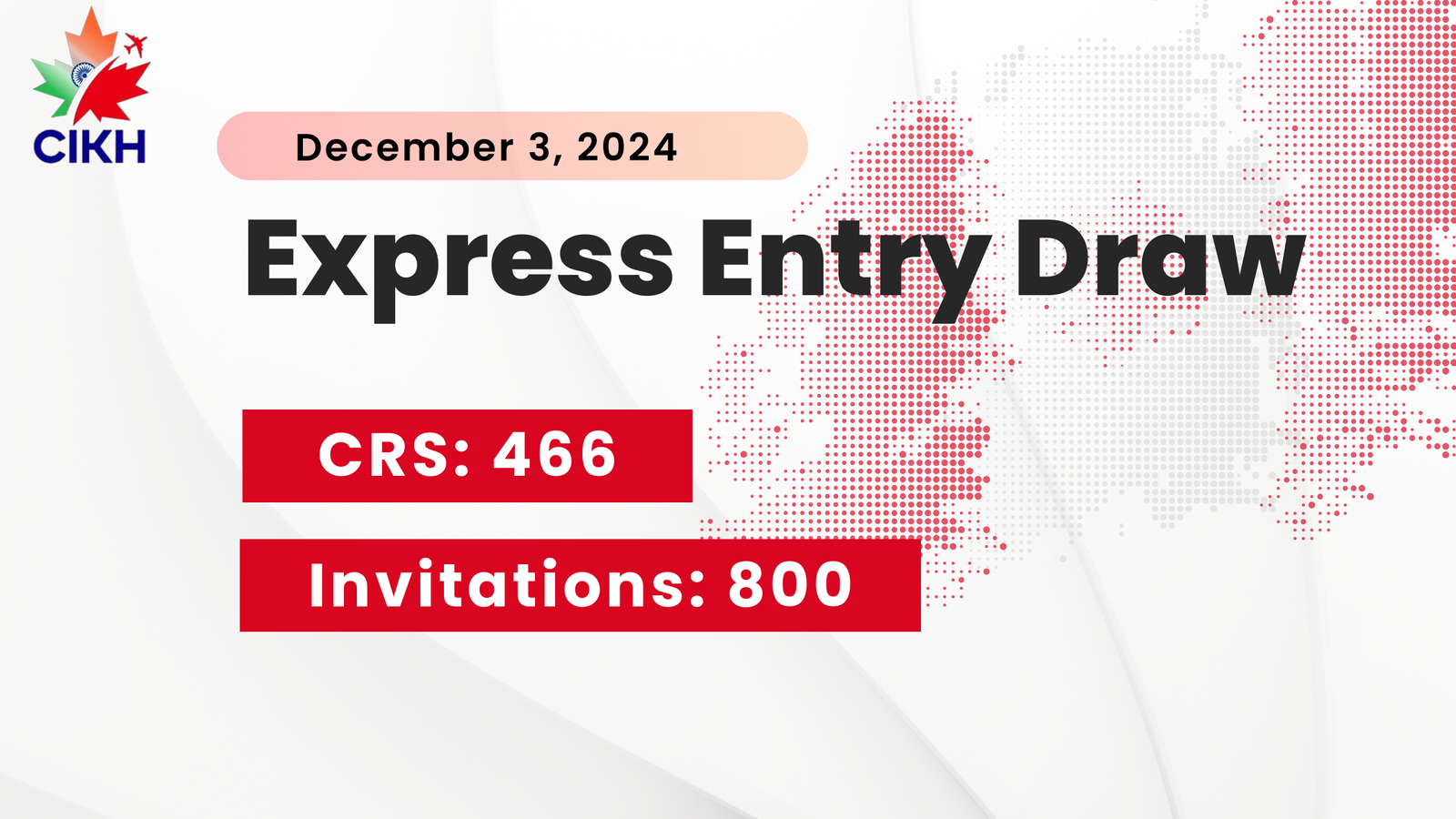
Immigration, Refugees, and Citizenship Canada (IRCC) have extended additional invitations to apply (ITAs) in a recent Express Entry draw. In this category-based selection, 800 ITAs were issued to candidates with French-language skills. To be eligible, candidates needed a minimum Comprehensive Ranking System (CRS) score of 466. This draw marks the second selection in December, following a draw for Provincial Nominee Program (PNP) candidates on December 2. In November, there were six Express Entry draws, resulting in the issuance of 5,507 invitations to apply (ITAs) for permanent residence (PR). As in previous months, consistent draws have been held for candidates in the Canadian Experience Class (CEC) and the Provincial Nominee Program (PNP). This trend is expected to continue, especially with the introduction of the new “In-Canada” focus category, which aims to specifically target candidates from the CEC and “other regional programs.” Candidates from the Federal Skilled Worker Program (FSWP) and Federal Skilled Trades Program (FSTP) may also be considered. Under Canada’s latest Immigration Levels Plan, this category is set to receive 82,980 PR admissions, accounting for over 40% of all planned admissions next year. Additionally, candidates with strong French language skills are expected to see a rise in ITAs in 2025, as the PR admissions allocation for French speakers outside Quebec increases to 29,235. ITA issuance for this category is also expected to grow in 2026 and 2027, in line with IRCC’s Francophone immigration strategy. Full Details of the Express Entry Draw: December 3, 2024 Category: French language proficiency (Version 1)Number of invitations issued: 800Rank required to be invited: 800 or aboveDate and time of round: December 03, 2024, at 15:44:17 UTCCRS score of lowest-ranked candidate invited: 466Tie-breaking rule: November 26, 2024, at 02:44:59 UTC Summary of Express Entry Draws in 2024