
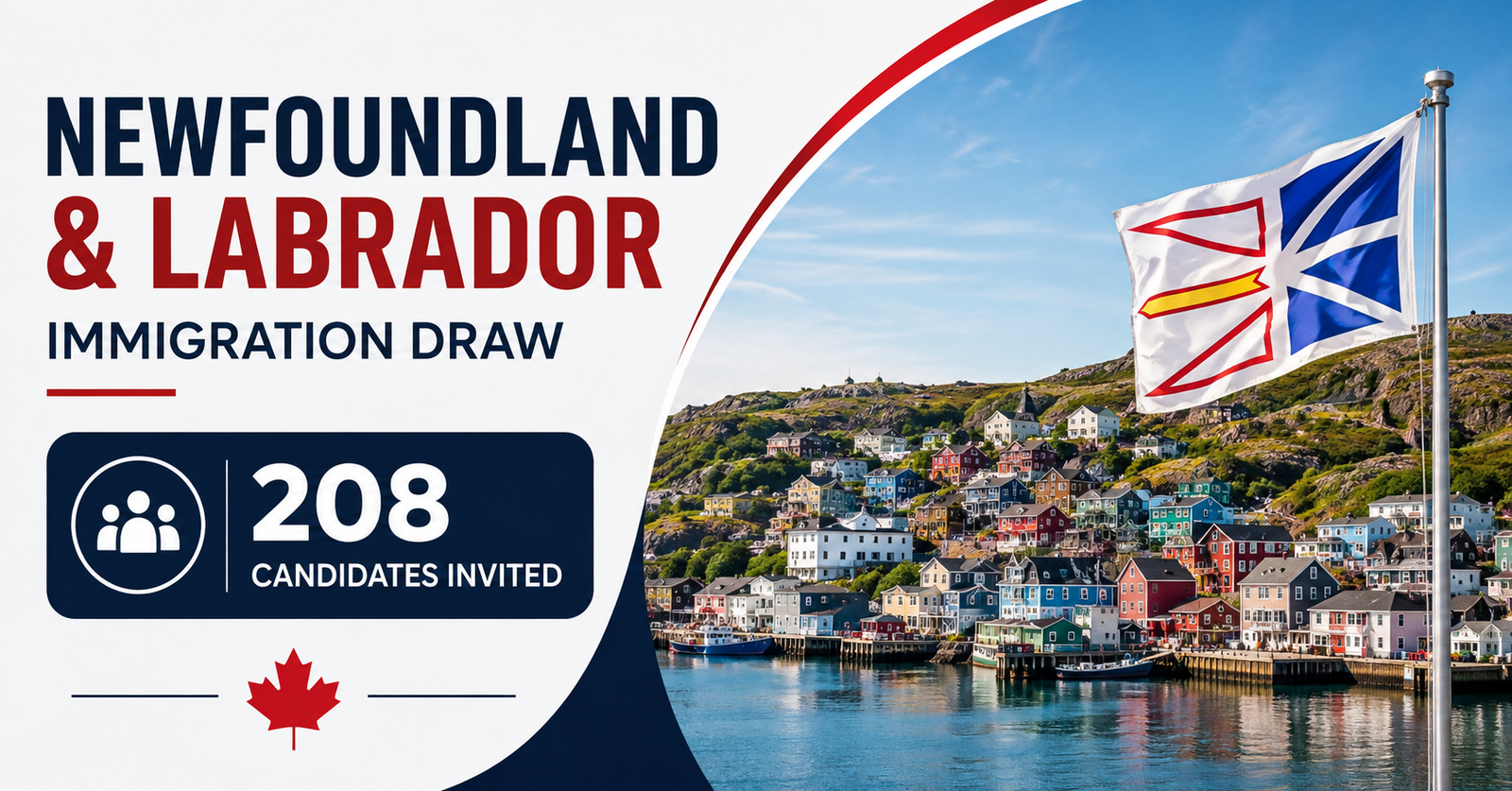
A total of 208 candidates received Invitations to Apply (ITAs) in Newfoundland and Labrador’s latest immigration selection round on August 10, 2026. The province divided these invitations between the Newfoundland and Labrador Provincial Nominee Program (NLPNP) and the Atlantic Immigration Program (AIP), giving eligible candidates another opportunity to move toward permanent residence in Canada.
The latest Newfoundland and Labrador immigration draw was the province’s 10th selection round of 2026. While the overall number of invitations was moderate compared with some earlier draws, the selection continues to show how Newfoundland and Labrador is using its Expression of Interest (EOI) system to target candidates who fit its labour-market and immigration priorities.
Newfoundland and Labrador immigration draw results
The August 10 selection was dominated by the NLPNP, which accounted for 186 of the 208 invitations. The remaining 22 invitations went to candidates under the Atlantic Immigration Program.
| Program | Invitations |
|---|---|
| Newfoundland and Labrador Provincial Nominee Program (NLPNP) | 186 |
| Atlantic Immigration Program (AIP) | 22 |
| Total | 208 |
The 186 NLPNP invitations represented approximately 89.4% of all invitations issued in this round. Newfoundland and Labrador’s Office of Immigration and Multiculturalism (OIM) did not publish a further breakdown showing which specific NLPNP streams received those invitations.
This distinction matters for applicants because receiving an invitation does not automatically mean permanent residence has been approved. An ITA allows the invited candidate, or their employer where applicable, to move forward with a complete provincial application that will still be assessed against program requirements.
How the August draw compares with earlier 2026 selections
The province’s invitation numbers have varied significantly throughout the year. For example, Newfoundland and Labrador issued 445 invitations on March 6, followed by 245 on March 30 and 210 on April 13. The number then moved below 200 in several subsequent rounds before rising sharply again to 445 on July 28.
The August 10 draw therefore sits somewhere in the middle of the year’s selection pattern. It was considerably smaller than the July 28 round but substantially larger than the July 10 selection, when only 57 invitations were issued.
| Draw date | Total invitations | NLPNP | AIP |
| March 6, 2026 | 445 | 362 | 83 |
| March 30, 2026 | 245 | 209 | 36 |
| April 13, 2026 | 210 | 177 | 33 |
| May 1, 2026 | 190 | 157 | 33 |
| May 11, 2026 | 186 | 168 | 18 |
| May 28, 2026 | 103 | 84 | 19 |
| June 10, 2026 | 108 | 89 | 19 |
| July 10, 2026 | 57 | 17 | 40 |
| July 28, 2026 | 445 | 400 | 45 |
| August 10, 2026 | 208 | 186 | 22 |
By August 10, Newfoundland and Labrador had issued 2,197 invitations through the NLPNP and AIP combined during 2026. Of these, 84.2% went to NLPNP candidates.
One detail worth watching is the AIP figure. The latest round issued just 22 AIP invitations, making it the lowest AIP invitation total since June 10, when 19 invitations were issued. That does not, by itself, establish a future trend, but it shows that the number of AIP selections can change considerably from one provincial draw to another.
Who does Newfoundland and Labrador prioritize?
The province does not simply operate its EOI system as a first-come, first-served queue. Newfoundland and Labrador introduced its EOI model in February 2025 and uses prioritization criteria when reviewing candidate profiles.
The province says the EOI captures information such as an applicant’s occupation, education and intention to reside in Newfoundland and Labrador. OIM then assesses the profiles and selects candidates for ITAs based on provincial priorities.
The current framework can give greater consideration to profiles connected with areas such as healthcare, sales and service, rural communities and occupations with lower representation. Applicants should therefore avoid assuming that having a profile in the pool guarantees an invitation. The province is looking at how a candidate’s overall profile fits its current economic and labour-market needs.
What this means for applicants
For someone considering Newfoundland and Labrador as a permanent-residence destination, the practical takeaway is that the quality and relevance of the EOI profile matter. Education, employment history, language ability and plans to establish yourself in the province are all part of the information considered through the EOI process.
It is also worth checking that the information in the profile accurately reflects your current circumstances. An applicant whose employment, education or other key details have changed should not assume that an old profile will continue to represent them correctly. Keeping documents and employment information organized before an invitation arrives can make the next stage much easier.
How the Newfoundland and Labrador EOI system works
The province uses a two-stage economic immigration selection process. The first stage is the submission of an Expression of Interest. Candidates provide information about themselves and enter the provincial pool, where their profiles can be considered in future selection rounds.
The basic process is:
- Submit an EOI through Newfoundland and Labrador’s Immigration Accelerator Portal.
- OIM reviews the profiles in the EOI pool using its prioritization criteria.
- Selected candidates receive an ITA to submit a complete application.
- The invited applicant or employer submits the full application, depending on the program.
- The provincial authorities assess the application and, if successful, issue a nomination or endorsement.
- The candidate can then proceed with the federal permanent residence application, subject to meeting IRCC’s requirements.
The EOI stage is therefore not the same as submitting an application for permanent residence. An EOI is an initial expression of interest, while the ITA opens the door to the full provincial application process.
Is a job offer required?
For the NLPNP and AIP pathways covered by this selection, a valid job offer is generally required, with an exception for candidates applying through the NLPNP entrepreneur streams.
The Atlantic Immigration Program has an especially strong employer component. Newfoundland and Labrador employers participating in AIP must be designated by the province, and designated employers can endorse eligible international workers or graduates.
For applicants considering AIP, this means that simply wanting to immigrate to Atlantic Canada is not enough. The job-offer and employer requirements need to be addressed as part of the pathway.
The NLPNP, meanwhile, covers several categories, including Express Entry Skilled Worker, Skilled Worker, International Graduate and entrepreneur streams. The exact eligibility requirements depend on the category through which a candidate applies.
What happens after receiving an invitation?
Candidates who receive an ITA from Newfoundland and Labrador have 60 days to submit a complete application under the applicable program. The province’s EOI guidance specifically sets this 60-day period for candidates who receive an invitation.
There is an important difference between the two pathways at this stage. Under the NLPNP, the employer submits the application, while under the AIP, the candidate is responsible for submitting the application after receiving the invitation.
This is one area where preparation can make a real difference. Once an ITA arrives, the deadline is limited, so applicants should not wait until that point to start locating employment records, education documents, language-test information and other supporting paperwork.
What happens after provincial nomination or AIP endorsement?
A provincial nomination or AIP endorsement is not the final permanent residence decision. Once the provincial stage is successfully completed, the candidate can move forward with the federal permanent residence process.
For provincial nominees, IRCC explains that applicants must meet federal requirements and submit the required documents before the application can be finalized. If approved, IRCC can issue a Confirmation of Permanent Residence (COPR).
For AIP candidates, the federal stage similarly involves submitting the permanent residence application and supporting documents to IRCC after obtaining the required endorsement.
Applicants should also remember that a provincial nomination by itself does not automatically give them authorization to work in Canada. A separate work permit may be required depending on their circumstances.
Newfoundland and Labrador EOI profiles remain valid for 12 months
An EOI submitted to Newfoundland and Labrador does not remain in the pool indefinitely. According to the province, EOIs remain valid for 12 months.
If a candidate does not receive an ITA during that period, the EOI expires automatically. The candidate must submit a new EOI to continue being considered. For AIP cases, the employer may need to submit the new profile as applicable.
This is an easy detail to overlook. Candidates who have been sitting in the pool for several months should keep track of when their EOI was submitted rather than assuming it will remain active until they receive an invitation.
Current federal processing times
The source information reports the following IRCC processing times as of August 10, 2026:
| Application type | Processing time |
| Base PNP | 13 months |
| Enhanced PNP | 7 months |
| AIP | 26 months |
These figures apply to the federal permanent residence processing stage and should not be interpreted as a guaranteed timeline for an individual case. IRCC says processing times can vary depending on factors such as application completeness, verification requirements, background checks, family circumstances and the number of applications already in the system.
The distinction between provincial processing and federal processing is particularly important. An applicant may first spend time going through the Newfoundland and Labrador selection and application process before the federal permanent residence stage begins.
Practical takeaway for prospective applicants
The August 10 draw is a useful reminder that Newfoundland and Labrador’s immigration system is being managed around provincial priorities rather than simply inviting candidates in a predictable, fixed pattern. The difference between 57 invitations on July 10, 445 on July 28 and 208 on August 10 shows just how much invitation numbers can move between selection rounds.
If Newfoundland and Labrador is part of your immigration plan, the sensible approach is to focus on profile fit rather than trying to predict the exact number of invitations in the next draw. Review your occupation, employment situation, education, language results and job-offer requirements, and make sure your EOI accurately reflects your circumstances.
For candidates already in the EOI pool, it is equally important to watch the profile’s 12-month validity period and be ready to act within 60 days if an ITA arrives. Those two deadlines can become important very quickly once a candidate moves from the selection pool to the application stage.
FAQs
Newfoundland and Labrador issued 208 invitations on August 10, 2026. Of these, 186 were issued through the NLPNP and 22 through the Atlantic Immigration Program.
No. The August 10 selection was the province’s 10th immigration draw of 2026. By that date, Newfoundland and Labrador had issued 2,197 invitations through the NLPNP and AIP combined.
Candidates who receive an ITA have 60 days to submit their complete application under the applicable Newfoundland and Labrador program.
An EOI remains in the provincial pool for 12 months. If it expires without an invitation, the candidate must submit a new EOI to remain under consideration.
No. An ITA only allows the candidate to move to the full provincial application stage. If the provincial application is approved, the candidate can then proceed with the federal permanent residence process, where they must still meet IRCC’s eligibility and admissibility requirements.
Fact Check: This article is based on Newfoundland and Labrador's official Office of Immigration and Multiculturalism ITA update, EOI guidance and program information, updated August 10, 2026.
Disclaimer: This article is for general informational purposes only and does not constitute legal or immigration advice. Immigration programs, eligibility requirements and processing times can change, so readers should verify the latest information through official Newfoundland and Labrador and IRCC sources before taking action.