
Many people only notice bank fees after checking their account balance. I have seen this happen with subscription payments, insurance bills, and other automatic withdrawals. A small shortage in the account can sometimes lead to unexpected charges that are difficult to understand.
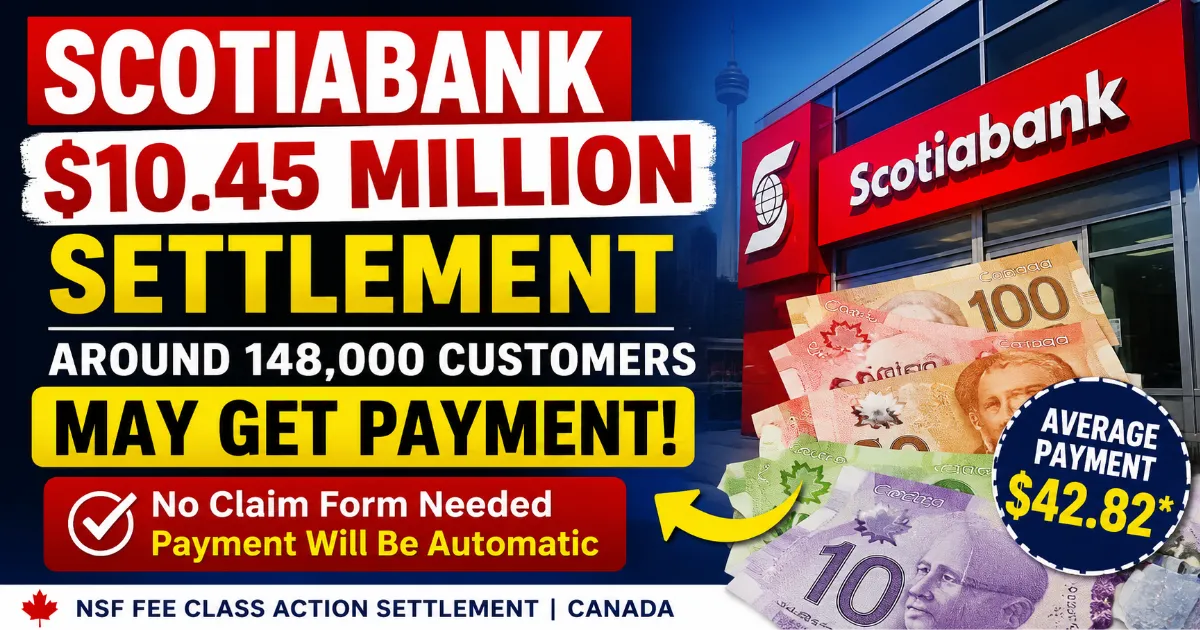
Now, thousands of Scotiabank customers in Canada may receive money back through a class action settlement. The bank has agreed to pay $10.45 million to settle claims related to certain Non Sufficient Funds or NSF fees. If you qualify, you do not need to submit a claim because eligible payments will be made automatically.
Why Was the Scotiabank Settlement Filed?
The lawsuit focused on NSF fees charged on some pre authorized debit payments between June 21, 2020, and April 30, 2024.
When there was not enough money in a customer’s account, Scotiabank charged a $48 NSF fee. According to the lawsuit, another issue happened when the same company tried to collect the exact same payment again within two to thirty days.
If that second payment also failed, another $48 NSF fee was charged.
The case argued that customers had no control over whether a business would try the same payment again. Because of this, many people ended up paying two NSF fees for what was essentially one payment.
The lawsuit was handled by Koskie Minsky LLP, which represented affected customers across Canada.
How the Class Action Reached a Settlement
The legal case was officially certified as a class action by the Ontario Superior Court of Justice in April 2024.
After discussions between both sides and with the help of a mediator, a settlement agreement was reached on January 21, 2026.
The court later approved the settlement after a hearing held on June 12, 2026.
As part of the agreement, Scotiabank has chosen to settle the case but has not admitted any wrongdoing or legal liability.
Do You Need To Apply for the Settlement?
One of the biggest benefits for eligible customers is that there is no application process.
You do not need to:
- Fill out a claim form
- Upload documents
- Register online
- Contact Scotiabank
The bank will identify eligible customers using its own records.
If you qualify, the payment will be deposited directly into your eligible Scotiabank account once the distribution process is completed.
The average payment is expected to be around $42.82, although the final amount depends on the court approved distribution of the settlement fund.
Who Is Eligible for the Scotiabank Settlement?
You may qualify if all of the following conditions apply.
- You currently have an active Scotiabank personal deposit account.
- You were charged a $48 NSF fee between June 21, 2020, and April 30, 2024.
- The same merchant submitted the same pre authorized debit again within two to thirty days and another $48 NSF fee was charged.
- You were not already refunded for that duplicate fee before the settlement.
Scotiabank will use its internal records to determine who qualifies.
How This Settlement Compares With Other Canadian Banks
Several major Canadian banks have faced similar legal action over duplicate NSF fees.
| Bank | Settlement Amount | Status |
|---|---|---|
| TD Bank | $15.9 Million | Approved |
| Scotiabank | $10.45 Million | Approved |
| RBC | $7.05 Million | Approved |
| CIBC | $10 Million | Awaiting Court Approval |
| BMO | Not Announced | Ongoing |
These cases show that duplicate NSF fees have become an important consumer protection issue across Canada’s banking industry.
New Banking Rules Now Protect Customers
Alongside these lawsuits, Canada introduced stronger consumer protections for personal banking customers.
From March 12, 2026, new federal rules limit NSF fees at federally regulated banks to a maximum of $10 per occurrence for eligible personal deposit accounts.
The updated rules also prevent banks from charging multiple NSF fees within a short period for the same account under certain conditions.
Another important protection is that no NSF fee can be charged when the account shortage is less than $10.
These changes are expected to reduce banking costs for millions of Canadians each year.
What Should Scotiabank Customers Do Now?
If you think you qualify for this settlement, there is usually nothing you need to do because eligible payments will be made automatically.
Going forward, you can reduce the chances of NSF fees by following a few simple habits.
- Turn on low balance alerts in mobile banking.
- Keep enough money in your account before automatic payments are due.
- Consider overdraft protection if it fits your financial needs.
- Check that government benefit and salary deposits are reaching the correct account.
If you believe your bank charged an NSF fee that does not follow the current federal rules after March 12, 2026, you can first contact your bank through its official complaint process. If the issue is not resolved, you may also contact the Financial Consumer Agency of Canada.
Common Mistakes To Avoid
Many customers unintentionally increase their chances of paying NSF fees by making a few common mistakes.
- Ignoring automatic subscription renewals.
- Not checking account balances before scheduled payments.
- Assuming a failed payment will not be attempted again.
- Missing banking notifications or balance alerts.
Reviewing your upcoming payments every month can help avoid unnecessary charges.
FAQ
The payment is connected to previously charged banking fees rather than regular employment income. Tax treatment can vary depending on individual circumstances, so it is best to speak with a qualified tax professional if you have questions.
Under the settlement terms, recipients generally must have an active Scotiabank personal deposit account that can receive the payment. Former customers who closed their accounts before distribution may not qualify for the automatic payment.
No. Eligible customers do not need to submit documents or complete an application because Scotiabank will identify qualifying accounts using its own records.
You can review the official settlement information or contact the class counsel for guidance about your specific situation.
Fact Check
The settlement amount of $10.45 million, the eligibility period from June 21, 2020, to April 30, 2024, and the court approval process are based on publicly available information released through the official class action materials and related public announcements. The federal $10 NSF fee cap is based on regulations announced by the Government of Canada for federally regulated financial institutions.
Disclaimer: This article is provided for general information only. It should not be treated as legal, financial, or tax advice. Settlement eligibility depends on the official terms approved by the court. If you need advice about your personal situation, speak with a qualified legal, financial, or tax professional.