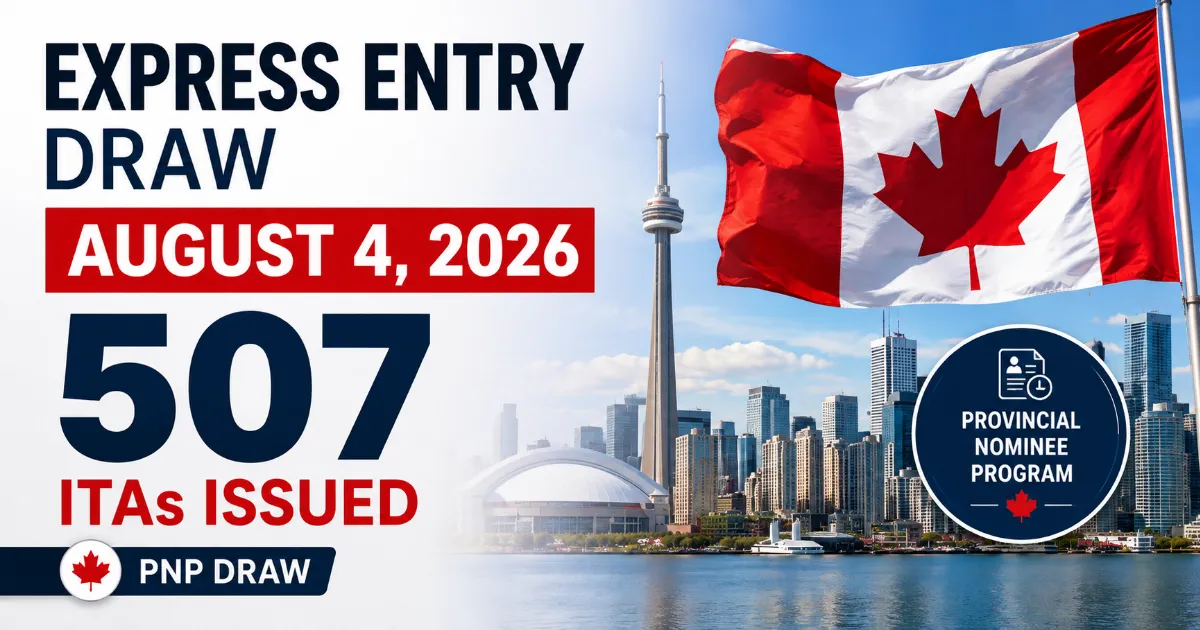
Immigration, Refugees and Citizenship Canada (IRCC) has started August with a new Express Entry draw. On August 4, 2026, the department invited 507 candidates to apply for Canadian permanent residence through the Provincial Nominee Program (PNP) stream.
This was the first Express Entry draw of August and the 43rd invitation round held in 2026. Like the previous few months, IRCC once again opened the month’s draw sequence with a Provincial Nominee Program round before other expected Express Entry categories.
For candidates who already hold a provincial nomination, this draw confirms that provinces continue to play an important role in Canada’s immigration system. While the number of invitations was not the highest seen this year, the latest round shows that provincial nominations remain a steady pathway toward permanent residence.
4th August 2026 Express Entry Draw at a Glance
| Detail | Information |
|---|---|
| Draw Date | August 4, 2026 |
| Draw Type | Provincial Nominee Program (PNP) |
| Invitations Issued | 507 |
| Minimum CRS Score | 768 |
| Draw Time | 10:39:04 UTC |
| Tie Breaking Rule | May 15, 2026 at 15:58:19 UTC |
Candidates who received an invitation can now move to the next stage by submitting their permanent residence application through their Express Entry account within the required deadline.
Why Was the CRS Score 768?
Many people notice that PNP draws usually have CRS scores above 700. This is completely normal.
When a candidate receives a provincial nomination and successfully links it to an active Express Entry profile, the system automatically adds 600 additional CRS points.
Because of this extra score, Provincial Nominee Program draws almost always have much higher CRS cutoffs than Canadian Experience Class or category based draws.
For this round, the lowest invited candidate had a CRS score of 768.
Candidates with scores above 768 automatically received an invitation, while applicants with exactly 768 needed to meet the tie breaking requirement announced by IRCC.
Understanding the Tie Breaking Rule
Whenever several candidates finish with the same CRS score, IRCC uses a tie breaking rule.
For this draw, the tie breaking date was:
May 15, 2026 at 15:58:19 UTC
This simply means that candidates who had a CRS score of 768 needed to have submitted their Express Entry profile before that exact date and time.
Anyone with the same score who created or updated their profile after that moment was not invited in this round.
Applicants with CRS scores above 768 were invited regardless of when they submitted their profiles.
Current CRS Score Distribution in the Express Entry Pool
IRCC also released the latest snapshot of candidates available in the Express Entry pool as of August 3, 2026.
| CRS Score Range | Candidates |
|---|---|
| 601 to 1200 | 500 |
| 501 to 600 | 19,705 |
| 451 to 500 | 73,099 |
| 401 to 450 | 60,905 |
| 351 to 400 | 50,107 |
| 301 to 350 | 17,101 |
| 0 to 300 | 7,683 |
| Total Candidates | 229,100 |
Candidates Between 451 and 500
| CRS Range | Candidates |
|---|---|
| 491 to 500 | 12,939 |
| 481 to 490 | 12,890 |
| 471 to 480 | 16,368 |
| 461 to 470 | 16,057 |
| 451 to 460 | 14,845 |
Candidates Between 401 and 450
| CRS Range | Candidates |
|---|---|
| 441 to 450 | 13,595 |
| 431 to 440 | 13,267 |
| 421 to 430 | 11,942 |
| 411 to 420 | 11,326 |
| 401 to 410 | 10,775 |
The latest pool data shows that competition remains strongest in the 451 to 500 CRS range, where more than 73,000 candidates are currently waiting in the Express Entry system.
How Does This Draw Compare With Earlier PNP Rounds?
The latest invitation round fits within the overall trend seen throughout 2026. IRCC has continued holding Provincial Nominee Program draws on a regular basis, although the number of invitations has changed from one round to another.
| Draw Date | Invitations | CRS Cutoff |
|---|---|---|
| January 5 | 574 | 711 |
| January 20 | 681 | 746 |
| February 3 | 423 | 749 |
| February 16 | 279 | 789 |
| March 2 | 264 | 710 |
| March 16 | 362 | 742 |
| March 30 | 356 | 802 |
| April 13 | 324 | 786 |
| April 27 | 473 | 795 |
| May 11 | 380 | 798 |
| May 25 | 334 | 805 |
| June 22 | 955 | 730 |
| July 6 | 534 | 708 |
| July 20 | 511 | 744 |
| August 4 | 507 | 768 |
Although the latest CRS requirement is higher than some recent PNP rounds, it still falls within the range already seen during 2026.
One important point many applicants misunderstand is that a higher PNP cutoff does not necessarily mean Express Entry has become more difficult.
In Provincial Nominee Program draws, the CRS score mainly depends on how many nominated candidates are available in the pool before the draw takes place. When provinces issue a larger number of nominations, IRCC generally has more eligible candidates to choose from. When fewer nominations enter the pool between draws, the CRS requirement can move higher or lower depending on the available profiles.
What This Means for Express Entry Candidates
If you already have a provincial nomination linked to your Express Entry profile, the latest draw is another reminder that PNP continues to be one of the strongest routes to permanent residence.
If you do not have a nomination yet, this draw should not be viewed as a benchmark for your own CRS score. Provincial Nominee Program draws operate differently from Canadian Experience Class and other category based invitation rounds because nominated applicants receive an additional 600 CRS points.
Practical Take
One mistake many applicants make is waiting until they receive an Invitation to Apply before collecting important documents.
If you are expecting a provincial nomination or believe your profile could receive one soon, it is worth preparing documents such as employment reference letters, educational records, police certificates, and passport copies in advance. Some of these documents can take several weeks to obtain, and early preparation can make the application process much smoother after receiving an invitation.
Another good practice is to regularly review your Express Entry profile and ensure every detail remains accurate. Even a small error in work history or education can create unnecessary delays later in the permanent residence process.
Express Entry Invitation Numbers in 2026 So Far
With the latest Provincial Nominee Program draw completed, IRCC has now issued 105,123 Invitations to Apply (ITAs) across 43 Express Entry draws in 2026.
The invitation numbers show that IRCC has continued using different draw categories instead of relying on one single stream. Canadian Experience Class and French language proficiency draws remain the biggest contributors this year, while Provincial Nominee Program rounds continue to provide regular opportunities for candidates who receive nominations from provinces or territories.
Express Entry Invitations by Category in 2026
| Category | Number of Draws | Total ITAs | Share of Total Invitations |
|---|---|---|---|
| Canadian Experience Class | 12 | 45,250 | 43.0% |
| French Language Proficiency | 8 | 40,500 | 38.5% |
| Healthcare and Social Services | 2 | 8,000 | 7.6% |
| Provincial Nominee Program | 15 | 6,957 | 6.6% |
| Trades Occupations | 1 | 3,000 | 2.9% |
| Senior Managers | 2 | 750 | 0.7% |
| Physicians | 2 | 662 | 0.6% |
| Skilled Military Recruits | 1 | 4 | Less than 0.1% |
| Total | 43 | 105,123 | 100% |
An interesting trend this year is that Canada has already issued more invitations than the entire 2024 calendar year, even though several months are still left in 2026. This highlights IRCC’s continued focus on inviting skilled candidates through Express Entry while balancing different immigration priorities.
What the 2026 Numbers Tell Us
Looking at the overall invitation data instead of a single draw gives a much clearer picture of Canada’s current immigration strategy.
Canadian Experience Class and French language proficiency draws together account for more than 80 percent of all invitations issued so far this year. This shows that candidates with Canadian work experience or strong French language skills continue to receive significant attention within Express Entry.
At the same time, Provincial Nominee Program draws remain an important pathway because they allow provinces to nominate candidates who meet their local labour market needs.
Rather than looking at one draw in isolation, applicants should pay attention to the broader pattern that has developed over recent months.
What Draws Could Come Next?
IRCC does not publish a fixed Express Entry schedule, so no future draw can be confirmed in advance.
However, based on the draw pattern seen throughout recent months, many applicants will now be watching for additional invitation rounds during the same draw window.
If IRCC continues following its recent sequence, the next few days could include:
- A Canadian Experience Class draw.
- A French language proficiency draw.
- A possible category based draw if IRCC decides to target a specific occupation group.
These expectations are based on recent invitation trends only. The department can change draw dates, categories or invitation numbers at any time without prior notice.
What This Means for Applicants
Every Express Entry draw provides useful information, even for candidates who were not invited.
If you already hold a provincial nomination, this draw confirms that PNP candidates continue receiving regular invitations throughout the year.
If your profile is still waiting for a nomination, this is a good opportunity to review provincial programs that match your education, work experience and occupation.
Many provinces update their immigration streams throughout the year. Meeting the eligibility requirements early can improve your chances if a suitable stream opens later.
Practical Observation
One common mistake is focusing only on improving the CRS score while ignoring provincial programs.
For many applicants, obtaining a provincial nomination can have a much bigger impact than trying to increase their CRS score by only a few points.
It is also a good idea to keep language test results, passport validity, employment records and educational documents updated. If you receive a nomination or an Invitation to Apply, having these documents ready can help you complete your application within the required timeline.
How the Provincial Nominee Program Fits Into Express Entry
The Provincial Nominee Program allows provinces and territories to select candidates who meet their local economic and labour market requirements.
When a nomination is linked to an active Express Entry profile, the candidate automatically receives 600 additional CRS points.
This additional score is the main reason why Provincial Nominee Program draws usually have CRS cutoffs above 700.
Each province manages its own nomination streams and eligibility rules. Some focus on specific occupations, while others may prioritize graduates, workers with local experience or candidates who meet regional workforce needs.
Applicants interested in this pathway should regularly check the official provincial immigration websites because eligibility criteria and application windows may change during the year.
What Should Invited Candidates Do Next?
Candidates who received an Invitation to Apply in this draw now have 60 calendar days to submit a complete permanent residence application through their Express Entry account.
Before submitting the application, applicants should carefully review all supporting documents and ensure the information matches their Express Entry profile.
Documents commonly required include:
- Valid passport
- Police clearance certificates
- Immigration medical examination results
- Educational Credential Assessment, where applicable
- Employment reference letters
- Language test results, if required
- Other supporting documents requested by IRCC
Submitting accurate and complete information is important because incomplete applications may lead to delays or other processing issues.
If an application is not submitted within the allowed period, the Invitation to Apply expires. The candidate’s Express Entry profile remains in the pool with its original CRS score, provided the profile is still valid.
Looking Ahead
The first Express Entry draw of August continues the invitation pattern that applicants have seen throughout much of 2026. Provincial Nominee Program rounds remain a regular part of the Express Entry system, while other categories are expected to continue receiving invitations as IRCC manages different immigration priorities.
Although future draws cannot be predicted with certainty, applicants should continue monitoring official announcements instead of relying on unofficial schedules or speculation.
Keeping an active Express Entry profile updated and maintaining complete documentation remains one of the best ways to stay prepared for future invitation rounds.
FAQ
No. Provincial Nominee Program draws are only for candidates who have an active provincial or territorial nomination linked to their Express Entry profile.
Candidates with provincial nominations receive an additional 600 CRS points. This is why PNP draw cutoffs are usually much higher than other Express Entry categories.
A provincial nomination greatly improves the chances of receiving an Invitation to Apply, but applicants must still submit a complete permanent residence application and meet all IRCC requirements.
Candidates invited through Express Entry generally have 60 calendar days to submit a complete permanent residence application after receiving their Invitation to Apply.
IRCC has not officially announced upcoming draws. While recent invitation patterns suggest additional rounds may follow, future draw dates and categories remain entirely at the department’s discretion.
Fact Check
Source: This article is based on the official Immigration, Refugees and Citizenship Canada (IRCC) Express Entry round of invitations announced on August 4, 2026, along with the CRS distribution published by IRCC on August 3, 2026.
Disclaimer
This article is provided for general informational purposes only. It should not be considered legal or immigration advice. Applicants should always verify the latest information through official IRCC and provincial immigration websites before making any immigration decisions.