
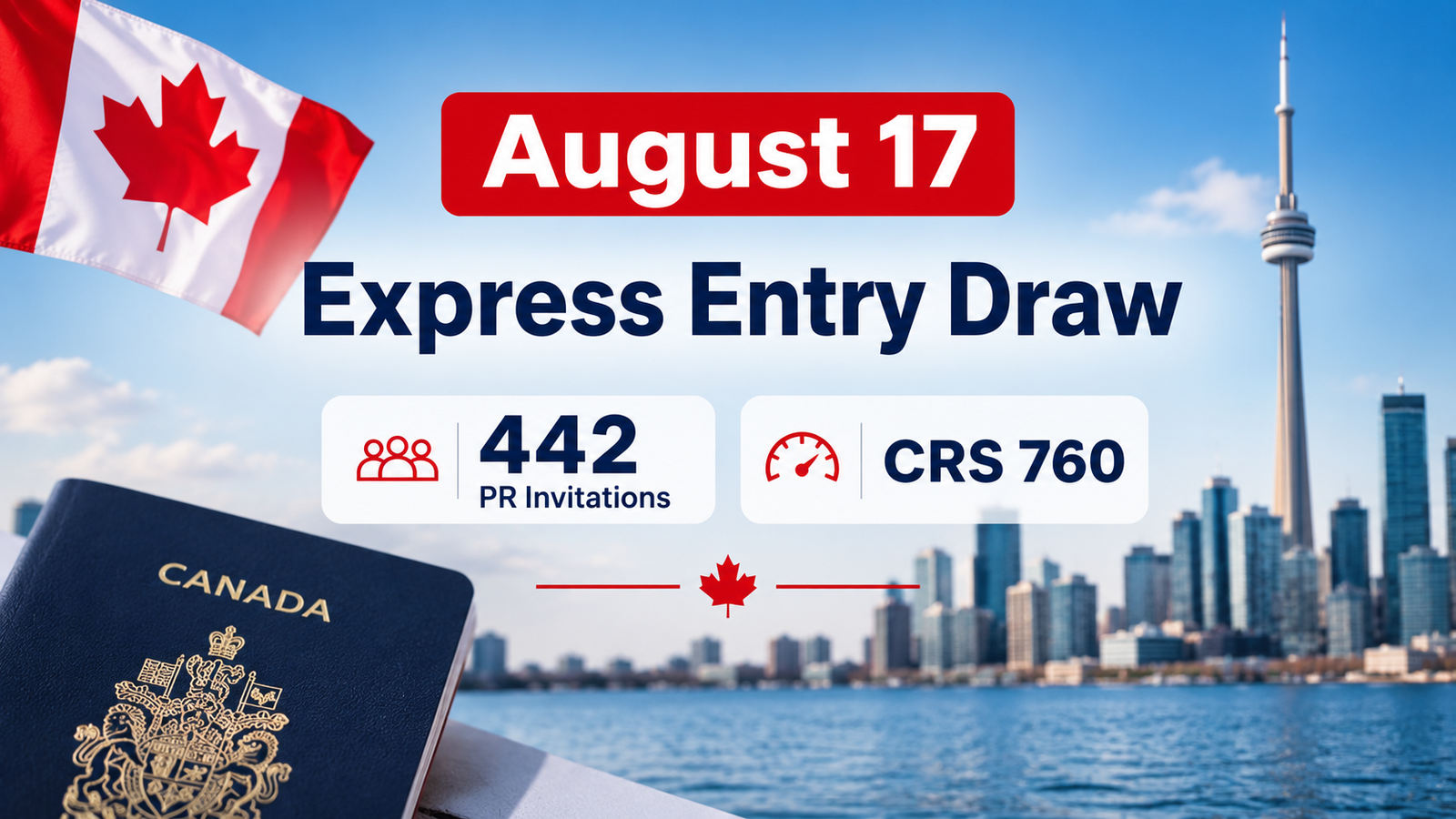
A provincial nomination made the difference again in Canada’s latest Express Entry draw, with 442 candidates receiving invitations to apply for permanent residence on August 17, 2026. The round was specifically for Provincial Nominee Program (PNP) candidates, and the minimum Comprehensive Ranking System (CRS) score was 760.
The latest CRS cutoff was 8 points lower than the previous PNP draw on August 4, when candidates needed 768 points. This was the 47th Express Entry draw of 2026 and the fourth draw conducted in August, marking the beginning of the month’s second draw cluster.
For candidates already holding a provincial nomination, the result is particularly relevant because a nomination adds 600 CRS points to an Express Entry profile. That means the 760-point cutoff largely reflects the underlying CRS scores of nominated candidates rather than a requirement for a regular Express Entry candidate to have 760 points independently.
August 17 Express Entry Draw Results
Immigration, Refugees and Citizenship Canada (IRCC) conducted the latest PNP-specific Express Entry round on August 17. A total of 442 invitations to apply (ITAs) were issued to eligible candidates.
Here are the key details:
| Draw Detail | August 17, 2026 Result |
|---|---|
| Program | Provincial Nominee Program |
| Draw date and time | August 17, 2026, at 12:33:42 UTC |
| Invitations issued | 442 |
| Lowest CRS score | 760 |
| Rank required | 442 or higher |
| Tie-breaking date and time | August 7, 2026, at 18:01:56 UTC |
The tie-breaking rule is important for candidates sitting exactly at the cutoff. Anyone with a CRS score of 760 needed to have submitted their Express Entry profile before August 7, 2026, at 18:01:56 UTC to receive an invitation in this round. Candidates scoring above 760 were not affected by the tie-breaking date.
Why the CRS Cutoff Fell to 760
The change from 768 to 760 may look small, but it matters to candidates whose scores sit around this range. The main reason is the structure of PNP draws: candidates entering the pool with provincial nominations receive a substantial CRS increase, and the cutoff can move as new nominees enter the system.
A provincial nomination provides 600 additional CRS points. As a result, a candidate invited at 760 would generally have had a base CRS score of at least 160 points before the nomination points were added. The source analysis notes that this base score can be reached through combinations of factors such as age, education, language ability and Canadian work experience.
The August 17 result also shows why candidates should not treat one PNP cutoff as a permanent benchmark. The previous PNP draw required 768, while the latest round dropped to 760. Changes in the number and timing of provincial nominations entering the Express Entry pool can influence the next cutoff.
How the August Draw Compares With Earlier PNP Rounds
Looking at the previous PNP rounds gives candidates a better picture of how much CRS scores have been moving throughout 2026.
| Date | Program | Invitations | CRS Cutoff |
| August 17, 2026 | PNP | 442 | 760 |
| August 4, 2026 | PNP | 507 | 768 |
| July 20, 2026 | PNP | 511 | 744 |
| July 6, 2026 | PNP | 534 | 708 |
During 2026, PNP draws have issued between 264 and 955 invitations per round, while CRS cutoffs have ranged from 708 on July 6 to 805 on May 25. That variation reflects changes in the pool and the number of provincial nominations available for each round.
The August 17 draw therefore sits within the range already seen this year. The 442 invitations were fewer than the 507 issued on August 4, but the CRS cutoff also moved down by 8 points. For PNP candidates, both the invitation volume and the composition of the nominated candidates matter when a draw is conducted.
What the Latest Express Entry Pool Shows
The Express Entry pool snapshot available on August 16, 2026, one day before the latest draw, contained 226,859 candidates.
That was a net decrease of approximately 2,241 profiles compared with the 229,100 candidates recorded on August 3. The pool does not remain static because new candidates enter, existing candidates receive invitations and profiles can expire after remaining in the system for 12 months.
The CRS distribution at the time of the August 17 draw was:
| CRS Score Range | Candidates |
| 601–1200 | 439 |
| 501–600 | 18,657 |
| 451–500 | 73,554 |
| 491–500 | 12,915 |
| 481–490 | 13,066 |
| 471–480 | 16,626 |
| 461–470 | 16,133 |
| 451–460 | 14,814 |
| 401–450 | 60,631 |
| 441–450 | 13,555 |
| 431–440 | 13,229 |
| 421–430 | 11,890 |
| 411–420 | 11,269 |
| 401–410 | 10,688 |
| 351–400 | 48,600 |
| 301–350 | 17,269 |
| 0–300 | 7,709 |
| Total | 226,859 |
The smaller numbers shown beneath the broader CRS ranges are detailed breakdowns of those larger ranges. These figures represent the pool snapshot available shortly before the draw and should not be treated as a permanent picture of Express Entry competition.
What Does a 760 CRS Score Actually Mean?
For a PNP candidate, a CRS score of 760 should be interpreted differently from a score of 760 held by a candidate without a nomination.
The provincial nomination itself contributes 600 points. Therefore, someone invited at the August 17 cutoff could have had a base CRS score of at least 160 before receiving the nomination points. This is why provincial nomination remains such an important part of the Express Entry system for candidates who qualify for a provincial pathway.
The practical takeaway is that candidates with lower base CRS scores should not automatically conclude that Express Entry is out of reach. A provincial nomination can substantially change a candidate’s position in the pool. However, obtaining that nomination requires meeting the requirements of the relevant provincial program, and each province has its own selection process.
Provincial Nomination Remains a Major Route to an ITA
The 2026–2028 Immigration Levels Plan increased the provincial nominee admission target to 91,500 for 2026, representing a 66% rebound from the reduced allocation in 2025. That increase is relevant for candidates watching PNP opportunities because provincial nominations feed directly into this part of the Express Entry system.
The source article also points to activity across several provinces. Ontario launched the Ontario Workforce Priority stream on August 4, 2026, replacing all eight former OINP streams with one unified pathway. Alberta, British Columbia, Manitoba and Saskatchewan have also maintained active draw schedules during the first seven months of 2026, with significant nomination room remaining.
For someone trying to improve their Express Entry prospects, this is where practical preparation matters. It is not enough to watch the federal CRS cutoff every time IRCC conducts a draw. If your score is not competitive for a non-PNP round, checking provincial options that match your work experience, education and other qualifications can be a more useful strategy.
How Many Express Entry Invitations Have Been Issued in 2026?
The August 17 draw brought the approximate number of Express Entry invitations issued in 2026 to 113,865 across all draw categories combined. This figure includes invitations from the different types of Express Entry rounds conducted during the year, rather than only PNP draws.
The latest round was the 47th Express Entry draw of 2026. It was also the fourth invitation round of August, meaning the month had already produced multiple draw types before the August 17 PNP round.
That broader figure is useful context, but candidates should still focus on the category that applies to their own profile. A PNP draw, Canadian Experience Class draw and category-based draw do not necessarily have the same CRS pattern or eligibility requirements.
What Could Come After the August 17 Draw?
IRCC has recently been following a pattern in which a PNP round starts a draw cluster, followed by other invitation rounds.
Based on the pattern described in the source article, a Canadian Experience Class draw was expected within one to two days of the August 17 PNP round. A French-language proficiency draw or another category-based draw was then expected to potentially close the cluster before the end of the week.
However, candidates should be careful with predictions. IRCC does not publish its Express Entry draw schedule in advance, and the department can change the timing, category or number of invitations at any time. Therefore, an expected draw should never be treated as a confirmed draw until IRCC publishes the official results.
What Should Express Entry Candidates Do Now?
The August 17 result is a useful reminder that candidates should keep their profiles and supporting documents ready instead of waiting for a draw announcement before taking action.
If you already have a provincial nomination, review your Express Entry profile and make sure the information supporting your nomination and CRS calculation remains accurate. If you are still trying to obtain a nomination, focus on provincial programs for which you actually meet the requirements rather than applying broadly without checking eligibility.
It is also worth keeping documents current. The source article notes that incomplete documentation remains one of the leading causes of processing delays and refusals across economic immigration categories. Having key documents ready before receiving an ITA can therefore make the next stage much smoother.
What Happens After Receiving an ITA?
Receiving an Invitation to Apply is an important step, but it is not the same as receiving permanent residence.
Candidates who receive an ITA through Express Entry have 60 calendar days to submit a complete permanent residence application to IRCC. That deadline means candidates should be prepared to move quickly once an invitation arrives.
This is why keeping documents organized before a draw can be valuable. An invitation gives you a limited period to submit the application, and missing information or incomplete documentation can create problems during processing.
Express Entry Processing Times
The latest IRCC processing-time information cited in the source article was released on August 10, 2026. It showed Canadian Experience Class permanent residence processing at approximately six months.
Based on those current timelines, candidates receiving invitations in the August 2026 draws could see permanent residence decisions arrive in early to mid-2027. IRCC’s reported processing window is based on actual applicant outcomes and represents the period within which 80% of applicants received a decision on their permanent residence applications.
Processing times can change, so candidates should not treat six months as a guaranteed decision date for an individual application. The completeness of an application is also important, particularly because incomplete documentation can contribute to delays.
Frequently Asked Questions
The CRS cutoff was 760 points. IRCC issued 442 invitations through the Provincial Nominee Program Express Entry draw on August 17, 2026.
IRCC issued 442 invitations to apply for permanent residence in the August 17 PNP draw. This was the fourth Express Entry invitation round of August and the 47th draw of 2026.
A provincial nomination adds 600 CRS points to an Express Entry profile. That additional score is why PNP candidates typically have much higher CRS totals when they receive an invitation.
Candidates who receive an ITA have 60 calendar days to submit a complete permanent residence application to IRCC.
When is the next Express Entry draw?
The source article expected a Canadian Experience Class draw within one to two days after the August 17 PNP round, potentially followed by a French-language proficiency or another category-based draw. However, IRCC does not announce its draw schedule in advance, so candidates should wait for an official announcement rather than relying on projections.
What the August 17 Draw Means for Candidates
The latest Express Entry round delivered 442 PR invitations at a CRS cutoff of 760, giving provincial nominees another opportunity to move forward toward permanent residence. The cutoff was lower than the 768 recorded in the August 4 PNP draw, while the number of invitations also fell from 507 to 442.
The bigger picture is that PNP candidates continue to occupy a distinct position within Express Entry because of the 600 CRS points attached to a provincial nomination. For candidates without a nomination, the August 17 result should not be viewed as their personal CRS target because this was a PNP-specific round.
The Express Entry pool is also changing continuously. As of August 16, it contained 226,859 candidates, while the 2026 total had reached approximately 113,865 invitations across all categories. With additional draws expected during the current cluster, candidates should keep their profiles accurate, watch official IRCC results and prepare documentation in advance rather than waiting until an ITA arrives.
Fact Check: The draw information in this article is based on the Immigration, Refugees and Citizenship Canada Express Entry rounds of invitations information cited by the source article and published for the August 17, 2026 draw.
Disclaimer: This article is provided for general informational purposes only and does not constitute legal or professional immigration advice. Express Entry candidates should verify the latest requirements and draw information directly through official Government of Canada sources before making immigration decisions.